LIBS New Beryllium Testing Method
LIBS – A new beryllium testing method
by Richard W. Hughes
April 29, 2004 – Laser-Induced Breakdown Spectroscopy (LIBS) is a technique being touted as a means of bringing the cost of beryllium testing in corundum down to reasonable levels.
Also known as Laser Spark Spectroscopy (LASS) or Laser-Induced Plasma Spectroscopy (LIPS), this technique was first developed at Los Alamos National Laboratories and involves focusing a laser pulse onto a surface. The energy from the pulse heats, vaporizes, atomizes and then ionizes the material on the surface, resulting in a small, hot plasma. The atoms and ions in the plasma emit light which is then detected. The unique spectral signatures allow elements in the plasma to be identified. This technique can be applied to the rapid analysis of metals for the purpose of sorting and/or monitoring composition during processing.
| Why LIBS matters | ||
| In
mid-2001, unusual orange sapphires began appearing in
Thai gem markets. It was later proven that these stones
were actually pink sapphires with an artificially colored
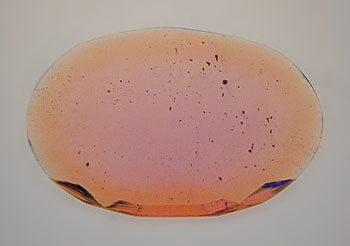
rim created by diffusing beryllium into the stone. By itself, the beryllium creates a yellow color through a trapped-hole color center. Just a few parts per million of beryllium are enough to produce a significant alteration of color in many specimens. Put this yellow on a pink stone and you get orange. In the case of some orange sapphires, such as the stone pictured below, immersion is enough to unmask the fraud. But in others, the beryllium penetrates entirely through the gem, making them impossible for even sophisticated gem labs to positively identify. Such stones previously had to be sent out for expensive SIMS or LA-ICP-MS analyses, tests costing hundreds of dollars per stone. Enter LIBS. LIBS equipment costs approximately $50,000–80,000 per unit, as opposed to the $300,000+ of LA-ICP-MS or $750,000+ for SIMS. This puts LIBS within reach of most major gem labs, and will translate into more affordable gem testing. This breakthrough should keep the gemologists at least temporarily ahead of those seeking to pass off beryllium-treated rubies and sapphires as something else.
|
According to published reports, LIBS sensitivity for light elements such as beryllium and lithium can be accurate down to the 1–10 ppm level. The caveat, though, is that calibration standards for each substance being tested must be created. Thus for accurate testing of beryllium levels in corundum, calibration standards of known levels of beryllium in corundum would need to be prepared.
According to one online source:
Both portable and permanent prototype LIBS units can be developed. Each unit would be tailored to the particular application and conditions under which the unit would be operated and cost varies accordingly.
Within the past three years, applications for LIBS have exploded. Indeed, prototype LIBS units are even being fit into backpacks for landmine detection, helping soldiers distinguish mines from ordinary metal.
Henry Hänni’s Swiss Gemmological Institute (SSEF) was the first gemological lab to announce LIBS testing for beryllium in corundum. In the summer of 2003, the SSEF’s Dr. Michael Krzemnicki came across a reference to the LIBS technique on the internet. Hänni had previously been involved in making spectrographs of rocks using light arcs, a similar but more primitive technique. Following Krzemnicki’s discover of LIBS on the internet, he and Hänni began investigating it as a possible solution to the beryllium problem. By January 2004, they were convinced of the technique’s viability, but it took some hunting to find a unit suitable for gem testing. In the case of gem testing, important considerations are:
- Ability to detect beryllium down to the 3–4 ppm level
- A laser that will leave the smallest possible mark on the stone
SSEF now has a suitable unit on order and will offer low-cost beryllium testing as soon as it is installed. They will also offer to the trade and to gemological laboratories:
- Gem LIBS training
- Gem LIBS instrument (package including Gem LIBS standards, Gem LIBS sample holder, Gem LIBS sample stage, Gem LIBS training)
- Gem LIBS standard materials for quantification of LIBS spectra
Interested parties should contact them directly at: gemlab@ssef.ch
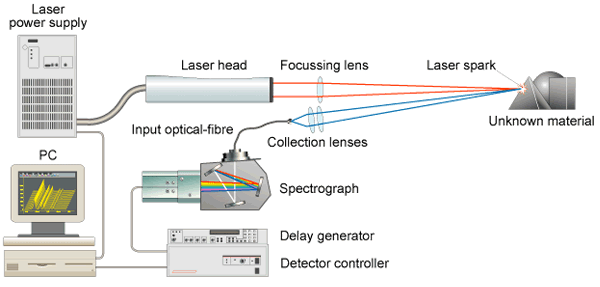 |
| Schematic diagram of a Laser-Induced Breakdown Spectroscopy (LIBS) system. Graphic courtesy of Applied Photonics Ltd, www.appliedphotonics.co.uk; used with permission. Applied Photonics specializes in LIBS applications. |
 |
 |
 |
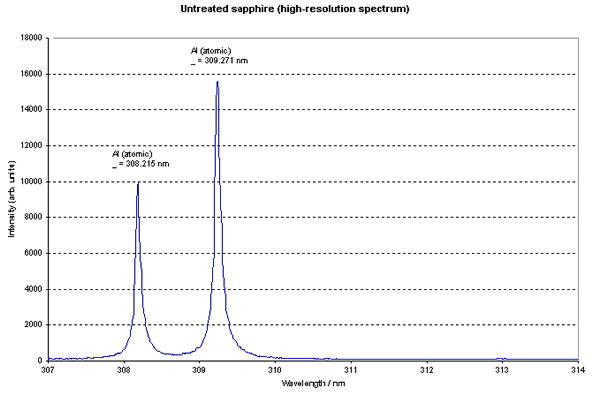 |
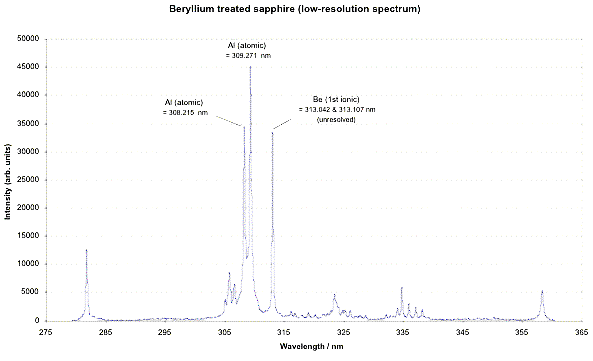
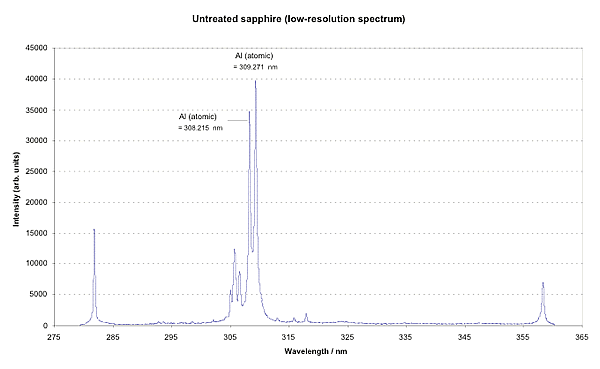
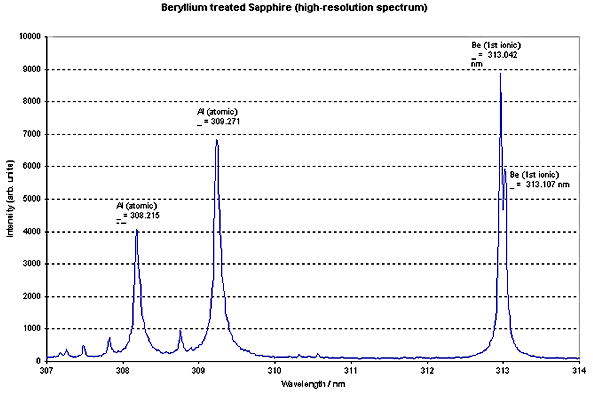
| Laser-Induced Breakdown spectra (LIBS) of both beryllium treated and untreated sapphires. Graphics courtesy of Applied Photonics Ltd, www.appliedphotonics.co.uk; used with permission. Applied Photonics specializes in LIBS applications. |
A number of other
gemological labs and related facilities
around the world are also currently exploring the feasibility of
incorporating such testing into their operations.
An excellent description of the LIBS technique
can be found in this
PDF file.
Further reading
- Orange-pink sapphire alert by the AGTA GTC, posted 8 Jan., 2002.
- The Skin Game by Richard Hughes, covers the earliest developments on beryllium treated orange sapphires in a comprehensive article. Fully illustrated. Posted Feb. 2002.
- From Gems & Gemology: GIA researchers uncover important data on new treated corundum by the GIA, posted 15 Feb., 2002.
- Understanding the new treated pink-orange sapphires by John Emmett and Troy Douthit, posted 13 May, 2002.
- Eine neue Diffusionsbehandlung liefert orangefarbene und gelbe Saphire [A new diffusion treatment supplies orange and yellow sapphires] by H.A. Hänni and T. Pettke, Gemmologie: Zeitschrift der Deutschen Gemmolgigischen Gesellshaft, Vol. 51, No. 4, 2002, pp. 137–152.
- Beryllium diffusion of ruby and sapphire by John L. Emmett, Kenneth Scarratt, Shane F. McClure, Thomas Moses, Troy R. Douthit, Richard Hughes, Steven Novak, James E. Shigley, Wuyi Wang, Owen Bordelon and Robert E. Kane, Gems & Gemology, Summer 2003, pp. 84–135.
- Gods, graves & sapphires by William F. Larson, posted March 2004.