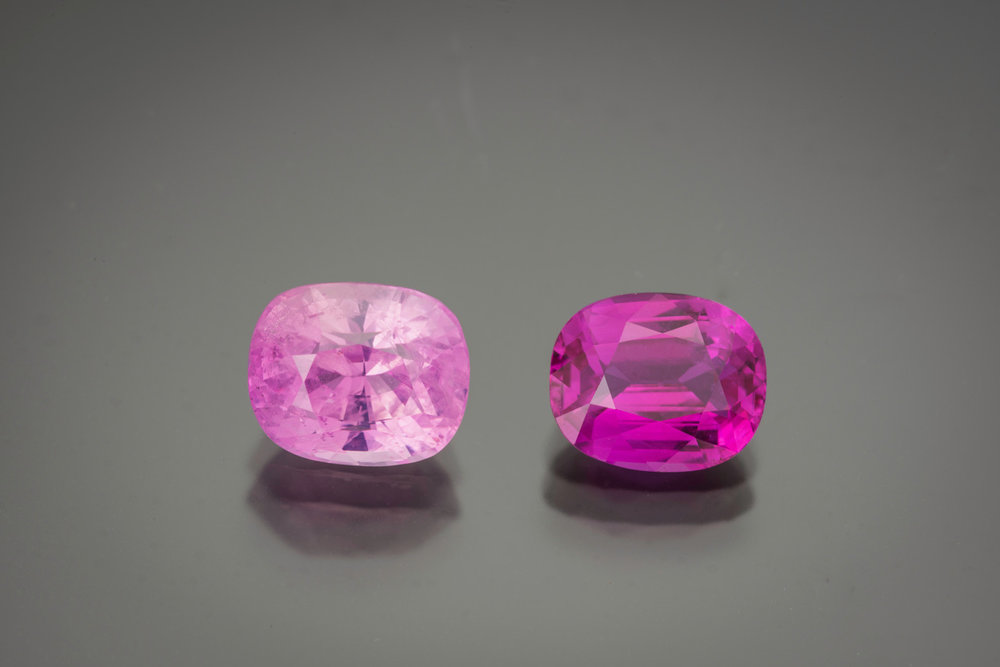
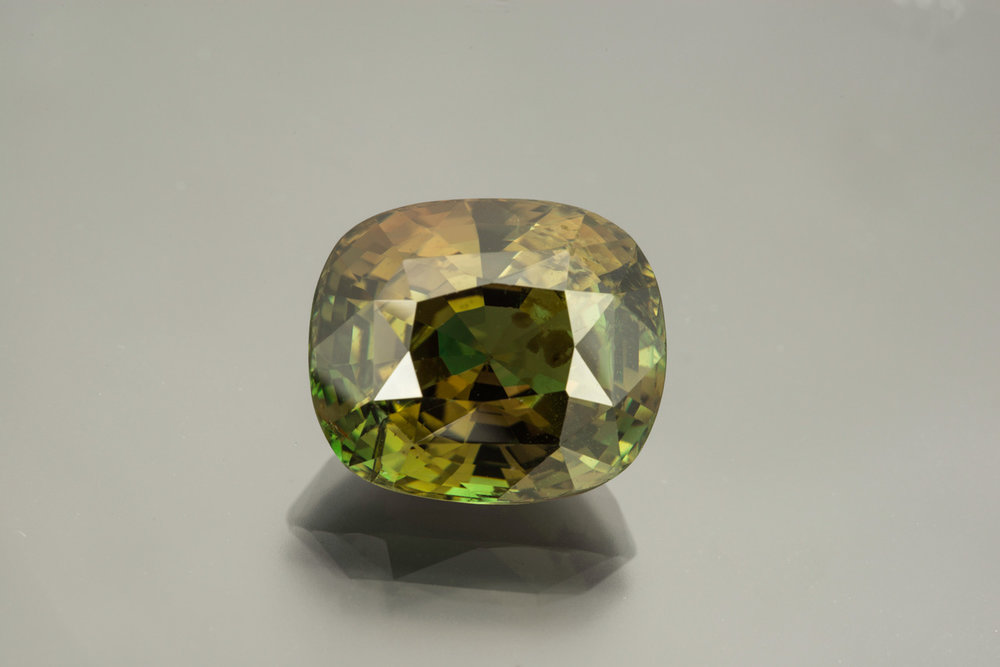
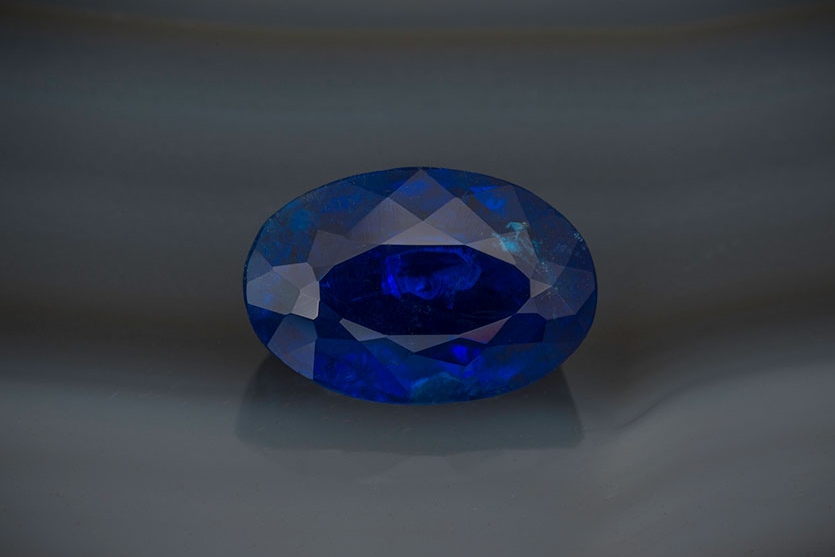
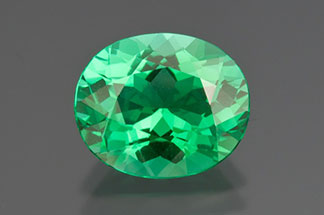
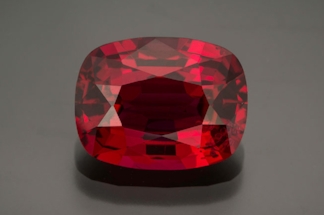
Pala International’s Featured Stones – 2008
Featured in Pala’s Gem News. All photographs by Wimon Manorotkul.
April 20: Sapphire and Ruby
Rough and Cut: From Crystal to Jewel
To stay on topic with this month’s unveiling of our new corundum collection, we though we’d highlight a ruby and sapphire rough-and-cut pair to further appreciate and visualize corundum’s different forms—the speciation of corundum, if you will, from nature’s attempt at crystal perfection to man’s final artistic push to bring out the inner brilliance and color in the faceted form. An intelligently designed crystal with a human touch; the duality of nature and man at its finest.
![]() |
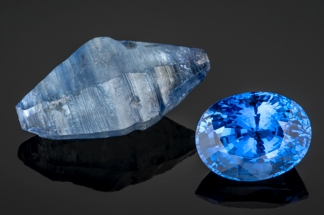
| Sri Lankan sapphire pair. The crystal measures 4.3 x 1.3 cm. and weighs 48.23 cts. The faceted gem measures 10.48 x 9.56 x 7.3 mm., weighs 7.13 cts., and is certified natural color from Sri Lanka. Search for the cut stone on inventory number 14737. (Photo: Wimon Manorotkul) |
Blue sapphire. A perfect pair showing the classic tapering hexagonal bipyramidal corundum crystal and its sparkling blue faceted counterpart. The white and blue color banding seen throughout the length of the crystal is quite common and often can be seen with magnification from the back of a faceted blue sapphire. The exceptional size and rich, natural royal blue hue of the sapphire definitely classifies this as an upper echelon gem.
![]() |
| Burma ruby pair. The crystal measures 2.8 x 1.0 cm. and weighs 27.28 cts. The faceted gem measures 7.79 x 6.30 x 4.67 mm., weighs 1.96 cts., and is from Mong Hsu, Burma. Search for the cut stone on inventory number 15516. (Photo: Wimon Manorotkul) |
Ruby tends to form in less euhedral crystals, as the perfect symmetry breaks down during formation. This ruby crystal shows the basic hexagonal faces with a rhombohedral termination. Clearly visible are crisscrossing bands of color and small clear pockets interrupted by a network of fractures—probably why the crystal stayed in the natural form and was not able to yield clean stones. The purity of the red hue is seen in the faceted stone, while the crystal shows a more pinkish red. Purity of color is a big factor when evaluating quality; straight red will demand a much higher price than a red with a pink secondary.
Browse the online catalog for blue sapphire and ruby:
Interested? Call or email us. [back to top]
March 19: Ruby and Sapphire Suites, Cat’s Eye Emerald
This month we go back to the classics: ruby, sapphire, and an emerald with a twist.
Ruby and Sapphire Suites
Two beautiful sets of corundum, red for girls and blue for…well, probably girls, too.
![]() |
| Ruby suite. Sixteen gorgeous, pure and vivid red, round brilliant-cut rubies with a total weight of 16.43 cts. Dimensions range from 5.5 to 6.4 mm. Search on inventory number 13895. (Photo: Wimon Manorotkul) |
The limited market on fine quality ruby and sapphire seems to be shrinking as prices keep climbing. Finding a nice matched pair can even be difficult, since most of the time only one stone can be cut from a single piece of rough (because corundum crystals don’t grow very large). Then the process of matching stones by hue, tone, saturation, size, and cut can be a tedious and time consuming task.
So take in the sight of these beautiful suites, which have been accumulated through time and with attention to detail.
![]() |
| Blue sapphire suite. Twelve beautiful royal blue, round brilliant-cut sapphires with a total weight of 24.85 cts. Dimensions range from 6.3 to 7 mm. Search on inventory number 13894. (Photo: Wimon Manorotkul) |
Cat’s Eye Emerald
The color of chrysoprase, the preciousness of an emerald, and the phenomenon of a cat’s eye. This stunning gem will fool even the sharpest of collectors with its individuality. This unique emerald will certainly be:
A cool colored cat’s eye in a colloquialism amongst collectors.
![]() |
| Cat’s eye emerald from Brazil, 4.62 cts., 10.50 x 9.92 x 6.37 mm. Search on inventory number 16247. (Photo: Wimon Manorotkul) |
Interested? Call or email us. [back to top]
February 21: Haüyne
Haüyne. Huh?
The origin of the name stems from the French pioneer in crystallography. René Just Haüy lived from 1743–1822 and is considered one of the founders of modern mineralogy. Haüyne is a member of the sodalite family, which also includes lazurite, hackmanite, and sodalite.
![]() |
| Pear-shaped haüyne, 1.73 cts. View inventory #16208. (Photo: Wimon Manorotkul) |
These vivid neon blue haüynes were mined in Germany by some local collectors within the last couple of years. They are from a small quarry in the Mendig lava flow in Niedermendig, in the Eifel Mountains. The color is reminiscent of a blue sapphire or a dark paraiba tourmaline. Also available is a 1.03-ct. oval (view inventory #16219).
Most facetable stones are under 0.2 cts., so the size of these pieces is exceptional.
Interested? Call or email us. [back to top]
January 16: Multi-Colored Tourmaline
Mozambique Surprise
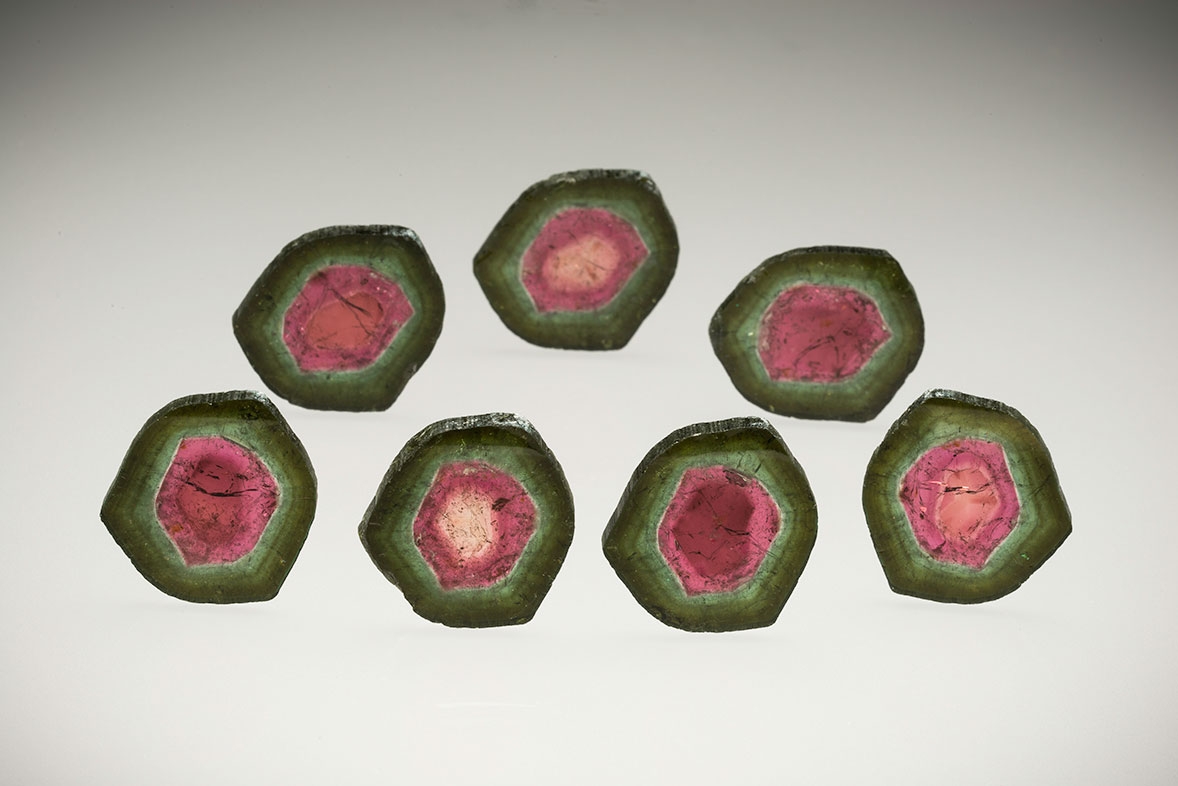
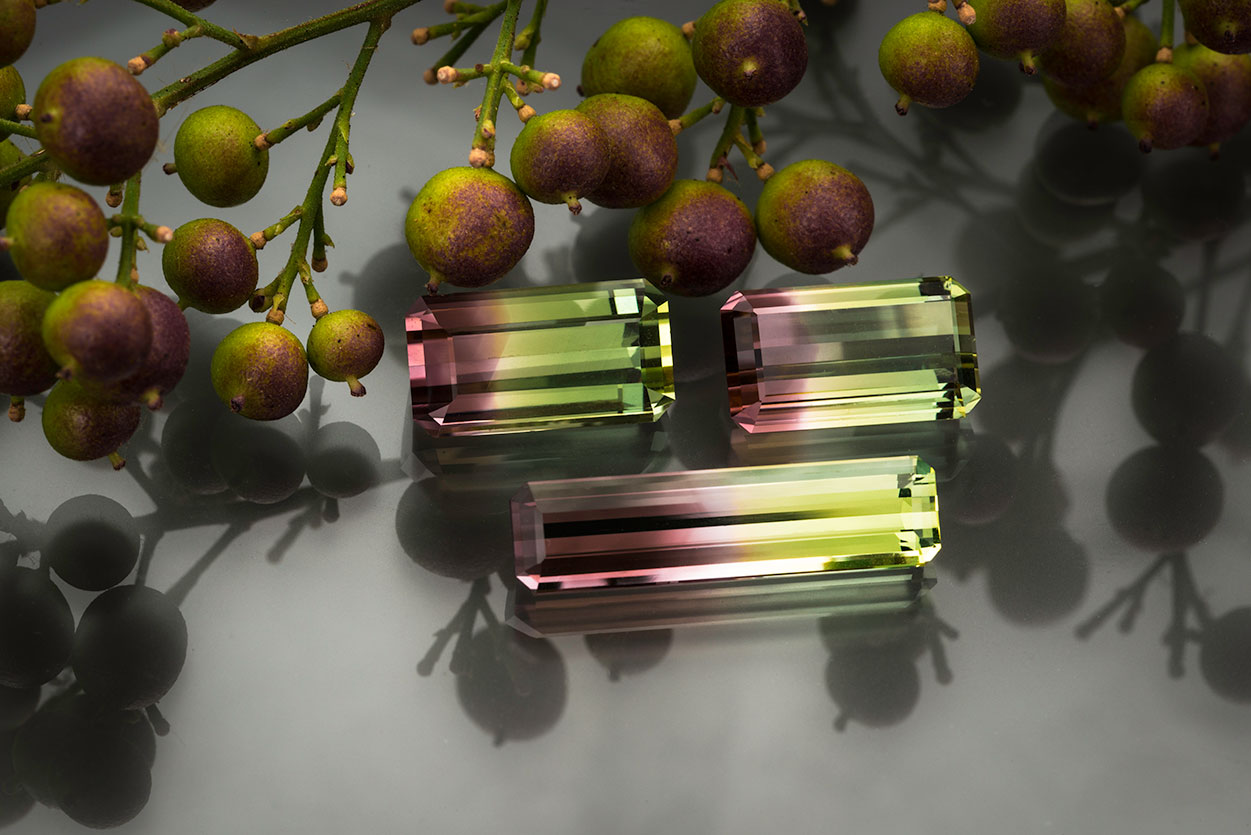
This month’s featured stone comes from the land made famous for the recent discovery of paraiba tourmalines. Along with the rare occurrence of the element copper, we also find a mix of elements creating a wide variety of colors in the tourmaline family. The multi-colored tourmaline exhibits the unusual nature of tourmaline deposits in Mozambique.
![]() |
| Multi-colored tourmaline, 59.40 cts., 36 x 15.23 x 12.57 mm. Search on inventory number 16129. (Photo: Wimon Manorotkul) |
You can imagine the original crystal growing through a metamorphosis of color: first encapsulating all the iron in the green section of the crystal, then introducing a mixture of manganese and titanium to produce the yellow band, and then finally exhausting all the iron and crystallizing the newly introduced manganese chromophore into the tourmaline lattice, which produces the final pinkish-red section. (Don’t quote us on this; our description is a simplification of a complex process that occurs in the genesis of multi-color tourmaline.)
This complex and varying composition must crystallize in unique conditions. The fact that the entire tourmaline emerged flawless after cutting is a true feat of Mother Nature.
Interested? Call or email us—or see this gemstone in person at the Tucson Show. [back to top]
Pala International’s Featured Stones – 2007
Featured in Pala’s Gem News. All photographs by Wimon Manorotkul.
December 16: Natural Yellow Sapphire
Big and Beautiful
This month’s feature is a full-figured natural beauty. Weighing in at 104.76 carats this healthy and happy sapphire from Sri Lanka is a natural blonde, very clean on the inside and well formed on the outside. This sexy stone is reminiscent of a canary diamond with excellent brilliance and a pure lemon-yellow hue.
![]() |
| Natural yellow sapphire, 104.76 cts., 30.2 x 23.60 x 16.80 mm. Search on inventory number 14982. (Photo: Wimon Manorotkul) |
A perfect companion for a night out on the town or just a cozy winter evening by the fire. She is a handful, but sure to make your dreams come true.
Interested? Call or email us to see if she’s available. [back to top]
November 18: Star Padparadsha Sapphire
A collector’s choice
Phenomenal gemstones, including star sapphires, surface through in-depth mining efforts and percolate through the hands of gem cutters and merchants, eventually finding their way into the hands of the collector. This month we dig a little deeper down the rabbit hole and find a natural padparadsha star sapphire from Sri Lanka. A phenomenal phenomenon with a peach hue and a nicely formed six-rayed star.
![]() |
| Star Sapphire, 10.28 cts., 12.64 x 9.84 x 7.34 mm. Inventory #15610. A fine example of high saturation and crystalline clarity. |
Fine star sapphires of any color are quite rare to begin with, captivating collectors of the rare and unusual. The large size, natural pinkish-peach color, translucency, and the presence of the star all contribute to the rarity and desirability of this jewel.
See Pala’s selection of star sapphires here.
Interested? Select the inventory link above for pricing, email us, or give us a call. [back to top]
October 18: Sri Lankan Taafeite
Taafeite is one of our planet’s extremely rare creations. It is named after its discoverer Count Edward Taafe, a Bohemian-Irish gemologist. Taafeite was originally found mixed within a parcel of mauve-colored spinels. Upon closer examination, it can be easily differentiated from spinel by using a polariscope or dichroscope.
![]() |
| Sri Lankan taafeite, 3.28 cts., 12.23 x 7.24 x 4.82 mm. Inventory #15836. A fine example of high saturation and crystalline clarity. (Photo: Wimon Manorotkul) |
Taafeite is known to occur in Russia, China, Burma, and Sri Lanka. According to the Color Encyclopedia of Gemstones by Dr. Joel E. Arem, in 1987 there were around 50 true taafeites that had been properly identified. This month’s beauty comes to us from Sri Lanka, and shows an incredible saturation and a luscious mauve hue. See Pala’s selection of taafeites here.
Interested? Select the inventory links above for pricing, email us, or give us a call. [back to top]
September 15: Peridot from Pakistan
A common gemstone to some but a real treasure to the purveyors of exceptional gem quality. Peridot is the gem variety of forsterite of the olivine group, and it is found in igneous and some metamorphic rock types. Peridot in its most basic form is a relatively common mineral when looking at the big picture of our Earth. As we trace peridot’s formation from tiny crystals scattered through massive rocks to larger well-formed crystals we began to see the rarity increase. Larger gemmy crystals are quite rare, in fact, and can draw much higher prices than their micro counterparts.
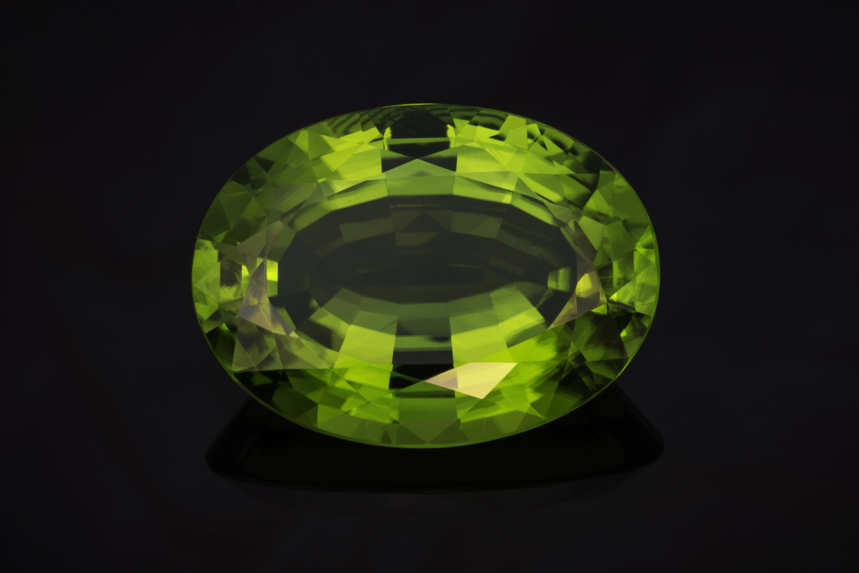
![]() |
| Peridot, 36.70 cts., 19.67 x 17.74 x 13.74 mm. Search on inventory number 15529. (Photo: Wimon Manorotkul) |
In last month’s Pakistan Update, we included a nice 13-carat peridot, and got quite a few “clicks.” This month we feature an exquisite example of big and beautiful. This 36.70-carat Pakistani peridot exhibits some of the most exceptional characteristics of fine material. Super-saturated yellowish-green hue, with flawless clarity, and a precision cushion cut. See more peridot from our inventory here.
Read more on peridot in Pala’s Buying Guide, and the history of its discovery from Peter Bancroft’s Gem & Crystal Treasures,
Interested? Select the inventory link above for pricing, email us, or give us a call. [back to top]
August 15: Purple Spinel
This month’s featured stone is an unusually intense purple variety of spinel. With the base hue of a fine amethyst, the slight color shift of a sapphire, and the diagnostic dispersion, this spinel is in a class all its own. For more on color shift see April’s featured stone. Also visit our Spinel Buying Guide.
In many respects, spinel is an ideal gemstone. Its wide range of colour, relatively high refractive index, colour dispersion modestly higher than corundum, good hardness as well as lack of birefringence and cleavage raise it above other, even well known precious stones. Spinel definitely deserves to rank next to ruby and sapphire.
– From Gübelin & Koivula, Photoatlas of Inclusions in Gemstones, Vol. 2, p. 662.
![]() |
| Spinel, 8.13 cts., 10.22 x 9.57 x 6.95 mm. Price upon request. |
To further understand external beauty, we must delve internally to see the features that define the genesis of spinel: randomly oriented growth tubes, rutile needles in an obscure phantom pattern, and platelets flashing spectral colors. This phenomenal mix of inclusions and unique appearance is a refreshing sight. Shall we say “by intelligent design”?
![]() |
| Internal beauty. Needles and platelets flashing spectral colors following the octahedral-like phantom in a micrograph from this month’s featured gemstone. |
Browse Pala’s inventory of spinel. Interested? Email us, or give us a call.
![]() |
![]() |
![]() |
[back to top]
July 15: Fire Opal
Mexican fire opal comes to us with a variety of characteristics. Yellow to deep orange body color with the very unusual hues moving into the reds. Like opal from other parts of the world, Mexican fire opal can display full-spectrum play of color. This month’s phenomenal featured stone has all the components of a top notch collector’s gem.
![]() |
| Mexican fire opal, 23.15 cts., 22.99 x 16.93 x 11.82 mm. Search on inventory number 15222. (Photo: Wimon Manorotkul) |
As we look internally, we find another visually stimulating characteristic. Stalagmite and stalactite formations occur within fire opal and are usually composed of goethite rods encrusted in limonite (Gübelin & Koivula: Photoatlas). There also seems to be some hematite crystals inside. See the inclusion photo below for the internal world of this month’s featured stone.
![]() |
| Tiny tower. This single stalagmite formation is one of many found in our intriguing Mexican fire opal. (Photo: Wimon Manorotkul) |
Interested? Select the inventory link above for pricing, email us, or give us a call.
![]() |
| Surreal sceptre. An unusual tube growth formation with larger terminating crystals. (Photo: Wimon Manorotkul) |
![]() |
| Fire and water. Coral-like stalagmite/stalactite formations are clearly seen in this magnification of this month’s featured fire opal. (Photo: Wimon Manorotkul) |
[back to top]
June 15: Star Ruby
Star, or asterism, is a phenomenon that appears when light is reflected from oriented inclusions in corundum. These silk inclusions are exsolved needles of rutile, oriented along three directions in a basal plane. Light is reflected and concentrated into bands perpendicular to the three directions; if everything is in alignment inside and outside the stone, a 6-ray star will magically appear. (Adapted from Richard W. Hughes, Ruby & Sapphire, p. 67.)
![]() |
| Star ruby, 7.53 cts., 10.22 x 9.57 x 6.95 mm. Search on inventory number 13873. (Photo: Wimon Manorotkul) |
This star ruby comes to us from Mogok, Burma. With a pinkish-red hue and good translucency this beauty is a pleasing sight. Beyond the color, the star is very sharp and all the rays are well defined.
Please give us a call regarding this as well as other star rubies we have in stock.
Interested? Select the inventory link above for pricing, email us, or give us a call. [back to top]
May 15: Russian Demantoid Garnet
Demantoid garnet truly captures the spirit of gemstone collecting. A rare and beautiful gem with provenance and gemological intrigue.
![]() |
| Russian demantoid garnet, 3.69 ct, 10.02 x 8.36 x 5.77 mm. Inventory #14687. A fine example of high saturated green and medium tone. (Photo: Wimon Manorotkul) |
Originally discovered in the Ural Mountains of Russia in 1853, these Ural pearls captured the imagination of the likes of reigning Czars, Peter Carl Fabergé, and George F. Kunz of Tiffany’s. The initial mining operations and popularity lasted until about 1919 when demantoid went off the radar. It wasn’t until the 1970s when demantoid resurfaced in limited production along some of the rivers leading out of the Urals. Small scale operations have been sporadic over the last few decades, which included a serendipitous effort by Bill Larson and Pala International to recover some of these green beauties in the late 1990s. Our featured stone this month comes from some of the last premium lots that were coaxed out of the ground.
![]() |
| Horsetail inclusion, the identifying mark of excellence—from Russia with love... (Photo: Wimon Manorotkul) |
Demantoid is a highly saturated green variety of andradite garnet. The exquisite dispersive properties of this garnet are similar to a diamond, with flashes of color from our visible spectrum. Lighter tones tend to pronounce the dispersion while darker tones show less fire. To further identify these green Russian beauties, most contain horsetail inclusions. These golden byssolite threads occur in curved sprays, resembling horse tails, and are diagnostic of Russian origin.
Demantoid garnets have now been found in Iran, Italy, and Namibia; however the original Russian material seems to hold its place as the finest. With some of the last material available on the market Pala offers a fine selection of demantoid. See the inventory here.
For more information, see:
Interested? Select the inventory links above for pricing, email us, or give us a call. [back to top]
April 16: Madagascar Sapphire
A shift in color...
Sapphire comes to us in many sizes, shapes, colors, and phenomena. Change of color is an optical phenomenon that can be observed as one takes a sapphire from the indoor incandescent light to outdoor sunlight.
Incandescent light is tipped to the longer wavelength end of the visible spectrum, which includes yellow, orange, and red; while sunlight is balanced, emitting the full spectrum. The human eye is sensitive to green light, so we observe more of the blue-green end of the spectrum in daylight, and more of the purple-red under incandescent light.
![]() |
| Madagascar sapphire, 3.75 ct., 8.34 x 8.01 x 5.76 mm., radiant cut. Violet-blue color shown in daylight. Inventory #14621. (Photo: Wimon Manorotkul) |
In sapphire, this unusual selective-absorption behavior takes place when the stone has a mixture of chromophores. Technically, as Richard W. Hughes has explained in Ruby & Sapphire, these are: (Cr3+), which creates the red/purple component, and (Fe2+ + Ti4+), which creates the blue component.
![]() |
| Same Madagascar sapphire as above, shifting to the purple side under incandescent light. (Photo: Wimon Manorotkul) |
Change of color can occur as a full color change from green to red, or as a color shift from blue to purple. Color change from one end of the spectrum to the other, aka the alexandrite effect, is rarely seen in sapphires and often is caused by the presence of vanadium. Color shift from blue to purple is more commonly seen and can add a beautiful twist to sapphire. This month’s featured stone is a fine example of this color shift.
Read more on sapphires from the expert, Richard Hughes, at www.palagems.com. And check out Pala President Bill Larson’s “Gods, Graves & Sapphires,” an editorial about sapphire treatment.
Interested? Select the inventory link above for pricing, email us, or give us a call. [back to top]
March 16: Spinel
The cousin of a king...
Spinel’s popularity has not quite made it to the throne yet, but its rare vivid colors and many varietals definitely make it royalty. Often mined in close proximity to its famous relative corundum, spinel is composed of the same basic elements, aluminum (Al) and oxygen (O), with the addition of magnesium (Mg). With a similar upbringing and a genetic tie to corundum, spinel shines brightly with distinguishing properties. Featuring a higher dispersion, common natural colors, and a lower price point, spinels are being exposed to the discerning collector of regal gems.
![]() |
| Pair of cushion brilliant red spinels, 3.79 cts. total, 8.3 x 6.4 x 3.8 mm. Inventory #11049. |
Spinels have found their way into some of the world’s most famous gem collections, including the British crown jewels in which a 140-ct. spinel (in the Imperial State Crown) was long thought to be a ruby, and a large assortment in the crown jewels of Russia and Iran.
![]() |
| Oval brilliant pink spinel from Burma, 7.79 cts., 15.12 x 12.94 x 9.05 mm. Inventory #13859. |
Today fine spinels originate from Burma, Sri Lanka, Vietnam, Tajikistan, Tanzania, and Madagascar. Read more in our Spinel Buying Guide.
Interested? Select the inventory links above for pricing, email us, or give us a call. [back to top]
February 15: Mozambique Tourmaline
The talk of the town
With everyone talking about paraiba in Tucson, we naturally followed suit with our featured stone this month: a greenish-blue tourmaline, which has a natural copper component that gives it a neon glow.
This Mozambique tourmaline has the “paraiba type” color that was originally made famous by material from Brazil. In general, the Brazilian paraibas are small, included, and unavailable. Luckily the new Mozambique paraibas have a larger size range, are mostly eye clean, and are available—for the time being. Below is a stunning example of how clarity and saturation combine to create a new level for colored stones.
![]() |
| Mozambique tourmaline. Brilliant cut pear shape, 6.73 ct., 14.1 x 10.03 x 7.28 mm. Inventory #14148. |
It’s not very often that something rare and beautiful arrives on the gemstone market. The novelty of these tourmalines was quite apparent at the recent AGTA GemFair in Tucson. Virtually everyone who walked by our booth stopped to take in the view of these emissaries of color. The Mozambique tourmaline is opening up a whole new color palette for gem lovers. This deposit not only has colors reminiscent of Paraiba blue, but also intense greens, lavenders, purples, and everything in between.
Please view the array of colors here. And stay tuned for more on the magnificent Mozambique tourmaline.
Interested? Select inventory #14148 for pricing, email us, or give us a call. [back to top]
January 16: Kashmir Sapphire
Naturally gorgeous...
As the world becomes seemingly smaller and the scope of mining and production of gemstones grows, we are reminded how truly rare some stones from the classic localities have become. Words like Burmese ruby, Colombian emerald, and Kashmir sapphire are commonly used to describe the finest quality, but to find material that is naturally occurring with saturated color and crystalline clarity is far from common.
![]() |
| Cushion Kashmir sapphire, 3.30 ct, 7.46 x 7.28 x 6.31 mm. Inventory #14358. The deep hue of this gemstone is captured against a white background. |
![]() |
| Brilliant! Against a black background the same stone shows its luminous side. Obviously this beauty needs to be seen in person. |
This untreated Kashmir sapphire defines the exception from amongst a seemingly endless supply of commercial quality sapphire. Sapphires are found on most continents but it takes a precise combination of geologic conditions and chemical components to coalesce in the formation of upper echelon gemstones. In other words, this sapphire is rare and naturally gorgeous.
Read more on blue sapphires from the expert, Richard Hughes, at www.palagems.com.
![]() |
| Silk. Needly, cloudlike inclusions, known as silk, are visible under magnification, proof of the absence of heat treatment. |
Interested? Select the inventory links above for pricing, email us, give us a call—or come see it for yourself in Tucson. [back to top]
Pala International’s Featured Stones – 2006
Featured in Pala’s Gem News. All photographs by Wimon Manorotkul.
December 14: Spessartite Garnet
Looks good enough to eat...
Spessartite garnet is a juicy gem, with color that can resemble a ripe orange. In fact, some stones with reddish-orange hues are referred to as mandarin. When plucked and sliced this jewel comes alive with a natural color and a brilliant appearance. A refreshing change from the common dark red garnet, mandarin-type colors are an attractive variety, demonstrating yet another flavor of the garnet family.
![]() |
| Pear shape spessartite garnet from Nigeria, 5.76 ct, 10.92 x 10.44 x 6.71 mm. Inventory #11929. |
The true mandarin garnets were first put on the collector’s plate from a source in the Kunene River Valley along the border of Angola, in Namibia. Now, beautiful orange material is also coming from Nigeria, Brazil, and more rarely the Ramona mine in San Diego County, California. For more on spessartite garnet, see this Colored Stone article and, of course, our own Buying Guide.
Come sample the fresh fruit at www.palagems.com.
![]() |
| Round brilliant matched pair of spessartites from Nigeria, 7.79 ct, 9 x 6 mm. Inventory #13064. |
Interested? Select the inventory links above for pricing, email us, or give us a call. [back to top]
November 15: Brazilian Alexandrite
Ambiguous Alexandrite: The Chameleon of the Gemstone World
Like the chameleon hiding from its prey, the alexandrite shifts color as it moves into the daylight. The observer notices that the gemstone takes on a whole new appearance. Different wavelengths of light excite the crystalline structure in different ways, producing two distinct colors. Whether from a scientific view or an artistic eye the alexandrite is a refreshing sight.
![]() |
| Brazilian alexandrite (daylight at left; incandescent at right), emerald cut, 3.18 ct, 9.06 x 7.23 x 5.1 mm. Search on inventory number 14006. |
This month’s alexandrite is from a fairly new discovery in Brazil (see Gems & Gemology, Spring 1988). The beauty of the Brazilian material rivals that produced by the historic Russian locality. These phenomenal gemstones exhibit medium-dark tones, teal blue to raspberry hues, and strong saturation—properties that define excellent quality and distinct rarity.
Please give us a call regarding this as well as other alexandrite we have in stock.
Interested? Select the inventory link above for pricing, email us, or give us a call. [back to top]
October 20: Natural Pearl
Made in America!!
This month’s featured stone is sure to appeal to the pearl lover in all of us.
When one thinks of beautiful pearls, visions of exotic far off lands such as Malaysia, French Polynesia, Japan......and Mississippi come to mind?
Yes—Mississippi.
When it comes to collecting, one would include pearls from the North American continent. The waters of Tennessee, Baja California, and even less often, Mississippi have produced pearls that can rival their Oriental cousins.
![]() |
| Natural Mississippi pearl. Search on inventory number 13916. |
This natural beauty weighs 16.84 cts. and measures a full 14 mm. around. It has a lovely cream base with an incredibly full, satin-peach overtone. A pearl such as this is a rare get for any connoisseur.
Please give us a call regarding this as well as other rare pearls we have in stock.
Interested? Select the inventory link above for pricing, email us, or give us a call. [back to top]
September 14: Purple Tourmaline
These stunning purple tourmalines are yet another example of the fine material coming from Mozambique. It seems we are seeing more and more magnificent colors from this deposit.
![]() |
| Purple tourmaline, 16.5 ct. Inventory #13732. |
These two stones are both clean, well cut, and show a purple color unlike we have ever seen before. Even more remarkable, both are natural and unheated.
![]() |
| Purple tourmaline, 9.92 ct. Inventory #13731. (Note: In our emailed newsletter this stone was misidentified as an emerald cut 6.61-ct. purple tourmaline, Inventory #13733.) |
Interested? Select the inventory links above for pricing, email us, or give us a call. [back to top]
August 16: “Paraiba”-type Tourmaline
Copper (Cu) bearing tourmaline is all the rage! Not in many years has a gem material caused so much excitement, confusion, and curiosity as has the “Paraiba”-type tourmalines from the most recent sources of Mozambique and Nigeria.
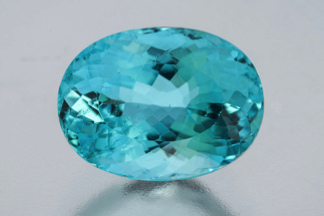
![]() |
This lovely pair of ovals, from Mozambique, has many of the same traits of color and chemical composition as its very popular cousins from Brazil. The two weigh a total of 9.94 cts. See our story about Paraiba tourmaline.
Interested? Email us or give us a call. [back to top]
July 20: Aquamarine
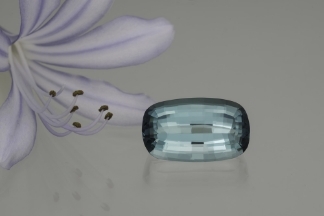
![]() |
Our featured stone is an exceptional aquamarine from antiquarian jewelry, most likely from Santa Maria, Brazil. The immutable aqua color of this gemstone is devoid of the gray found in lesser stones. We dare you to find a finer, darker aquamarine available on the market today.
At 37.60 carats (29.9 x 19.6 x 12.2 mm) this rare stone is perfect for either pendant or investment. The price is available upon request. [back to top]
July 4: African Zircon
![]() |
![]() |
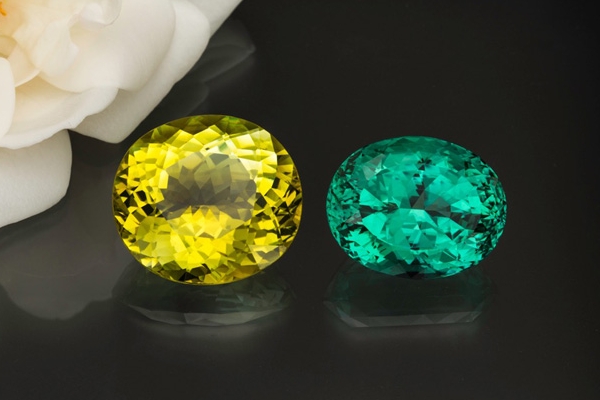
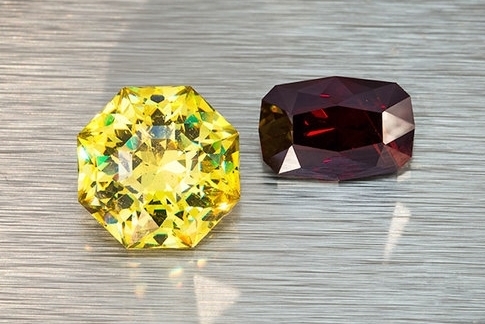
As demonstrated by our last two featured stones, Africa offers a wealth of various gem materials from all regions. Naturally occurring zircon has a brilliance and refractivity very much like that of diamond. Often confused with zirconia, zircon is most well known in yellows and brown-yellows, but new material of unusual and scintillating colors is what we present to you this month.
The zircons pictured above (top, 5.91 ct.; bottom, 10.96 ct.) are examples of the latest colors being produced from Kenya and Tanzania.
Prices are available upon request. [back to top]
May 22: Imperial Garnet
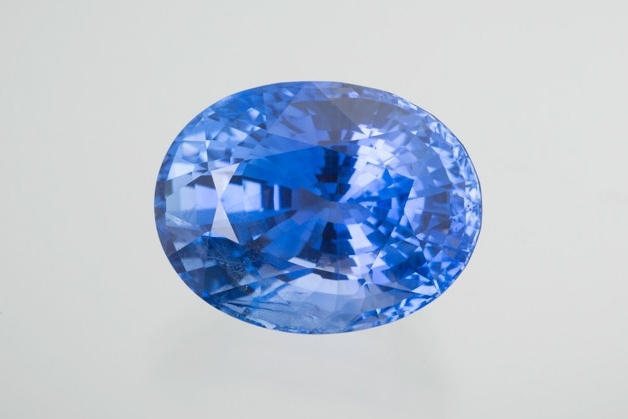
![]() |
This unusual pyrope-spessartite garnet is the latest in beautiful and rare gem materials to be unearthed from the Lindi Province of southeastern Tanzania.
What makes this particular stone so special is its size. Marketed as “imperial” garnet, it is reported that most such material suitable for cutting is rarely over one carat in size, and inclusions are common. This incredible “gem” weighs 57.12 carats and has an amazing, intensely saturated combination of rich orange with a crisp pink secondary that indeed gives it a color similar to fine imperial topaz. The clarity is exceptional and the cutting is superb.
The price is available upon request. [back to top]
April 17: Chrysocolla
![]() |
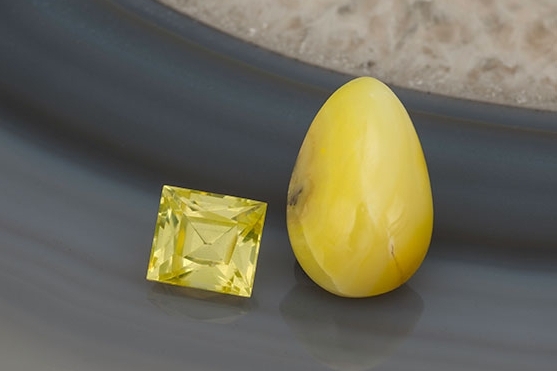
This month we bring you a sampling from our inventory of chrysocolla, consisting of both cabochon-cut and uniquely carved pieces. The 63.99-ct piece pictured above is from material found in the 1950s and cut by Bud Standley. It features an attractive agatized pastel blue band and a small druzy window.
![]() |
The second piece above, 16.46 cts., is another great chrysocolla, perfect for custom-made jewelry. It is masterfully carved to show off both its color and the delicate druzy area.
![]() |
Finally, a fine translucent cabochon with an even pastel blue, 7.63 cts. Simply exquisite. These are just a few of our unique pieces. Prices are available upon request. [back to top]
March 9: Blue Tanzanite
![]() |
Since its history-making discovery in 1966, most deep-blue-color tanzanite in the market today is the result of heat treatment. Most of the time... This 47.43-ct. “gem” was cut from the amazing unheated natural-colored crystal seen below, which weighed 114.67 cts. before cut. |
The stone, the rough of which was acquired at this year’s show in Tucson, is a vivid blue with intense trichroic flashes of violet and red; often compared to sapphire. A natural tanzanite of this size, with documentation of its “before cut” state is a rarity. When the time came for cutting a crystal of this caliber, we chose to entrust the stone’s fate to the eye of master cutter, Raphael De Gottrau, of Raphael’s Lapidary in Scottsdale, Arizona. We are happy we did. The price for this blue tanzanite is available upon request. [back to top] |
![]() |
January 16: Alexandrite
![]() |
![]() |
Our featured stone this month is alexandrite, from the chrysoberyl family. This outstanding matched pair is from Brazil.
These stones, 2.48 carats combined, possess a strong color-change effect, the primary qualification for labeling a chrysoberyl alexandrite. The change is from fine bluish green in daylight to raspberry/rhodolite in incandescent light.
The price for this exquisite pair is available upon request. For more information on color-change properties visit our Palagems.com Alexandrite Buying Guide. [back to top]
Pala International’s Featured Stones – 2005
Featured in Pala’s Gem News. All photographs by Wimon Manorotkul.
December 15: Green Tanzanite
![]() |
In our last featured stone presentation we introduced you to a unique mint-colored garnet from the Merelani mining district in Tanzania. This month we return to Tanzania to acquaint you with the most rare of tanzanites.
What would make this stone any rarer than other tanzanite? you might ask. The color, for one thing: at first glance you might not even guess that it is a tanzanite at all.
Due to chromium, this material produces tones that are predominantly green with subtle blue overtones in contrast to the more familiar royal violet/blue tones, derived from vanadium. Green tanzanite is rarely seen in jewelry stores and is sought in large sizes by many gemstone aficionados and collectors.
When mining, it is rare to find any material that will produce something larger then 5-carat sizes. This beauty tips the scales at approximately 9.5 ct. and displays exceptional clarity. Please give us a call if your client/collector wishes to add a gem of this type to their portfolio. Price available upon request. [back to top]
November 15: African Mint-Colored Garnet
![]() |
Kenya and Tanzania have long been regarded as producers of some of the world’s finest colored stones. This mint colored-garnet is of the grossular variety and is particularly lovely with its delicate blue/green tone that is very brilliant when cut properly, as it is here. The northern Tanzanian mining area of Merelani, where this material is found, is also the magnet that has drawn tanzanite dealers for years.
The mint-colored garnet material is difficult to find in fine, crystalline form, and its size is always relatively small. It is often considered a softer companion to its big and more well known relative, Tsavorite garnet.
This gemstone weighs 7.14 cts and measures 10.5 x 10.5 mm. The hardness makes it a great everyday-wearing stone. This item was sold. [back to top]
October 6: A Special Gemstone
This pale pink poudretteite was found in the Mogok district of Burma. It is one of less than ten known faceted stones.
![]() |
It weighs 3.8 cts and measures 11.4 x 8.4 x 6.7 mm. Price available upon request.
Further information about poudrettite can be found in Gems & Gemology, Spring 2003, Volume 39, Issue 1, pp. 24-31. [back to top]
September 22: Imperial Topaz
![]() |
What’s in a name?
This 14.37-ct gem “Imperial Topaz” is the perfect example of what an imperial should look like.
This stone has a combination of fiery red, mixed with a brilliant orange and just the right splash of peach to bring it to the top of the list of the most desired topaz colors, second only to a true red, which has proven to be the rarest color to find in gemmy material.
It weighs 14.37 cts and measures 16.5 x 10.7 x 8.8 mm. Its stock number is 11657. We invite you to call us about this beauty or any of our other stones to help you complete that perfect piece. [back to top]
August 15: Unusual Spinel from Tanzania
![]() |
This beautifully cut gem spinel hails from the unusual location of Tanzania. Most aficionados of gemstones know Burma to be the classic and most familiar source for fine spinel… until now. In the past most spinels from Tanzania displayed a somewhat hazy appearance, what we refer to in the business as a “sleepy” overall look. This gemstone has a limpidity and brilliance that defies verbal description. And then there is the color!
This amazingly crystalline, perfectly cut, untreated natural “gem” is a perfect combination of fiery pink with a kiss of orange.
It weighs 2.39 ct and measures 9.7 x 7.7 x 4.9 mm. Its stock number is 12074. We invite you to call us about this beauty or any of our other stones to help you complete that perfect piece. [back to top]
May 28: 16.16-ct. Zircon
Pala International President Bill Larson’s most recent trip to Burma and Bangkok turned up this very clean blue Zircon.
This Cambodian stone features a fine, rich, bright blue with no green. The excellent cushion cut contributes to one of the finest stones of its kind to be procured by Pala.
![]() |
Interested? Search on Inventory Number 11628. Or call us about this or any of our other stones. [back to top]