On Kunz & Kunzite
Lawrence H. Conklin
2 West 46th St., New York, NY 10036
Tel: 212-382-0304; Web: www.lhconklin.com;
E-Mail: lhc@lhconklin.com
Reprinted from the Mineralogical Record, volume 18 (1987), pages
369–372.
(Note: Author’s notes within quotations are in blue)
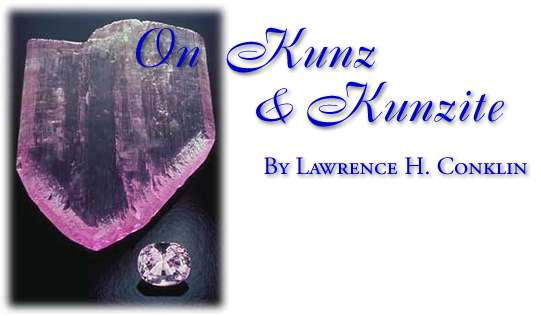
The pink or lilac-colored variety of spodumene is today universally known as kunzite, in honor of George Frederick Kunz. But it might well have retained any one of several other names instead. It is generally agreed that pink, gem-quality spodumene was first discovered by Frederick M. Sickler. At least it was Sickler who sent the first specimens to George Kunz at Tiffany & Company in December of 1902, thinking that they were possibly a variety of tourmaline. The exact locality was not furnished to Kunz at the time, but it was later revealed to be the White Queen mining claim on what was later known as Heriart or Hiriart Mountain, near Pala, San Diego County, California.
 |
| Figure 1. Fred M. Sickler, discoverer of kunzite at the White Queen mine, Pala, California. |
At that time credit for the discovery was disputed because coevally with the Sickler discovery, Frank A. Salmons, another miner from that area, made an independent find of the same material nearby at his Pala Chief mine, and many considered him to be the discoverer. In a letter to Kunz1 dated September 26, 1904, Sickler states:
A short time ago mention was, made in a San Diego paper of Frank Salmons, terming him the “discoverer of Kunzite.” George H. Hazzard immediately published an open letter calling attention to the facts of my discovery and contradicting the statement giving credit to Mr. Salmons. Mr. Hazzard’s article was unchallenged. For this reason I wish you to make it clear in your report2 the various dates of the discovery of Kunzite ledges or mines and thus relieve me from the annoying and malicious attacks of my disappointed competitor. Remember that no matter what may be said or rumored, that I have the written vouchers and correspondence showing I brought the stone before all local lapidists and experts a year before the Pala Chief yielded any Kunzite, and further that I made a sale to Tiffany & Co. before any work was done on the Pala Chief. I regret to mention that Salmons & Ernsting, who are handling the Kunzite output of the Pala Chief mine, are advertising to the trade that they have the only Kunzite deposit in the world!
The pink or lilac-colored variety of spodumene is today universally known as kunzite, in honor of George Frederick Kunz. But it might well have retained any one of several other names instead.
Kunz must have had a bit of trouble with this message because Salmons and the Pala Chief mine were Kunz’ source for the really fine, large and gemmy crystals of kunzite that yielded the beautiful, giant-sized faceted stones which had so impressed the jewelry fraternity. In his report Kunz wrote a few paragraphs on the discovery of kunzite, but finished by stating only that Sickler’s discovery “seems” to be entitled to priority. Oh well, commerce, as well as science and history, must be served.
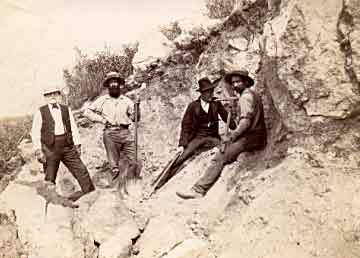 |
| Figure 2. Left to right: S. McLure, Bernardo Heriart, Frank A. Salmons and Pedro Peiletch at the Pala Chief mine, San Diego County, California, one of the localities where kunzite was first found. Photo ca. 1900, H.C. Gordon |
H.C. Gordon, who was an important long-time correspondent of Kunz’ and who supplied Kunz with much data and many photographs for the report, wrote to him on October 24, 1902: 3
Thinking you may like to know the history of the gem spodumene “Kunzite” I will let you know its location in this country, where first found, name of discoverers, etc. The discoverers are named Pedro Peiletch and Bernardo Heriart, Frenchmen. They first discovered it on section 24, T9S R2W, on a mine (the White Queen) located by themselves and Mr. Fred Sickler. This was at least 9 months prior to them finding it in a mine (the Pala Chief; in section 14, located May 1903) owned by themselves and Frank Salmons and John Giddens.
Here were two more “discoverers,” perhaps the real ones. Kunz was wise to hedge his bet.
Obviously confusion reigned, as exemplified by a photograph of Sickler,4 on the back of which is written (in Sickler’s hand) the following inscription:
To Hon. Lewis Aubury State Mineralogist Compliments of Fred M. Sickler Co-discoverer with M. M. Sickler of the mineral and gem lilac spodumene known as Sicklerite but also as Kunzite & Salmonite. (sic)
Thinking you may like to know the history of the gem spodumene “Kunzite” I will let you know its location in this country, where first found, name of discoverers, etc…
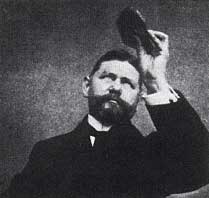 |
| Figure 3. George Kunz examining what may be the crystal of kunzite shown here in Figure 4. From the Mineral Collector, Vol. X, No.8, October, 1903, pp. 113–114. |
Presumably he should have added the names of Peiletch and Heriart to his list of honorees!
Charles Baskerville, a chemistry professor at the University of North Carolina and later the City College of New York, named kunzite in honor of George Kunz in 1903, but not without much input from Kunz himself. Exactly how the whole matter originated has not been recorded; nevertheless we can be sure that it was Kunz who began it. There is much reference to the matter in the Kunz-Baskerville file of correspondence at the American Museum of Natural History library in New York, from which I quote below.
Baskerville was still working on the analysis of kunzite when he wrote to Kunz on November 24, 1903:5.
Perhaps it may be necessary for me to have a little more of the kunzite. I prefer the colored pieces, the small refuse pieces from the cutting will answer. Will push along the analysis as fast as we can.
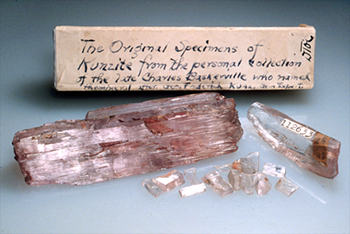
Baskerville got much more than “small refuse pieces” for analysis from Kunz, for in the early 1950’s I was shown a fine cut and polished prism of kunzite while attending an optical mineralogy course at City College of New York. Professor Kurt E. Lowe stated that it was the very same specimen worked on by Charles Baskerville in 1903. I certainly hope that it has survived the years with its history still attached.
In a somewhat later off-print of his original published work on kunzite in the American Journal of Science in 1903, Kunz warned us twice of what was to come. After describing several small crystals of pink spodumene, he said, “As this is an entirely new gem of peculiar beauty, a name will be given to it shortly.” And also, “If sufficient differences are found to exist between this spodumene and the other known varieties a new name will be given to it.” When the official publication (‘Kunzite: A new gem,’ Science, September 4, 1903) finally came out Baskerville states: “The observations of Dr. Kunz sufficiently characterize this mineral of peculiar beauty as a new gem, which he has not named... I propose the name Kunzite, for reasons unnecessary to give to American and European scientific men.” This publication (which included ten lines quoted from Sir William Crookes on the phosphorescence of kunzite) initiated the following exchange:
Kunz to Baskerville,5 December 19, 1903:
Our article looks fairly well in Science. Wait until they pull it to pieces - Who?
Baskerville to Kunz,5 January 13, l904:
By the way, you know I rather prefer leaving out Crookes’s verification of our work in his letters. Think better publish our own and send reprint; think we would be glad to have him make public his observations himself. It then doesn’t give appearance of bolstering one’s work.
Kunz to Baskerville,5 January 16, 1904:
Quite agree with you in regard to the reference about Sir William Crookes. I quoted him myself and although I knew the facts, felt that coming from him it might seem as if I was using his thunder and he has been and I believe will continue to show us courtesies in the future.
Somewhere in the correspondence is a reference to Crookes’ acknowledging a faceted kunzite for his wife.
Things were obviously handled (perhaps manipulated is a better word) very carefully as again is shown by a note from Baskerville to Kunz5 in 1903:
When (kunzite) analysis is complete will make another paper - brief one with anal. & send to Dana. Prefer to have things in better shape for him. Whereas in Science things need not be too specific.
In the Mineral Collector, April 1906, W. S. Valiant, a professor of geology at Rutgers College in New Jersey, wrote the following somewhat cryptic comments, in which I have inserted some clarifying notes (in blue):
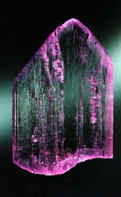 |
| Figure 4. Superb crystal of kunzite from the Pala Chief mine; 14 cm. Photo by Harold and Erica Van Pelt. Originally sold to J.P. Morgan by Kunz around 1903, then donated to the American Museum of Natural History in New York. In the 1960’s it was traded out to Peter Bancroft, and is now in the collection of William Larson, who in 1987 valued it at $250,000. This photo first appeared in Letters to George F. Kunz (Conklin:1986) |
A beautiful gemstone was found a few years since in California. This was examined by several supposed experts; one called it topaz, another tourmaline. Finally a fine sample was handed to Dr. W. V. Nichols of Oceanside, Cal., who sent it to New Jersey (i.e., to Valiant) for determination. This was returned (by Valiant) the same day it came, labeled “Spodumene of fine gem quality. Another letter was sent (by Valient) to New York (i.e., to Kunz) on the same day, reporting the find. This received a kindly reply, which stated that the same mineral was under examination there and the results would be published soon. In the meantime our letter and sample reached California, and in the same mail a letter asking for samples, etc. from New York. The results of the examination in New York were published nearly three months later, verifying our determination, and giving it a variety name, after the “discoverer.” (sarcastic quotation marks?) The naming was eminently proper.
In due time a letter came from California (from Sickler or Salmons?), to the present writer, stating that the correct name of the mineral was first given to Californians “in your letter of June 23d, 1903.” Also that in California it was called “Salmonite.”
Long stories have been published, one in the Mineral Collector, about this matter, but the question as to who first “discovered” it is still at large. A man in California claims to be the first, but did not know what he had discovered, and could find no one to tell him. What did he “discover?” Finding and discovering are sometimes different matters.
Later on, letters were received from New York (Kunz) by the writer, fully explaining the apparent discrepancy, but still leaving the question of priority as to correct locality and naming of the mineral, as far as Californians knew, to the present writer. We should have published the discovery at once; why we did not, will not be given at this time.
Nor was Valiant’s reason ever given. What would he himself have chosen for a name if he had published promptly? No one knows.
As late as 1915 controversy still surrounded “kunzite,” when George Otis Smith, director of the United States Geological Survey, wrote to Kunz6 as follows:
Mr. Parker has stated that you were not pleased with the manner in which the gem mineral spodumene was discussed by Mr. Sterrett in the report on the production of gems and precious stones for the years 1913 and 1914. I regret that you take this view of the matter, as I am sure no affront was meant. Mr. Sterrett was simply carrying out the policy he started several years ago of mentioning different trade [emphasis mine] names applied to certain gem minerals in the Survey reports. This has been done in order that the general public in purchasing such minerals under those trade names, might have some place to look up the character of those minerals. Mr. Fenton, Secretary of the Pala Chief Gem Mining Co., wrote at some length on the subject of the California iris, and was particularly anxious to let that name be known also, since he stated the gem spodumene was being sold in Europe under that name and in the Western part of the United States also. A change in wording has been made under spodumene to appear in the bound volume Mineral Resources for 1914, which I hope will prove more satisfactory.
Please note that “kunzite” is not mentioned once in Smith’s letter, and imagine how George Kunz must have felt upon hearing “kunzite” called a trade name! Surely an affront was meant.
Long stories have been published, one in the Mineral Collector, about this matter, but the question as to who first “discovered” it is still at large.
The report that originally upset Kunz started out satisfactorily enough:
Spodumene. Kunzite and Hiddenite. The production of spodumene gems in 1912 was confined to the kunzite variety.
Then it goes on to discuss Frank Salmons’ report of two large kunzite specimens with measurements and descriptions. Kunz was certainly pleased. But then:
Although the spodumene has heretofore been called kunzite as a compliment to Dr. George Kunz, the owners of the mine have given their permission to European jewelry firms to sell it under the name “California iris” as being appropriately descriptive of its native home and its remarkable coloring. Mr. R. Fenton, secretary of the Pala Chief Gem Mining Co., states that the mineral is being well received under this name in many countries of Europe. Much of this spodumene will be sold as “California iris” in the United States also, especially in the West where the name is considered especially appropriate.
George Kunz was no doubt angered by all this disrespect, and found little to soothe his feelings as promised by Smith in the “bound volume” for 1914. Here “California iris” was deleted, but so was “kunzite.” Only the species name spodumene was retained.
Please note that “kunzite” is not mentioned once in Smith’s letter, and imagine how George Kunz must have felt upon hearing “kunzite” called a trade name! Surely an affront was meant.
By 1919 things had obviously cooled down, and Frank Salmons, as president of the Pala Chief Gem Mine, wrote6 Kunz that he had “a half dozen fine specimens of kunzite. If you will be interested in same, I will be glad to send them on for your inspection.”
Kunz felt quite secure, as well as casual, about his beloved kunzite when he said the following in his memorial to kunzite collaborator, Charles Baskerville, in 1922:
About 1903 a variety of spodumene was identified as new by the writer, and it was his intention to name it after J. Pierpont Morgan. It was, however, impossible to get in touch with Mr. Morgan at that time, and Dr. Baskerville then named this mineral after the writer.
It seems amazing to me what self-serving remarks can be made by a person even allowing for some dimming of recollections of events 17 years past. I have often thought that the above quotation might instead have read:
It was impossible to get in touch with Mr. Morgan at that time because he was in the bath, or because he was having lunch.
In fairness, it must be pointed out that in 1911 Kunz had the opportunity to name the recently discovered pink variety of beryl, and he called it “morganite” after his distinguished patron.
The name “kunzite” for the pink variety of spodumene, like all varietal terms, carries no scientific weight. The acceptance or rejection of such terms is, in the end, determined solely by popular usage. It is, however, still a universally recognized varietal term along with others such as hiddenite, tanzanite and emerald that will surely survive. Sicklerite and salmonsite are today valid species unrelated to spodumene and J. P. Morgan is remembered in morganite. But “California iris” is long abandoned, and Messrs. Heriart, Peiletch, Valiant, Giddens and Nichols have yet to be honored with any mineral names. The spirit of George Frederick Kunz can rest easy – his namesake is secure.
_______________________________
Notes
- Letter in the library of Richard Hauck. (back to text)
- The “report” referred to is Kunz’ Gems, Jewelers’ Materials and Ornamental Stones of California, 1905. Even the publication of this work evoked controversy. Kunz’ name does not appear on the title page nor on the outside of the book. However, Lewis Aubury, State Mineralogist of California, does give Kunz a thank you in print for all his efforts. Kunz, although he must have been upset by this snub, according to tradition, promptly obtained a quantity of the reports for personal distribution, had them bound in kunzite-pink cloth, and had his name stamped on the title page and the cover! (back to text)
- Letter in the author’s collection. (back to text)
- Original photograph in the library of Richard Hauck. The photo is undated, but Sickler looks quite young; it must predate 1912 when two unrelated species (neither of them spodumene) were formally named salmonsite and sicklerite by Waldemar Schaller. (back to text)
- Letter in the American Museum of Natural History library. (back to text)
- Letter in the author’s collection, published in Letters to George Frederick Kunz (1986). (back to text)
- Pisani. Comptes Rendus, 84, 1509, 1877. (back to text)
- J. L. Smith, American Journal of Science, 21, 128, 1881. (back to text)
- Penfield, id., 20, 259, 1880 (back to text)

|
KUNZITE A New Lilac-colored Transparent Spodumene By Dr. George Frederick Kunz Reprinted from Science, September 4, 1903 The mineral spodumene is generally known in large opaque whitish crystals, but occasionally it appears in small specimens that are transparent and richly colored. Such are the clear yellow gem spodumenes of Brazil,7 the green variety Hiddenite, or “little emerald,” of North Carolina,8 and the lilac or amethystine pieces rarely found at Branchville, Connecticut.9 These last are plainly remnants of what must once have been elegant specimens; but spodumene is extremely subject to alteration, and has generally lost all its transparency and beauty of tint. A notable discovery has just been made, however, of large splendid crystals of transparent unaltered spodumene, of rich lilac color; in connection with other lithia minerals, in San Diego Co., Calif. The locality is a mile and a half from the famous rubellite and lepidolite mine at that place. Pala is already one of the most remarkable lithia localities known; amblygonite has been found there by the ton, and the lepidolite is estimated to occur by thousands of tons; while the pink rubellite crystals in the lilac lepidolite are familiar ornaments in every fine mineralogical cabinet. At the new locality spodumene crystals occur up to the size of a mans hand, entirely clear, and of a rosy lilac tint, varying with tile spodumene dichroism from a very pale tinge when looked at transversely, to, the prism, to a rich amethystine hue longitudinally. If cut and mounted parallel to the base, these will undoubtedly yield gems of great beauty. No such crystals of spodumene have ever been seen before, and the discovery one of extreme interest. A marked difference in color is noticeable also in these crystals, according as they come from some depth in the rock or lie nearer to the surface. The former having a deeper tint. This difference is doubtless due to the effect of air, water and light, which so frequently affect the color of minerals for some little distance into the rock. The material is exceedingly pure, with a hardness of about 7, and specific gravity (average of three crystals) of 3.183. The crystals are somewhat etched and corroded, and have a twinning, like the Hiddenite variety, about the a (IOO) face; this is strikingly shown in the etched crystals, where the etching extend to the twinning plane, and there stops. Close to the opening, also, a splendid occurrence of colored tourmaline was found, some of the crystals being a foot long and three inches across, of rich pink rubellite with an exterior coating, or terminal capping, of dark blue indicolite. Some similar, though smaller, crystals of transparent lilac spodumene were brought to the writer last winter, ostensibly from Hermosillo, Mexico; they were, however, found near Menchoir, California. As this is an entirely new gem of a peculiar beauty, a name will be given to it as soon as its characteristics are definitely determined. Since the above article was written, the name Kunzite has been given to this beautiful and interesting American gem, and we congratulate Dr. Kunz on having such a handsome namesake – Editor |
|
The Original Specimens of Kunzite by Lawrence H. Conklin The following article was originally printed in the May-June 1988 issue of Matrix magazine as part of their series on historic mineral specimens. It is generally assumed that the first specimens of kunzite were sent to George Kunz and Tiffany by Frederick M. Sickler from his White Queen mining claim in 1903. Kunz lost no time in supplying pieces to Charles Baskerville who then named the new pink variety of spodumene “kunzite” in Kunz’ honor.
In 1952, during my sophomore year at the City College of New York, my professor Kurt E. Lowe, showed me a cut prism of kunzite that had been the property of Charles Baskerville, a City College chemistry professor, and had been used in the original determination and naming of that species back in 1903. The specimens depicted here are more examples of this “type” material from Baskerville’s collection. The label is in the hand of Daniel T. O’Connell, and is initialed by him. O’Connell probably never met Baskerville (who died in 1922), as he arrived on the C.C.N.Y. scene in 1928. However, he recognized the importance of these specimens, and saw to it that their history was not lost. In a letter from Charles Baskerville to George F. Kunz, dated November 24, 1903, Baskerville states: “Perhaps it may be necessary for me to have a little more of the kunzite. I prefer the colored pieces, the small refuse from the cutting will answer.” Those “small refuse” pieces are also here. When and how they left City College is not clear, but they were in the famous O. Ivan Lee collection, thence to John Albanese, a dealer from New Jersey and finally went to Clifford Frondel and the Harvard Mineralogical Museum, before coming into the hands of the writer. |
© 1999 Lawrence H. Conklin
For further information on mining, see also:
- California Gem Mining: Chronicle of a comeback
- The Queen Reigns Again: Pala mining at the Tourmaline Queen
- Mining at Pala: A history of Pala International’s mining projects