Featured Stones 2009-2013
Pala International’s Featured Stones – 2013
See also:
- 2014–2015 Featured Stones
- 2009–2012 Featured Stones – Scroll down
- 2005–2008 Featured Stones
December 16, 2013: Pearls, 3 + 1
This month we feature a little batch of some big scallop pearls and an exceptional oyster pearl…
We were in luck this month as our Mexican pearl broker passed through the office with a large and impressive selection of natural pearls from Baja California. It seems they have hit a new bank of oysters and other mollusks that is producing some of the largest scallop pearls and some of the finest oyster pearls we have seen.
The first scallop pearl, or “lion’s paw” (below left, Inv. #21517), is an 18.97-carat drop with an intense purple top, blending into a white bottom. A very striking and impressive piece; the morphology is perfect for a pendant. This natural pearl is from the Pectinidae family. The second scallop pearl (below right, Inv. #21518) weighs in at a whopping 21.52 carats, and looks like a mini Jupiter, with swirls and bands of purple, mauve, pink and yellow. Full of character, with a pleasing blend of hues. This pearl is from the Spondylus calcifer species. The third scallop (Inv. #21539) is the 18.97-carat’s little sister, half the size, at 10.55 carats, with more lavender, yellow and light blue hues. A perfect accompaniment to the 21.52-carat, making a nice pair for a ring and pendant.
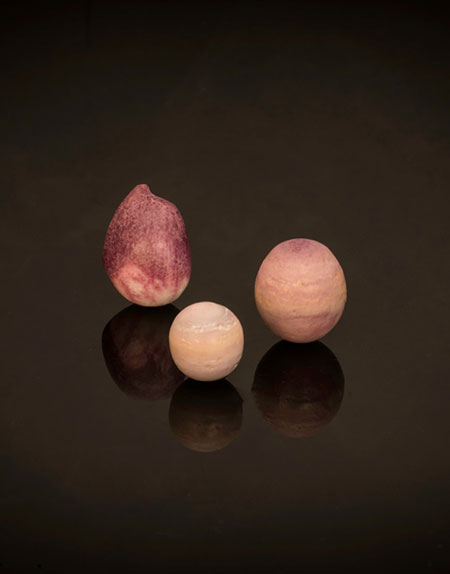 |
| 3 + 1. Above: this trio of pearls is from scallops. Below: this pearl is from a black-lipped oyster. (Photos: Mia Dixon) |
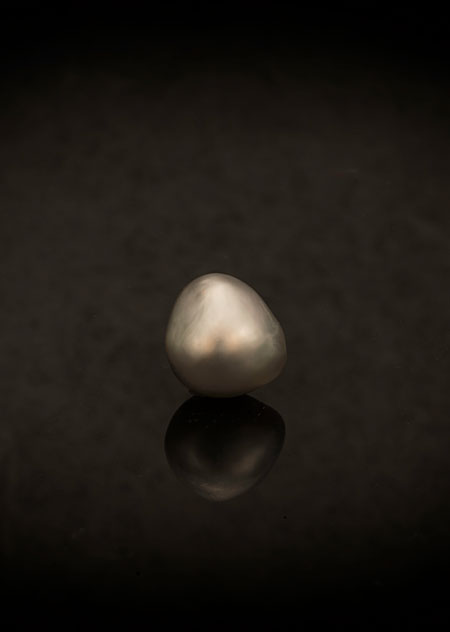 |
The fourth and most outstanding pearl is a 17.57-carat Calafia oyster pearl, also know as the La Paz oyster pearl and Pinctada mazatlanica. This species has been found from the Gulf of California all the way down to Peru. Its natural beauty rivals the finest of the cultured Tahitian pearls you see on the market, with a steely silver base featuring overtones of green, pink, blue…bringing it the appearance of peacock coloration. Price available upon request.
See our previously featured scallop pear. And compare with Radiant Orchid…Pantone Color of the Year 2014.
Interested? Select inventory numbers above, call or email us to inquire. [back to top]
November 18, 2013: Danburite from Tanzania
This month we feature not only a rare gem variety but also a gorgeous jewel. Danburite is not usually a gem that causes too much excitement, but this 51.29-carat screamer would catch the eye of any passerby. Reminiscent of a fine golden sapphire or an exotic Malawi yellow tourmaline, this danburite is sure to puzzle the gem connoisseur.
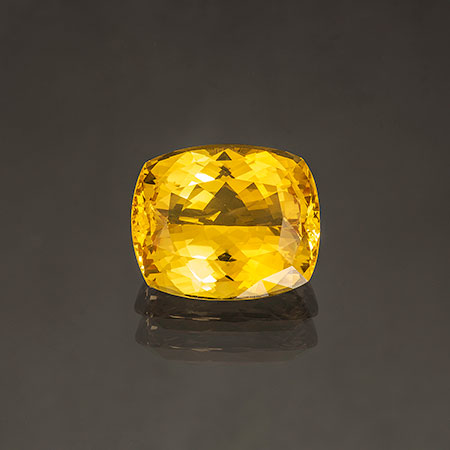 |
| Golden Danburite from Tanzania, 51.29 carats. Danburite is a crystalline mineral similar to topaz. Its chemical formula is CaB2(SiO4)2. It has a Mohs hardness of 7 to 7.5, so it’s very wearable. Ask for Inventory #21490. (Photo: Mia Dixon) |
Danburite is a silicate mineral found scattered throughout the planet in unassuming colors from pale yellow to brown. However, Tanzania is producing these neon yellow hues—color schemes completely unique to danburite. This intense golden yellow danburite comes to us from the Morogoro region in the Uluguru Mountains.
Interested? Call or email us to inquire. [back to top]
October 15, 2013: New Favorites
In the mind of a gem dealer or gem connoisseur, the favorite gem seems to be the next one. The thrill of unveiling a completely brand new stone is the fuel that keeps us pining for that ideal gem. That rush of the senses as you first lay eyes on a beautiful jewel is like no other. In this way the gem addiction rolls on and keep us wondering, Could there be another one even finer on the horizon? This one in front of me seems to be the finest, rarest, most colorful, but what else could lay in store, just waiting to be plucked from the Earth?
 |
| Circle of color. Here we have a 9.57-ct. peridot from Burma, a 11.83-ct. pale yellow star sapphire from Sri Lanka, a 2.53-ct. Mozambique ruby, a 2.03-ct. Madagasy blue sapphire and a 8.88-ct. Sri Lankan puroke star sapphire. Click to enlarge. (Photo: Mia Dixon) |
Being one of the biggest colored-stone houses in the U.S., we at Pala International are very fortunate to have new gemstones presented to us all the time. The mastermind behind Pala (Bill Larson) is even more fortunate to be able to travel the globe in search of the latest gemstones to enter the market. This month we feature a little sampling of Bill’s most recent finds in Thailand and Burma. A delightful array of colorful, exotic, and phenomenal jewels…. Enjoy!
Interested? Call or email us to inquire. [back to top]
September 17, 2013: Phenomenal Ruby and Chrysoberyl
Phenomenals seem to be making a subtle resurgence amongst gem connoisseurs. These colorful and magical jewels engage the senses and help us appreciate the dynamic chemistry and physics at work within the crystallized oddities. A feast for the eyes and a puzzle for the intellect.
 |
| The star: 5.85-carat Burmese ruby, 8.93 x 9.11 x 6.26 mm (Inv. #19983). The eye: Estimated over 20-carat Sri Lankan chrysoberyl 15.25 x 13.7 x 10.4 mm. Click to enlarge. (Photo: Mia Dixon) |
This Burmese star ruby exhibits a blazing, slightly pink, red hue with good translucency. On top of the exquisite color lies an exceptional asterism with six well-defined and positioned rays.
This cat’s eye seems to capture the best of a fine chrysoberyl. It displays a warm and pure milk-and-honey effect separated by a sharp white eye. This gem is also transparent, with only subtle internal graining tracing some of the structure. The stone is set in 18-karat gold with a precision bezel.
Interested? Select the inventory number above, call or email us to inquire. [back to top]
August 15, 2013: Red Beryl from Utah
This month we feature an exceptional red beryl from the Wah Wah Mountains of Utah. This fine blood-red jewel weighs in at 2.44 carats, which by red beryl standards is huge, especially in a fine quality piece. The red beryl crystals come out of the ground in small, mostly included elongated hexagonal prisms. It’s very rare to even find small gemmy sections with which to cut moderately clean stones.
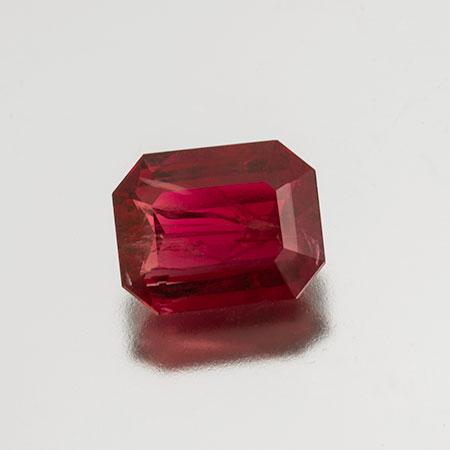 |
| Red beryl from Utah, 2.44 carats, 9.98 x 7.85 x 4.16 mm. Inventory #21250. (Photo: Mia Dixon) |
This particular gem was cut out of a crystal that Pala sold in the 1970s, which we recently bought back in the interest of using it as gem rough. Even though the crystal was very fine, the gem value far exceeded the specimen value. In the end, luckily we came out with a completely natural unoiled 2.44-carat emerald cut that would rival ruby for color and go way beyond, rarity-wise. Pala also purchased a few smaller crystals as well, so we have a good bit of a selection of these unique little red jewels right now.
Interested? Select the inventory number above, call or email us to inquire. [back to top]
July 16, 2013: Powellite from Tanzania
Powellite is more commonly seen in the mineral world, but these fine faceted stones bridged the gap into the gemstone side. These neon golden jewels are not only rare but radiate a beautiful glow. Stunning orange-yellow to greenish-yellow hues, with some dispersion, bringing them into a state that would be difficult for a sight ID. This is certainly some of the finest powellite we have ever seen, maybe even some of the finest the world has ever seen.
 |
| Powellite from Tanzania. Inventory #21167, 5.62-carat shield; Inventory #21168, 2.98-carat round; Inventory #21174, 2.90-carat trillion. Click to enlarge. (Photo: Mia Dixon) |
These unique powellites were discovered in the Mahenge region of Tanzania, near the deposit of fine pink and reds spinels we have all come to covet. Originally thought to be scheelite, the material later on was correctly identified as powellite. Powellite does form a solid solution series with scheelite, but powellite is a calcium molybdenum mineral whereas scheelite has a calcium tungsten makeup.
Interested? Select the inventory numbers above, call or email us to inquire.
For more on powellite, see Mindat.org. [back to top]
June 17, 2013: Burmese Star Sapphire
This month we feature an epic star sapphire from Burma. This massive chunk of corundum has found its way to Pala after being oriented and cut down to a shallow cabochon, leaving a large face-up appearance. It is polished to reveal a sharp and well formed star with an intense blue body color we associate with fine Burmese sapphires. This rare and unique combination of a fine star and pure blue color is a treat for the eye and and fun for the imagination. All the dynamic optics and chemistry are coming together in one stone to produce a fine world class specimen.
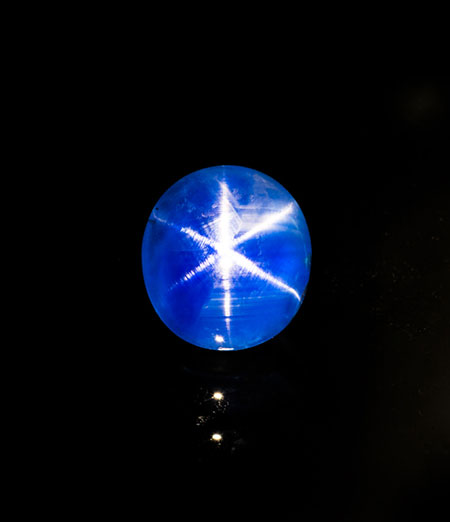 |
| Fine Burma blue star sapphire, 29.51 carats, 18.15 x 16.62 x 8.71 mm, Inventory #21218. (Photo: Mia Dixon) |
Interested? Call or email us to inquire. [back to top]
May 16, 2013: Spessartite from Nigeria
This month we feature a gargantuan spessartite garnet from Nigeria. Weighing in at 58.44 carats, this oversized jewel came to us through an estate collection recently. It probably was obtained between 2004 and 2005, when the Nigerian deposit was in full swing. The mining area in western Nigeria, Oyo State, produced by far the largest quantity of spessartites the world has seen. This massive deposit was known for quality as well, recovering many 10-carat-plus, near flawless mandarin colors, and a plethora of fine smaller sizes. Colors ranged from burnt reddish orange to the pure orange hues.
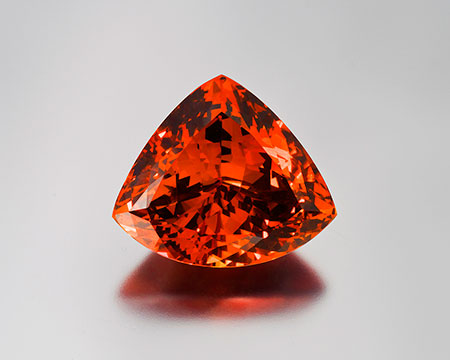 |
| Nigerian spessartite, 58.44 ct, 28.00 x 22.43 x 13.82 mm, Inventory #20641. (Photo: Mia Dixon) |
Pala International bought into one of the large parcels of rough back in 2004, and we are still supplying fine pieces in the 1 to 6-carat range. But since this epic find, which only lasted a few years, the mines have been exhausted and nothing has compared, causing the prices for fine orange spessartite to see a steady rise over the years. Our featured stone really shows the beauty of the material: deep orange hue and a unique modified trillion cut. Perfect for a museum or collector of the oversized gems.
Interested? Select the inventory number above, call or email us to inquire.
Ruby or Spinel?
For those of you who didn’t “cheat” by clicking on last month’s inventory items: the ruby is on the left. [back to top]
April 17, 2013: Ruby and Spinel
Can you pick out the ruby and spinel?
Throughout history ruby and spinel have gone from being considered the same gem, to ruby’s great rise as a precious stone and spinel’s fall in association with synthetics, on through to ruby’s continued ascent as one of the earth’s rarest and spinel’s attempt to find itself amongst the elite gemstones.
Ruby, of course, was one of the original gem varietals recognized by the first collectors of jewels, even categorizing spinel as a ruby simply because of its red hue. The foundation and provenance of ruby is ingrained into modern adornment, while spinel has waited patiently for its rise. Spinel has exploded onto the gem radar over the last few years as one of the next great collectable gems. One dealer described this rise as the pricing/value gap shrinking between ruby and spinel, by means of spinel gaining ground on ruby’s dominance.
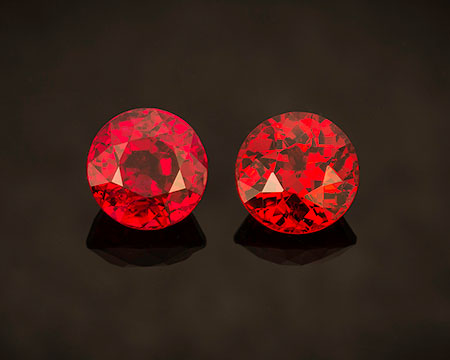 |
| Which is which? On the left, Inventory #19506. On the right, Inventory #20644. (Photo: Mia Dixon) |
Both have seen immense increases in value for larger, finer, completely natural varieties. In some cases it’s harder to source large red spinels than it is to find large rubies. The relationship between ruby and spinel runs deep and they continue to evolve together and separately in unique fashion.
Colors for ruby and spinel can overlap with a myriad of secondary hues, which give each stone a unique look. Fine ruby and spinel average in the range of 70–80% red and the remaining percentages can be filled in with pink, purple, orange or a mixer. Ruby still holds the most pure red the eye can perceive, in the “pigeon’s blood” realm, but in some cases spinel isn’t too far behind.
Interested? Select the inventory numbers above, call or email us to inquire. [back to top]
March 19, 2013: Tsavorite Garnet & Diamond Crystals
This month we feature some new purchases from the Tucson show.
The first feature is a tsavorite from Eastern Africa. This tsavorite is a step above the average, with an ideal medium tone and super saturation. So often tsavorite is overly dark in tone when you get into larger sizes. This one really is the Goldilocks of tsavorites…just the right color coming to us just at the right time as tsavorite has seen an uptick in demand. Tsavorites have a short history as a gem variety, only dating back to 1967 when the late Campbell Bridges discovered them in northern Tanzania. He later found them in southern Kenya in 1970, near Kenya’s Tsavo National Park, and coined the name tsavorite in 1974 along with Henry Platt of Tiffany & Co.
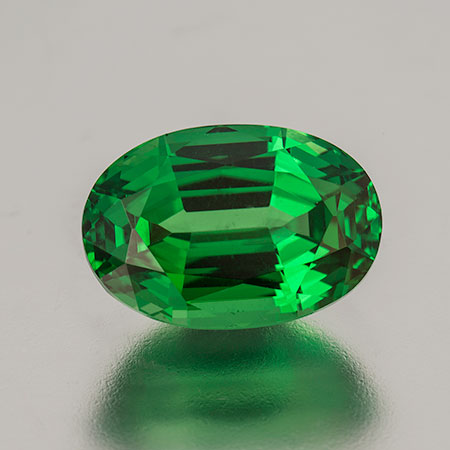 |
| Kenyan tsavorite, 10.94 x 7.36 x 5.69 mm, weighing 4.52 carats. Price available upon request. (Photo: Mia Dixon) |
This month’s second feature isn’t technically a faceted gem, but it certainly is a gem. We have seen rough diamond crystals popping up more and more in designer jewelry. These three unique gems would inspire design as well as entice the collector.
The first one is a 9.04-carat octahedron from The Democratic Republic of Congo. It displays perfect octahedral form with etched faces full of trigons and terraces. This crystal is a grayish white with no damage and good translucency. The second diamond is an unusual 7.8-carat double yellow macle from Russia, with an unusual Christmas tree-like formation from two penetrating macles. The top faces are like windows, looking into a fairly clean core with some internal crystals. This diamond is a light yellow, with no damage and very lustrous. The third is an extremely rare 3.44-carat white macle from Canada. It features perfect macle form with etched faces. The crystal is colorless and nearly flawless, showing great transparency. No damage; just a pristine jewel.
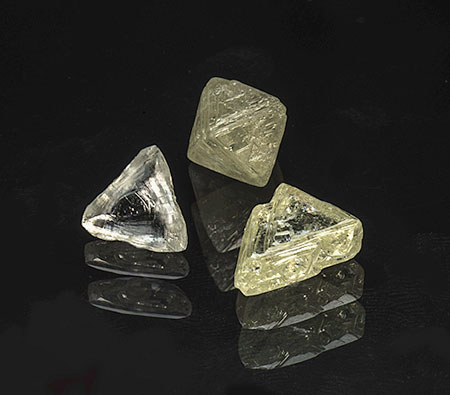 |
| Diamond Trio. See above for descriptions. Prices available upon request. (Photo: Mia Dixon) |
Interested? Call or email us to inquire.
[back to top]
February 18, 2013: Red Beryl from the Ruby Violet Claims
This month’s featured stone, without a doubt, has to be red beryl. With the gemstone portion of the Tucson Gem and Mineral Show just having been completed, we found that red beryl was the most sought-after and asked-for stone of our show.
With only one recognized gem-producing locality—in the Wah Wah region of Utah—this bixbite variety of beryl is highly valued as a rare acquisition to gemstone collectors all over the world.
 |
| Ruby Violet: ruby red. Red beryl from Wah Wah Mountains, Utah, 2.74 ct, 9.0 x 7.0 mm. Note that this particular stone has been sold. Click to enlarge. (Photo: Mia Dixon) |
In 1904, red beryl first was discovered at Topaz Cove, Juab County, Utah; the material mostly was not gemmy. Maynard Bixby was the head of this early mining project and in honor of Mr. Bixby, red beryl’s mineral name “bixbite” was conferred (not to be confused with bixbyite, also named for Bixby). This discovery was the beginning of what would prove to be one of the most important finds in U.S. gem mining history.
In 1958, gem-quality crystals were found 100 miles south of Juab County. It was in the Wah Wah Mountains of Beaver County that Lamar Hodges staked his claim. As a matter of fact, he had twelve claims that, throughout his mining career, were worked by him, various other family members and other sub-lease groups. These claims were known as the “Ruby Violet Claims.”
Although Hodges’s original desire was to prospect for uranium, he eventually deserted that plan, putting the Ruby Violet Claims project in its place. The discovery of gem-quality red beryl would launch this still relatively unknown variety of beryl on the road to legitimacy. This “red beryl” would forever stand in the “rare” category of “collection quality” gems and mineral specimens.
In 1967, the Rex Harris family would purchase the mining rights. The paltry amount of $8,000 seemed like a lot of money then. The mining started slowly, then mechanization eventually had to be established. Eventually the mine would be functioning at full capacity, producing upwards of 1,500 tons of material per year.
Rex’s daughter, Tina Nielson, states that the Harris family is in control of the only access and production available, and at present there is no material being commercially excavated for sale to the market due to negotiations in the works for the possible sale to a particular unnamed party.
At the Tucson show this year, it was lovely revisiting red beryl with our established clients and other enthusiastic trade members. It was fun to see how many visitors wanted to view the beautiful samples of ruby-like material, with selected pieces resembling lovely Burmese ruby with its pink secondary.
All of us at Pala love the rare and delicious, and take constant joy in sharing our knowledge and enthusiasm with all of you. Thank you for visiting us at Tucson and on the Web. With fond regards,
Gabrièl Mattice, G.G.
Fine Stone Acquisitions and Sales
Interested in other stones like this? Due to a limited amount of material on the market, we cannot promise that this will be available. Call or email us to inquire.
January 16, 2013: Amazonite Feldspar
This month we feature a gem usually found on the mineral side of the business. Amazonite feldspar is found in many pegmatites around the globe, ideally showing beautiful prismatic bluish-green crystals. These amazonite crystals are almost always milky and opaque, but occasionally you find clean enough sections to facet. Amazonite is a gemological term that can apply to green and bluish-green feldspars. As a gemological term amazonite has been applied to green feldspars (both microcline and orthoclase) recognized since the early 1900s (Bauer: Precious stones..., 1904, L. J. Spencer translation).
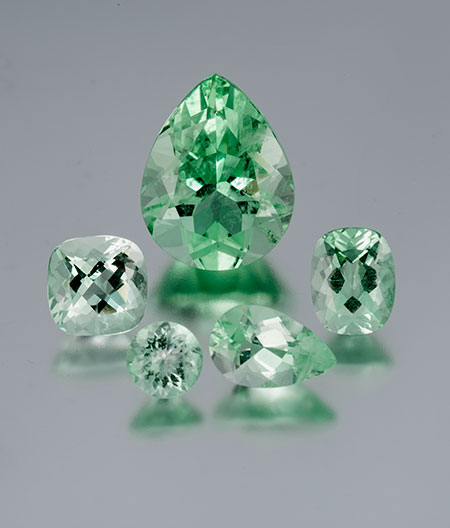 |
| Amazonite feldspar suite: above, 12.19-carat pear shape, 18 x 14 x 10 mm; below, left to right, 2.79-carat cushion, 0.97-carat round, 2.17-carat pear shape, 2.22-carat cushion. (Photo: Mia Dixon) |
Pala acquired a rough parcel of some of these exceptional amazonites, and had them tested by Prof. George Rossman up at Caltech to make sure they were 100% natural. These gems were cut from a parcel that can be traced back to a gem pocket in Luc Yen, Vietnam. This pocket was uncovered in 1997 and contained many high quality tourmaline crystals along with some of these gemmy amazonite feldspars. The color is reminiscent of neon-green paraiba tourmaline, showing fluorescent-like properties in daylight. This is fairly common mineral transformed into extremely rare and beautiful faceted gems.
Interested? Call or email us to inquire. [back to top]
Pala International’s Featured Stones – 2012
December 17, 2012: Sapphire Extravaganza
Blue and yellow and orange—Oh my! This month we feature a melange of sapphires. Sapphires are found in all colors of the rainbow and many mixtures in between.
 |
| Click to enlarge. (Photo: Mia Dixon) |
From the common ruby-red and sapphire-blue, to the more unusual purple color-change and blended orange and pink, sapphires fill the color wheel with endless possibilities. Clockwise from top: 5.66-carat natural pear-shape orange-red from Malawi (Inv. #20451), 25.51-carat fancy canary-yellow in a brilliant cushion cut (#20615), 10.08-carat violet-purple oval with lots of life (#20452). 4.03-carat purply pink one from Madagascar (#14626), 4.77-carat fine natural Sri Lankan blue (#20081), unusual 10.09-carat pumpkin orange (#20356), 11.5-carat pastel violet-blue (#19503). Center: 21.36-carat icy-blue oval brilliant-cut from Sri Lanka (#20453).
Interested? Call or email us to inquire. [back to top]
November 15, 2012: Imperial Topaz from Brazil
This month we feature an exceptional imperial topaz from Ouro Preto, Brazil. We normally focus just on the loose gem, but this exquisite piece of jewelry just fell in our lap out of an estate collection. We couldn’t help but present the piece in all its glory, from the finely crafted platinum mounting to the fine white diamonds, all accentuating the sherry-colored jewel that is the centerpiece. This imperial not only has the golden hues but spills over into the the sherry and cherry spectrum, which defines it as one of the most sought-after colors. Since these unusual colors only really come from a small area in Brazil, production is limited and demand has always been strong, making it difficult for us to fill our clients’ needs. This is a great opportunity to pick up one of Brazil’s little treasures.
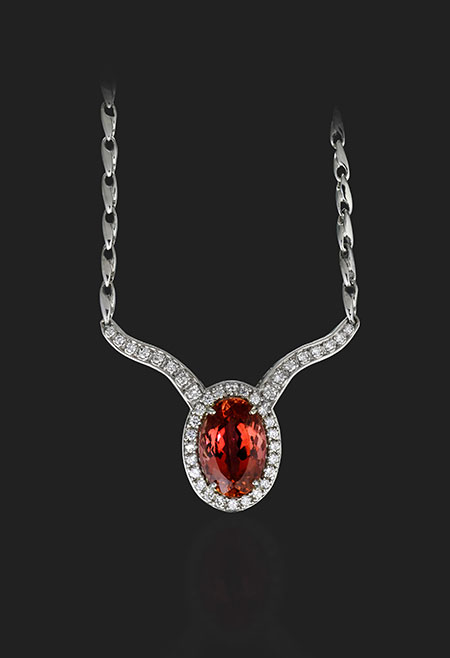 |
| Imperial topaz necklace. Topaz 17.54 carats, 19.08 x 12.88 x 8.99 mm, GIA certified. Diamonds 2.20 carats, VS clarity, F color. Platinum mounting. Price on request. (Photo: Orassa Weldon) |
Interested? Call or email us to inquire. [back to top]
October 16, 2012: Spinels from Abroad
The spinel family continues its campaign into the world as its color cornucopia and exquisite properties continue to impress. As the rarity and beauty of the spinel varietals disseminate, the collectors seem to be acquiring a taste for this rising phoenix. We in the trade have always had a love for spinels, but now it seems the secret is out. We can’t seem to keep up with the requests for fine reds and blues. So we are constantly scouring old collections and keeping an eye on material coming out of the major spinel-producing regions, mainly southeast Asia and eastern Africa.
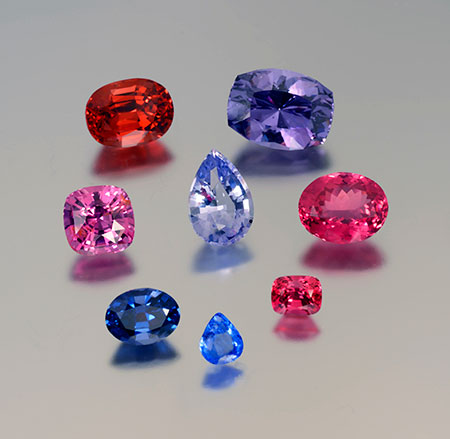 |
| Spinel spectacle: Clockwise from top left, 8.07-ct orangey red Burma oval (Inv. #20439), 12.37-ct lavender Burma cushion (#20436), 7.11-ct pinkish red Tanzania oval (#20468), 1.8-ct flame red Burma cushion, 1.26-ct cobalt blue Vietnam pear shape (#20502), 3.73-ct cobalt blue Burma oval (#20467), 6.14-ct purply pink Tajikistan cushion (#17979). Center, 5.90-ct violet blue Vietnam pear shape (#20437). |
We had the great fortune recently to buy a large gem collection filled with a variety of spinels, in an array of colors and sizes. Bill Larson also is just back from another buying trip to Bangkok and Burma. Above, we offer just a few highlights from these purchases…. Enjoy!
Interested? Select the inventory numbers above, call or email us to inquire.
See also this May 2011 article on spinel from Rapaport that quotes Pala’s Jason Stephenson. [back to top]
September 19, 2012: Purple Scapolite from Tanzania
This month we feature a purple scapolite from Tanzania.
This scapolite has a phenomenal purple hue, reminiscent of the finest amethyst, one of the most saturated and pure colors we have seen here at Pala. This scapolite is virtually flawless and has an exquisite trilliant cut with a very symmetrical brilliant-style faceting. Most scapolite you see from Tanzania is more often in the yellow color spectrum, but every once in a while an intense purple, like the one seen below, is produced. This gem is from an older collection Pala bought recently, so it’s hard to pinpoint a specific locality, but it’s probably from the Morogoro region in Tanzania. Other fine purple scapolites have been coming out of China and Afghanistan more recently.
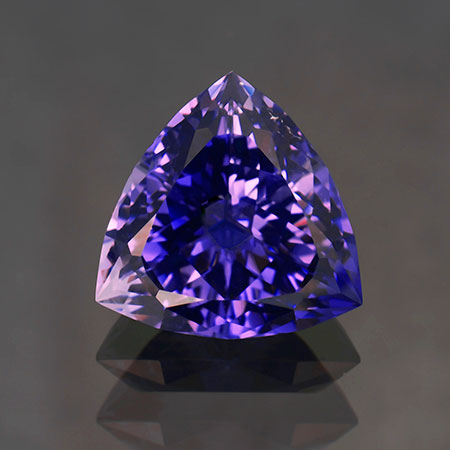 |
| Purple scapolite, 15.26 carats, about 17.3 mm. (Photo: Mia Dixon) |
Interested? Call or email us to inquire. [back to top]
August 17, 2012: Azurite-Malachite
This month we feature some colorful free-form cabochons with a mix of azurite and malachite. This material was mined pre-1960s from Bisbee, Arizona, and purchased years ago by Pala International as specimens, then cut more recently by Bud Standley. Similar specimens have been mined in Morenci, AZ, and more recently at the Milpillas Mine in Sonora, Mexico.
 |
| Azurite-Malachite. Various shapes and sizes. For reference the bullet shaped stone at lower right is 11 ct, 18.66 x 14 x 5.11 mm, Inventory #16149. Click to enlarge. (Photo: Wimon Manorotkul) |
The material features intricate flow and growth patterns, bands of alternating dark and light blues and greens. And brilliant cornflower to cobalt-blue azurite showing some bullseye patterns left after botriyoidal formations have been cross-cut and polished. Then, as if bubbling right out of the blue, radiating bands of malachite create an exquisite contrast. Two copper minerals are blended together to make a truly unique and beautiful gem.
Pala International has an extensive selection of azurite and malachite in specimens, rough, cabochons and free-form.
Interested? Call or email us to inquire. [back to top]
July 16, 2012: Brazilian Tourmaline!
This month we feature a couple of complimentary tourmalines in the teal spectrum. Tourmalines have been a jewel of interest for at least half a millennium, being mined all around the globe in every color imaginable. The range of colors, big sizes and clean nature has made tourmaline a staple of gem and jewelry connoisseurs worldwide.
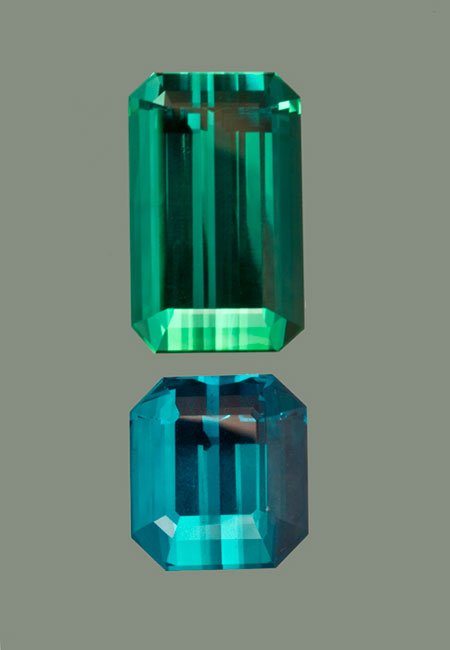 |
| Teal Tourmaline: 24.05-ct blue-green emerald cut, 20 x 12.1 x 10.5 mm, Inv. #20351; 15.49-ct indicolite emerald cut, 14.23 x 12.95 x 10.5 8mm, Inv. #15993. (Photo Mia Dixon) |
These two emerald-cut beauties seem to mix well with the teal green and teal blue hues exhibiting aquatic tones. The green one was a recent purchase from Brazil and the indicolite has been in inventory for a few years, most likely from Brazil as well.
Interested? Call or email us to inquire. [back to top]
June 14, 2012: Sri Lankan Purple Star Sapphire & Chrome Tourmaline from Tanzania
As the months roll on here at Pala International, it becomes increasingly harder to come up with a suitable featured stone. We have logged about 100 featured items so far on Palagems.com. Sure, there are thousands of gem varieties and a plethora of colors bubbling out from our planet. However, to find a truly exceptional crystal created by Mother Earth, found by Man, and cut into a rare and beautiful gem worthy of display and intrigue... is an exercise in patience.
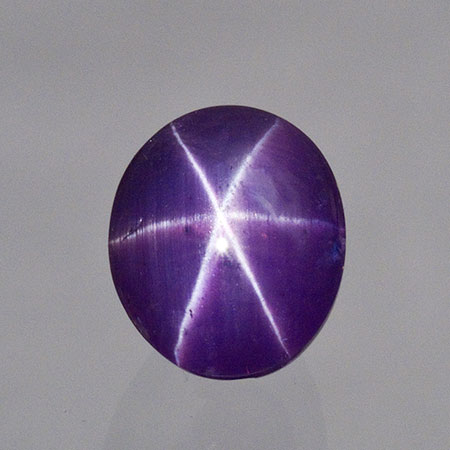 |
| Grape Asterism, 6.32 carats, 9.42 x 8.02 x 7.52 mm, Inventory #20268. (Photo Mia Dixon) |
This month we feature two new gems we purchased while at the Las Vegas show. First, a unique purple star sapphire from Sri Lanka. It’s an exceptionally fine star with sharp, full rays centered perfectly over the stone. The unique property is the grape-juice purple color that give the gem a candy-like feel.
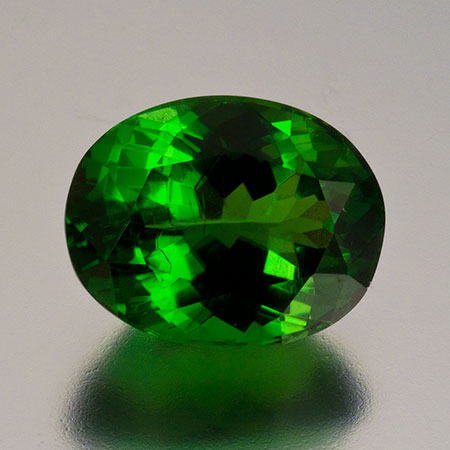 |
| Chrometastic, 5.75 carats, 12.33 x 9.7 x 7.08 mm, Inventory #20267. (Photo Mia Dixon) |
Another exceptional find in Vegas was this intense chrome tourmaline from Tanzania. It features a highly saturated evergreen hue with a pleasant medium-dark tone, brighter than most chrome tourmalines we normally see, since they can tend to be overly dark.
Interested? Call or email us to inquire.
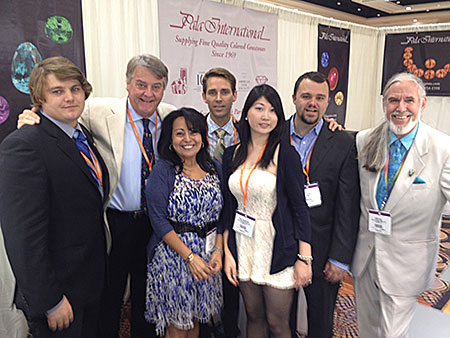 |
| Pala people at this year’s Las Vegas show. From left, Carl Larson, Bill Larson, Gabrièl Mattice, Jason Stephenson, Rika Nakamura, Will Larson, Josh Hall. (Photo: Rebecca Boyajian) |
[back to top]
May 17, 2012: Tanzanian Sunstone & Tanzanite
Tanzania has been a hot spot for many gem varieties lately. Ruby from Winza, spinel from Mahenge, prase opal from Mt. Iyobo, sunstone from Masai Boma, and of course tanzanite from Merelani. Along with Bill and Will Larson’s trip to the Arusha International Gem, Jewelry & Minerals Fair they were able to buy a few select things. This month we feature a wild sunstone and unusual tanzanite to be plucked from the Tanzanian soil recently.
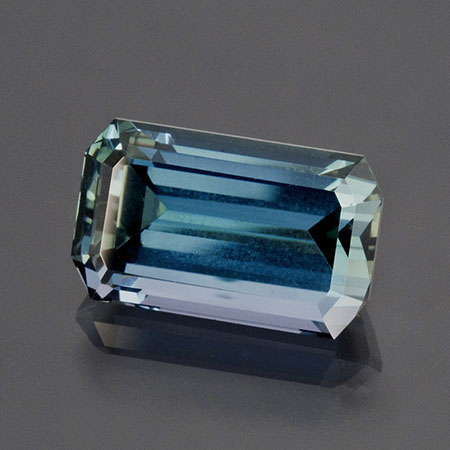 |
| Indigo blue tanzanite, 4.36 carats, 11.3 x 6.8 x 5.8 mm. (Photo: Mia Dixon) |
Merelani has continued to produce the world’s only source of gem quality tanzanite. Many millions of carats have found their way into the markets around the world since the late 1970s, but it seems the deposit has taken a turn and has been producing some more unusual jewels. We definitely have seen finer crystals and specimens being preserved as well as a variety of colors produced. We featured an amazing purple-pink faceted tanzanite a couple months back and now we have an intense steely blue-green emerald-cut that demands a second look. In a group of tanzanite, this unusual color stood out and earned a place in the Pala inventory.
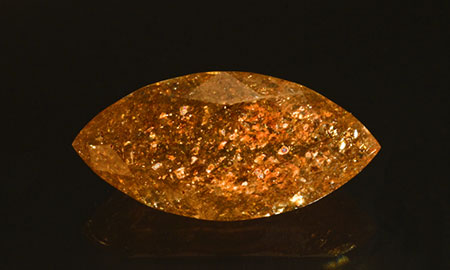 |
| Tanzanian sunstone, 19.53 carats, 27.50 x 13.47 x 10.27 mm. Inventory #20200. (Photo: Mia Dixon) |
The sunstone being produced out of Tanzania is very sporadic, with maybe a few kilos being unearthed occasionally. Most of the material seems to be heavily included and fractured. But every once in a while a large, fine stone like this one makes it out. This 19-carat marquise-cut beauty has a metallic copper sheen at first glance. Then, as you narrow in on the inclusions and start to rotate… the gem comes alive, throwing a full spectrum of colors from within.
See our previous featured Tanzanian sunstone here.
Interested? Call or email us to inquire. [back to top]
April 16, 2012: Burmese Spinel & Sri Lankan Sinhalite
This month we feature a couple of new jewels Bill was able to buy on a recent trip to Thailand and Burma. Other highlights included natural rubies from Mozambique, natural blue sapphires from Sri Lanka and Madagascar, blue zircon from Cambodia, and many other rare ones like hackmanite and amber from Burma.
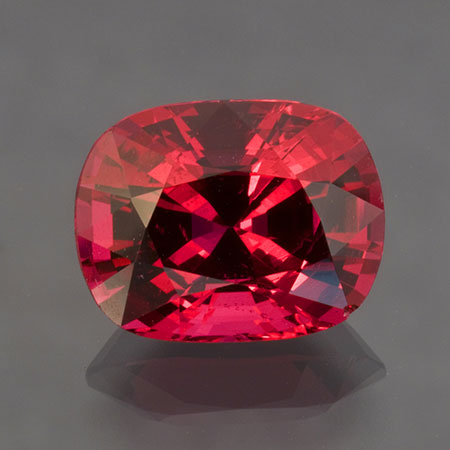 |
| Red spinel from Burma, 3.23 ct, 9.78 x 7.66 x 5.92 mm. Ask for Inventory #20075. (Photo: Mia Dixon) |
Red spinel has been in high demand recently, while the supply is slow to fill the increasing interest. This intense orangey-red spinel exhibits the highly saturated reds that many collectors are looking for. The Pala team is always happy to welcome another spinel into our family even though they seem to move out fairly quickly. Enjoy this one while it lasts.
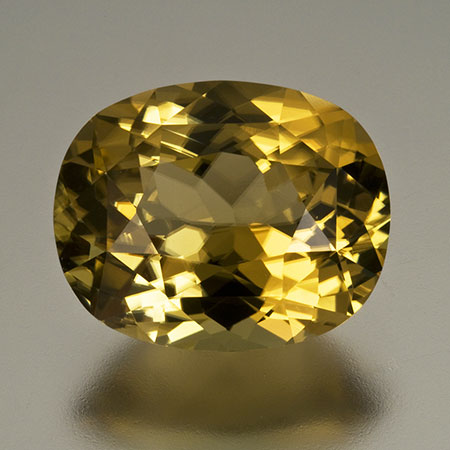 |
| Golden sinhalite from Sri Lanka, 14.36 x 11.64 x 7.93 mm. Inventory #20073. (Photo: Mia Dixon) |
Sinhalite was first identified as a new mineral species in 1952, previously thought to be a brown peridot because of its similar properties and color. Sinhalite is in the borate mineral group and is formed in metamorphic environments. This golden sinhalite is exceptional in size and color for this unusual species. Yet another exquisite gem to be plucked from the mineral-rich lands of Sri Lanka.
Interested? Select the invtentory numbers above, call or email us to inquire. [back to top]
March 15, 2012: Ethiopian Opals
In recent times play-of-color opal has been discovered in Ethiopia’s Shewa Province (1994) and Wollo Province (2008). The Shewa material turned out to be very unstable and unsuitable for jewelry, while the Wollo opal was more stable and exhibited an unusual property know as hydrophane, i.e., the latter opals came out of the ground very porous, possessing the ability to absorb water. The rich rainbow of colors and transparency are a recipe for beautiful gems. The Wollo opal has the most similarities to the Mexican fire and water opals with play-of-color.
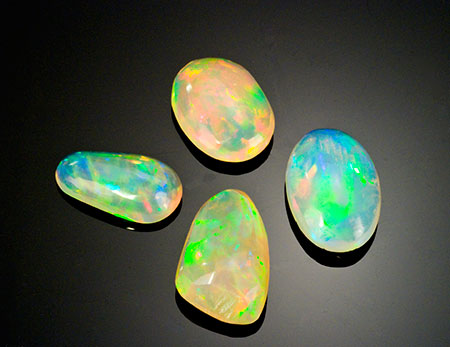 |
| Thirsty. Wollo opals from Ethiopia show a bounty of colors: clockwise from top, 2.75 ct, Inv. #19278; 3.38 ct, Inv. #19407; 3.4 ct, Inv. #19274; 1.86 ct, Inv. #19284. (Photo: Mia Dixon) |
Interested? Select inventory numbers above, call or email us to inquire. [back to top]
February 15, 2012: Purple-Pink Zoisite from Tanzania
This month we feature a purple-pink zoisite from Tanzania. The Merelani mines have produced large amounts of blue-to-purple tanzanite since its original discovery in 1968. The mines also have produced gem quartz, diopside, prehnite and calcite. Occasionally pink and purple zoisite (often referred to in the trade as pink tanzanite) is unearthed in small, localized pockets, but production of these colors is very limited.
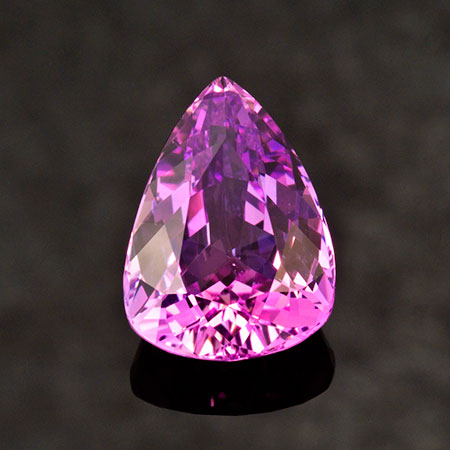 |
| Purple-pink zoisite, 4.28 carats, 12.18 x 8.89 x 5.61 mm, ask for Inventory #19821. (Photo: Mia Dixon) |
When the team at Pala first saw the intensity and brilliance of this jewel we figured it was a spinel or kunzite. We were all shocked to hear it was in fact a natural zoisite, and the color was unlike any we had seen in the past. Apparently the small series of pockets that produced this purple-pink color only yielded a few pieces of facetable rough. Luckily we were able to score this 4.28-carat gem before the AGTA show began. Pala’s supplier was quite confident that this stone was perhaps the finest single gem produced from these pockets.
Interested? Call or email us to inquire. [back to top]
January 18, 2012: Brazilian Paraiba
This month we feature a set of tourmalines from the original mining area in Brazil. The pegmatite that produced these copper-bearing beauties spans the states of Paraîba and Rio Grande do Norte. Distinguishing which side of the border an individual stone was mined from has been trying, even for the most highly equipped laboratories around the world.
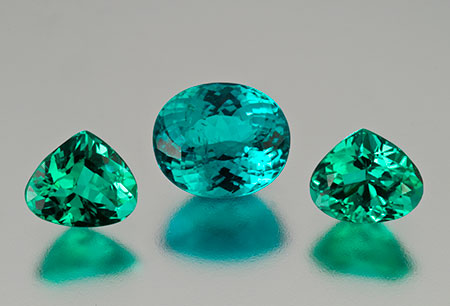 |
| Brazilian Paraiba. Blue green center oval, 2.8 carats, 9.22 x 7.8 x 5.57 mm, and the green teardrop pair, 2.51 carats, 7.5 x 6.3 x 4 mm. (Photo: Mia Dixon) |
Whichever state these paraibas were actually mined from seems irrelevant as you take in the light and color that is unlike any other gem on the planet. Dazzling neon hues of blue and green in a perfect medium tone, with saturation tilting the scales of what’s possible for a natural gemstone.
Throughout the year Pala is fortunate enough to have a handful of true Brazilian paraibas pass through our doors even though the mines have been exhausted for several years now. We also have a good supply of the now depleted Mozambique deposit. Contact us or check our inventory to see what’s available.
Interested? Call or email us to inquire. [back to top]
See other:
Pala International’s Featured Stones – 2011
Featured in Pala’s Gem News.
December 16, 2011: Star Moonstone from Burma
A phenomenal phenomenon. To understand what properties are at work here, we must start with feldspar, the most common mineral group found in the earth’s crust. Then we bounce light off the prism-like features that make up the crystalline structure within this gem and we illuminate the adularescent effect: a glowing, billowing light that seems to dance across the moonstone. As these internal structures start to line up in a repetitive pattern the light begins to concentrate and is refracted back out upon the surface of the stone as lines that form rays of the star. This is a common mineral with uncommon symmetry, filtering and focusing the light in a brilliant interface. The bottom half of the moonstone shows three rays of the star and a golden adularescence, while the upper half exhibits some of the blue sheen and traces of the star formation. The pattern morphs continuously as you move the light source above. The adularescence and star seems to float above the surface of the moonstone like the glow of a candle.
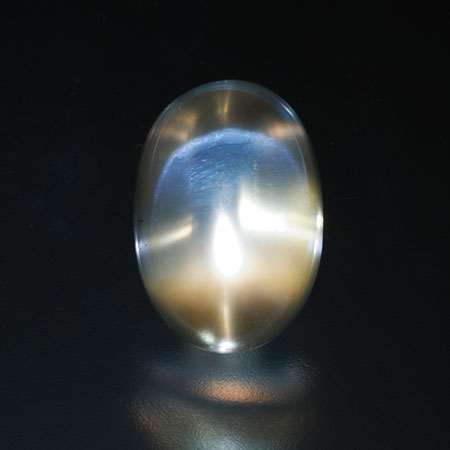 |
| Star from the East. Star moonstone from Burma, 4.57 carats, 13.24 x 9.15 x 5.87 mm. Inventory #18905. (Photo: Mia Dixon) |
Interested? Select the inventory number above, call or email us to inquire. [back to top]
November 17, 2011: Corundum Cornucopia
This month we feature the bounty of the corundum family: all-natural Mozambique ruby, Madagascar blue sapphire, and a Madagascar purple sapphire. This is a beautifully vivid trio exhibiting the best in each class. Just some of the freshly picked gems from Bill and Will’s recent trip to the Far East.
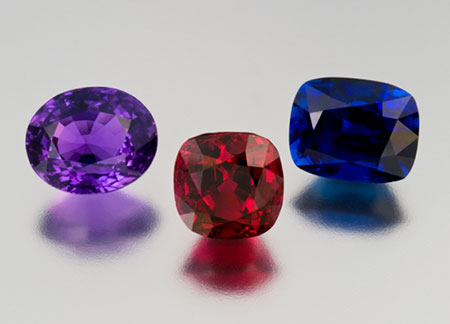 |
| Tempting trio. Purple sapphire (Inventory #19551), ruby (Inventory #19548), blue sapphire (Inventory #19550). (Photo: Mia Dixon) |
The 3.59-carat ruby comes to us from Mozambique, where some of the finest natural reds are being produced currently. Reminiscent of the Burma pigeon’s-blood red color, this dark and intense crimson stone illuminates in the daylight.
The 3.65-carat blue sapphire was mined in Ilakaka or perhaps in Andranondambo, Madagascar, once again where the finest of natural blues seem to bubbling up lately. It features rich, Kashmir-like blue with deep saturation and a classic cushion cut.
The 3.70-carat natural purple sapphire was most likely mined in Ilakaka, Madagascar, famous for fancy colors. This unique sapphire is quite amazing, shifting from purple to violet in different light sources. Vivid color raises the purity to levels rarely seen in sapphire.
For information on the gemstones of Madagascar, see “Sorcerers & Sapphires” by Richard W. Hughes, Vincent Pardieu and Dana Schorr.
Interested? Select the inventory numbers above, call, or email us to inquire. [back to top]
October 18, 2011: Hessonite Garnet
This month we feature a hessonite garnet from Sri Lanka.
Hessonite is a variety of the grossular species in the garnet group. Also referred to as “the cinnamon stone” due to its golden orange hue, hessonite takes on the color of fall and the upcoming Halloween spirit. Hessonite is known for its heat wave effect or roiled appearance internally which can be diagnostic for the variety.
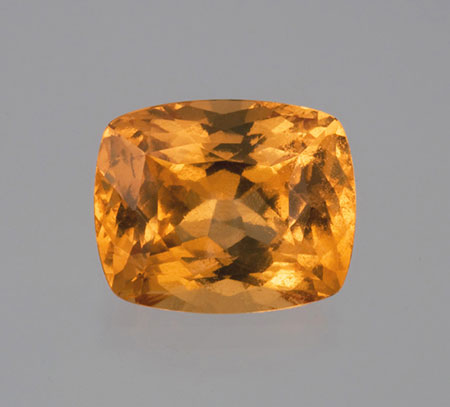 |
| Cinnamon stone, from Sri Lanka, 23.21 ct, 18.02 x 14.85 x 10.81 mm. Inventory #13351. (Photo Mia Dixon) |
This 23.21-carat hessonite is definitely large for its kind and comes to life with a beautifully faceted cushion cut. An unusual beauty, suited for the rare garnet collector or a specimen to work into a fall fashion piece of jewelry.
Check out all the wild varieties of garnet we have at Pala—from andradite, pyrope, spessartite and rhodolite—here and begin your search.
Interested? Select the inventory number above, call, or email us to inquire. [back to top]
September 15, 2011: Amber from Burma
When most of us hear amber we conjure up visions of some amorphous blobs of honey-colored sap with insects trapped inside. Usually this is the state in which you find amber, but during Pala International president Bill Larson’s last trip into Burma he found that the Burmese were faceting this hardened tree goo.
 |
| Snappy sap. A choice selection of Burmese faceted amber: Inventory #19335 3.25 ct cushion; 19332 3.85 ct emerald cut; 19337 2.75 ct cushion; 19338 4.0 ct emerald cut. Click to enlarge. (Photo Mia Dixon) |
It was kind of a sweet surprise to see these colorful, faceted golden ambers, a new twist on a fairly common gem. Another interesting property is that the specific gravity of amber is so low, a 4-carat gem actually appears to be what we would normally consider a 10-carat stone. Large, light-weight, honey amber jewels…. Fun for the whole family.
See our selection of amber here.
Interested? Select the inventory numbers above, call, or email us to inquire. [back to top]
August 17, 2011: Cat’s Eye Sillimanite from India
This month we feature an unusual gem variety with a phenomenal property. Sillimanite, aka fibrolite, was named after Benjamin Silliman, a professor of chemistry and geology at Yale University, in 1824. Sillimanite is an aluminum silicate and is closely related to andalusite and kyanite.
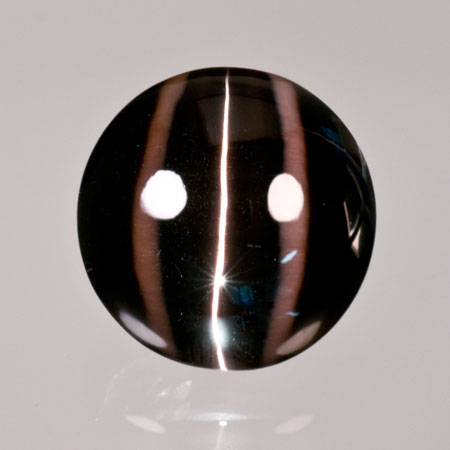 |
| Sharp cat’s eye sillimanite, 63.15 carats, 22.71 x 22.40 x 13.93 mm. Every light creates an eye; notice the thin white eye in the middle and the thick mauve bands outside. Inventory #19227. (Photo: Jason Stephenson) |
This cat’s eye sillimanite exhibits an exceptionally sharp white eye on a thick black base color. This contrast makes for a dramatic specimen. Weighing in at 63.15 carats, the piece also carries an impressive size in a perfectly round 22-millimeter diameter.
This is a great gem for cat’s eye collectors or folks who just look to go big. Many forms of sillimanite are found around the globe, but the largest and finest cat’s eyes come from Orissa in India.
Interested? Select the inventory number above, call, or email us to inquire. [back to top]
July 14, 2011: Paraiba Tourmaline from Mozambique
This month we feature an elegant suite of paraiba tourmaline from Mozambique. With its beautiful array of colors, it exhibits all the hues produced by this unique deposit in Nampula province, in western Mozambique.
 |
| Playful colors of paraiba from Mozambique: 12 pieces, 30.66 carats. Click to enlarge. (Photo: Mia Dixon) |
From purples to lavender, mints to evergreen, and teal to Caribbean blues, this neon color palette is unique to only three deposits on the planet where copper has entered the melt and produced theses fluorescent gems. From the original find in Brazil, then across the Atlantic to Nigeria, and then finally across the African continent to Mozambique, paraiba tourmaline has mesmerized gem collectors world wide. The deposit in Mozambique is producing very little these days and seems to be on its last breath, making these stones increasingly rare.
The demand for paraiba is still very strong in the market, and we cannot satisfy the appetite for many of our clients because there simply aren’t enough stones available. This progression of new finds and waning production seem to follow the natural punctuation of gem deposits—here and then gone—and so we hope you are left with one paraiba in your hand before the music stops.
Interested? Call, or email us to inquire.
Take a look to see what is still available in Pala inventory. And see our article on the Mozambique discovery. [back to top]
June 17, 2011: Sri Lankan Green Zircon
This month we feature an unusual green variety of zircon from Sri Lanka that glows with intensity. The substantial size of this zircon also adds to the rarity. It features a luscious evergreen hue and a pleasing antique cushion cut.
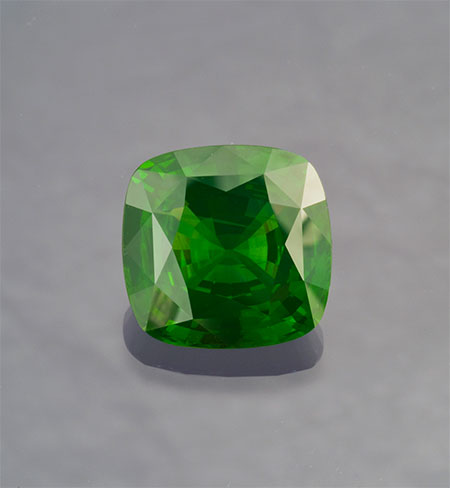 |
| Wide awake. Green zircon, 20.85 carats, cushion cut, 16.15 x 15.80 x 8.79 mm. This stone has been sold. (Photo: Mia Dixon) |
In zircon, a natural substitution of the element zirconium with uranium and thorium atoms causes damage to the crystal structure—known as metamictization—giving the material what some call a “sleepy” appearance as well as causing green coloring. Zircon that has been affected by metamictization is known as “low zircon,” but we have only the highest regard for this month’s gem, which exhibits lovely clarity and color, and perhaps a “stifled yawn.” A rare, beautiful, and intriguing gem sure to attract your attention.
Interested? Select the inventory number above, call, or email us to inquire.
For more than you ever wanted to know about metamictization, see this American Mineralogist article and also this Mindat.org entry on zircon. [back to top]
May 17, 2011: Lion’s Paw Pearl from Baja
Continuing with last month’s theme of natural pearls we bring you another rare beauty from the sea—this time from the lion’s paw scallop. The fan-shaped mollusk from the Pectinidae family (species Nodipecten subnodosus), known locally off of Baja California as Mano de León, produces natural colored pearls from white to pink to intense purple.
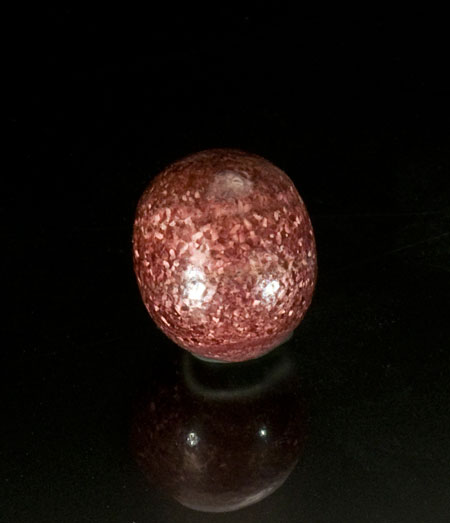 |
| Scallop pearl, 5.90 carats 10.21 x 8.75 mm. Inventory #19240. (Photos: Jason Stephenson) |
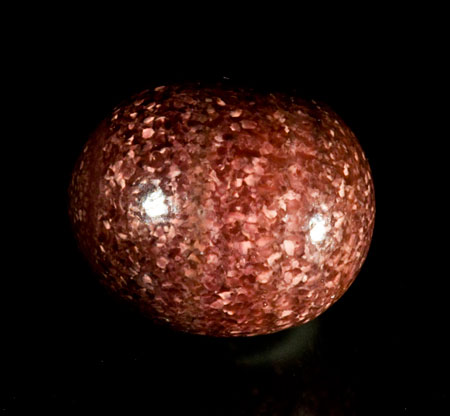 |
This month we feature a scallop pearl of the burgundy-colored variety, with a striking pixilated-type pattern. Random brushstrokes of white, pink and purple make for an almost 3-D effect when rotated in the sun. The light dances off these platelets of color like the pinfire effect in opal, or a miniature chatoyancy—definitely an interesting phenomenon.
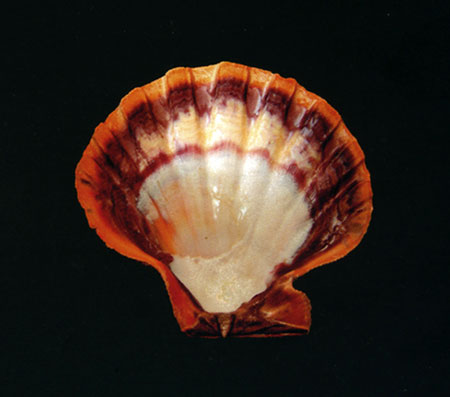 |
| Tie-dye lion’s paw. The scallop Nodipecten subnodosus displays rounded convex projections shaped like a lion’s digits. Only rarely does this bivalve produce its calcareous (non-nacreous) pearls, such as this month’s feature. The image above comes from Pearls by Hubert Bari and David Lam. (Photo: Hubert Bari) |
For more information on these pearls, see Scarratt, K. and Hänni, H. A., “Pearls from the Lion’s Paw Scallop,” Journal of Gemmology, Vol. 24 (2004), No. 4, 193–203.
Interested? Select the inventory number above, call, or email us to inquire. [back to top]
April 14, 2011: Natural Abalone Pearls
This month we feature something a little out of the ordinary—a local Californian/Mexican treat. Pala has found a new supplier of these ocean jewels and it has been exciting to see all the freeform shapes and iridescent colors nature can conjure up. Greens, blues, pinks, purples—oh my! These colorful metallic looking concretions spark in the viewer a wonder of formation and inspire design, as many shapes are personified or reminiscent of earthly objects. For instance, the featured piece below takes on the form of a hot air balloon or a tropical sea creature.
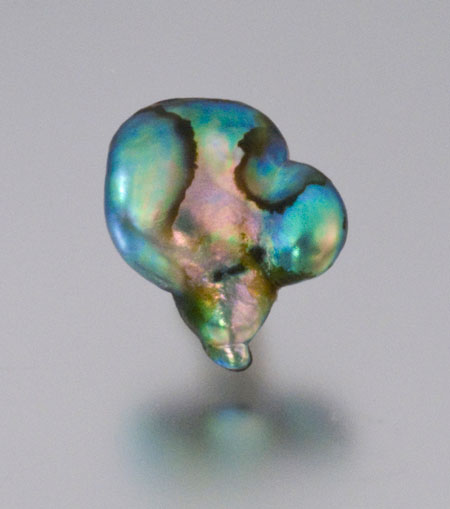 |
| Water balloon. This 11.82-carat freeform natural abalone pearl measures 20 x 17 x 7 mm. (Photo: Jason Stephenson) |
Abalone shells were once completely legal to pry from the ocean floor. For divers, all it took was some scuba gear, some hardware, and a shark radar. Today most of these abalone species are becoming endangered and many restrictions apply on fishing. Fortunately most of the abalone taken from the sea are harvested legally, but an estimated 12% are poached illegally. Natural abalone are estimated to produce a pearl only in one out of 50,000 cases, and it can take as long as eight to ten years to form a pearl. Farm raised abalone can produce a pearl in a shorter, two-to-three-year period.
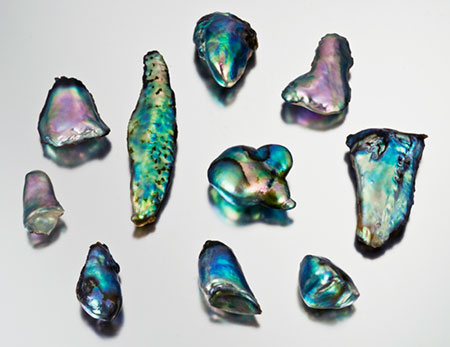 |
| Watercolors. This group of natural abalone pearls shows the variety of sizes, shapes and colors available. Prices for all available upon request. (Photo: Mia Dixon) |
See this government website for current information on abalone. For more on natural pearls see this article by Elise Skalwold from our January edition.
Interested? Call or email us to inquire. [back to top]
March 16, 2011: Mozambique Ruby
This month we feature a ruby from a new deposit in Mozambique. This unheated red beauty is from the Montepues (aka Montepuez) area of Cabo Delgado Province, about 225 km. north of Nampula in northeastern Mozambique. This new source came along just in time as our legal stock of rubies from Burma has been running out. Since we can no longer import rubies from Burma, these fine natural rubies from Mozambique fill a perfect niche for those in the U.S. on the hunt.
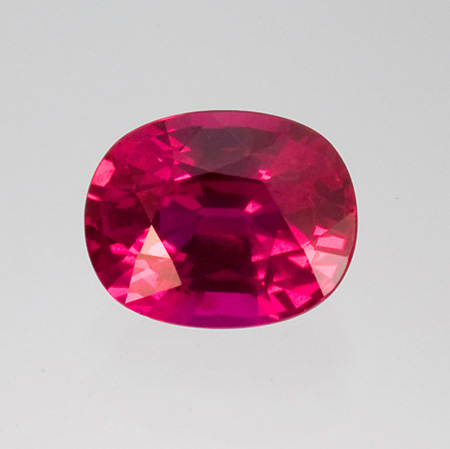 |
| Fine Mozambique Ruby: 3.16 carats , 9.11 x 7.31 x 5.55 mm., natural color and GIA certified. Inventory #18995. (Photo: Jason Stephenson) |
This 3.16-carat exhibits the finest properties from the deposit: fine natural red hue, virtually flawless and a beautiful make. A great alternative to a Burma ruby and the pricing is quite competitive. Pala recently bought a small parcel of these new rubies. See our selection of the new Mozambique rubies here.
Interested? Select inventory number above, call, or email us to inquire. [back to top]
February 16, 2011: Vietnamese Blue Spinel
Spinel has become increasingly popular, due in part to all the wonderful natural colors it produces. The more common colors are the red hues with secondary colors mixed in—like orange, purple and pink. To find pure red in spinel is probably even more rare than finding a pure red ruby. There just simply aren’t as many spinels coming out of the ground, so to find pure and intense natural colors seems to be on the wish list for many new collectors.
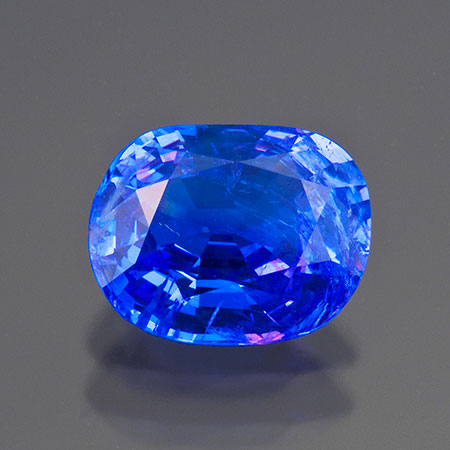 |
| Blue spinel from Vietnam, 2.59 carats, 9.0 x 7.0 x 4.8 mm. Note: This stone has been sold. (Photo: Mia Dixon) |
When we shift over into the blue hues the scarcity increases and we weed through many over-dark grayish-blue spinels until we find these blistering cobalt-blue jewels. In fact, we even had this most recent blue spinel (above) tested for cobalt at the Tucson show, at the GIA Show Service Laboratory. In the end the lab was able to find the presence of cobalt through the Chelsea filter, which glowed cherry red when illuminated.
This collector’s dream really didn’t even have a chance of making it into our inventory; there was a line of people who wanted it and it has already found a home. However, we still wanted to share the excitement of such a spectacular and rare gem with our loyal readers.
Interested in something similar? Call or email us to inquire.
See our latest selection of spinels here. And see a notice about a new book on spinel. [back to top]
January 18, 2011: Benitoite… A California Gem
Staying in suit with the theme of this year’s Tucson Gem and Mineral Show, we are featuring the state gemstone of California.
A monster in terms of the benitoite species, this 4.22-carat gem exhibits not only great size but also intense purplish blue color. This mixed cushion-cut jewel also throws out a little dispersion and shows some color banding seen as purple, blue, and white patches in the gem photo. This banding is also seen in the benitoite crystals with a purplish blue outer rim and a white center.
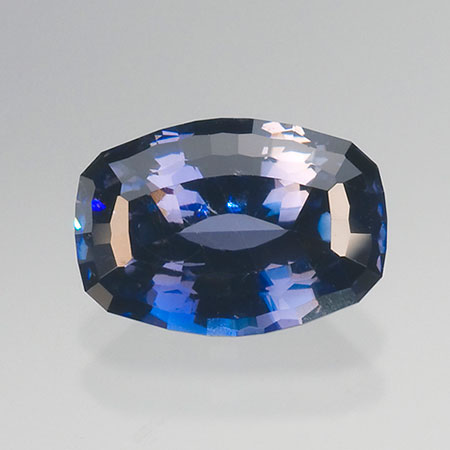 |
| Benitoite Gem, 4.22 carats, 11.77 x 8.27 x 5.0 mm. Inventory #18852. (Photo: Jason Stephenson) |
As you’re probably aware, large crystals and fine faceted benitoites are really only found in San Benito County in Central California. The story goes that a couple of copper prospectors serendipitously spotted the shiny blue gems on a weathered-out hillside one morning in 1907. Further investigations and several mining projects later, benitoite was unearthed and poised as California’s state gem.
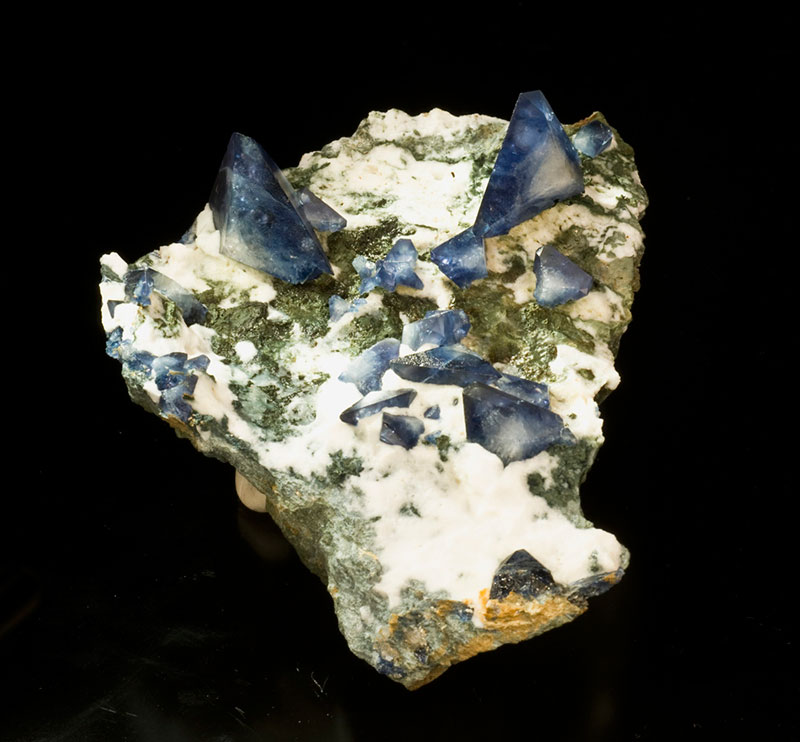 |
| Benitoite specimen: two large ditrigonal dipyramidal crystals (2.5 cm.) and several smaller ones on white natrolite and green serpentine matrix. Click to enlarge. (Photo: Jason Stephenson) |
Interested? Select the inventory number above, call, or email us to inquire.
See also these benitoite resources:
- Mineralogical Record, Jan–Feb 2008, “The Benitoite Issue” – Contains photos by Wimon Manorotkul of Bill Larson specimens (pp. 28, 31, and 33), amongst other goodies
- Mineralogical Record, Nov–Dec 1997, “The California Issue” – Includes “Minerals of the Benitoite Gem Mine” by William S. Wise & Robert H. Gill
- American Mineral Treasures, Michael Gray: “The Benitoite Gem Mine,” p. 120
[back to top]
Pala International’s Featured Stones – 2010
Featured in Pala’s Gem News.
December 15, 2010: Golden Zircon from Tanzania
Do not adjust your monitor; you are seeing the mesmerizing effects of zircon. The doubling within this jewel causes the onlooker to see two images in tandem. It’s kind of like crossing your eyes, except the two axes within the stone are doing the crossing to the light. When the two refractive indices or axes separate the light into two speeds, this difference—called birefringence—is manifested as two separate images or doubling. The higher the birefringence, the stronger the doubling.
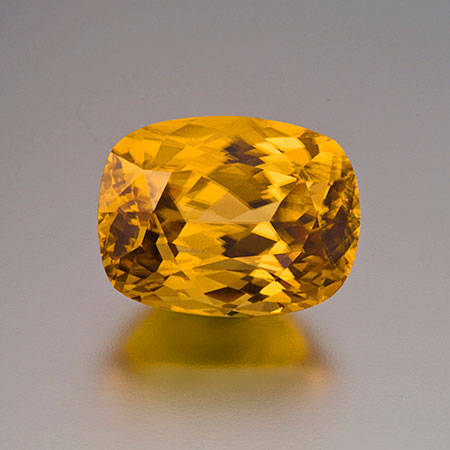 |
| Golden zircon. This 36.79-carat stone measures 19.87 x 15.28 x 11.7 mm. Ask for Inventory #18722. (Photo: Mia Dixon) |
Many gems play with light in varying fashions because of their complex structure and chemistry. Zircon is just another example of diverse optical characteristics that gems display. See our inventory of zircon here.
Pleasing to the eye… Color
As mentioned above, gems play with light and produce many wonderful phenomena and properties, but the easiest property to appreciate and understand is color. We see and take the plethora of colors around us for granted everyday. Pure, natural color in gems can be almost surreal, when mother nature produces vivid and pure hues. This suite of gems, below, from Pala’s inventory is a colorful reminder of all the amazing chromatics nature has to offer. Whether you see the pure beauty of these jewels or are intrigued by their unusual properties, they are sure to please.
 |
| Pleasing to the eye… Color. (Click the photo to zoom in) Row 1: Blue sapphire (2.55 ct. Inv #10127), Tsavorite (2.5 ct. Inv. #18582), Red Spinel (2.37 ct. Inv #16659) Row 2: Padparadscha (3.11 ct. Inv #18036), Yellow Sapphire (5.87 ct. Inv #14877), Tanzanite (3.19 ct. Inv #1762) Row 3: Spessarite (3.32 ct. Inv #13069), Paraiba (1.58 ct Inv #18754), Pink Spinel 3.08 ct. Inv #17388). (Photo: Mia Dixon) |
Interested? Select the inventory numbers above, call (telephone numbers below), or email us to inquire. [back to top]
November 17, 2010: Sphene from Burma
This month we are featuring a spectacular golden sphene from Burma. This dark honey-brown gem is warm and enticing at first glance. Then, when you rotate this stately gem and vary the light, it comes alive, waking up the dazzling dispersion that sphenes are famous for. Throwing all the colors of the rainbow, this jewel is mesmerizing and sure to entertain the veteran collector as well as the novice. Sphene is found all over the world in colors ranging from orange, yellow, green, and brown.
 |
| Golden brown sphene. This stone weighs 40.33 carats and measures 20.03 x 20.05 x 12.86 mm. Inventory #18755. (Photo: Jason Stephenson) |
See our full selection of sphenes here.
Interested? Select the inventory number above, call, or email us to inquire. [back to top]
October 19, 2010: Cuprite from Namibia
This month we feature a cuprite that is not usually on the palette for gem collectors. In fact, it’s rarely seen in fine faceted gems such as this 46.07-carat beauty. Fairly common to the mineral world, cuprite rarely crosses over to the gem trade in fine material, and the rough has become increasingly harder to obtain.
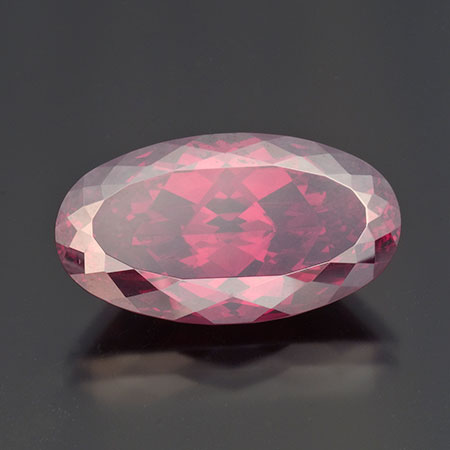 |
| Cuprite from Namibia, 46.07 carats, elongated oval 25.61 x 14.2 x 9.8 mm. This stone has been sold. (Photos: Mia Dixon) |
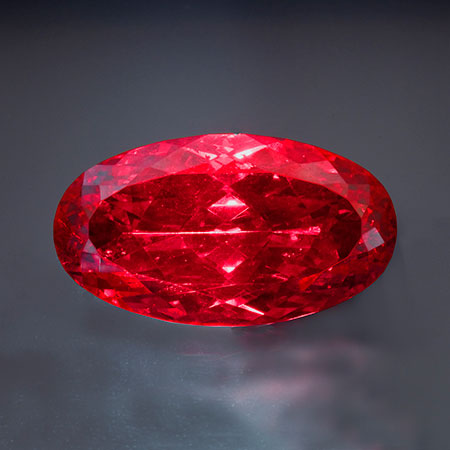 |
Consisting of just copper and oxygen, cuprite is associated with native copper, malachite, and azurite, and is found in oxidation zones of copper deposits all around the world. This gem is from the Emke Mine, Ogonja (Onganja), Windhoek District, Khomas Region, of Namibia. Its dark initial metallic luster is deceiving, because when the lights shine through, a ruby-red gem illuminates.
See a natural cuprite crystal here. And see the Mindat.org entry for cuprite.
Interested in something similar? Call, or email us to inquire. [back to top]
September 16, 2010: Demantoid Garnet Suite from Russia
This month we feature not only a rare and exceptional gem, but a whole line of dazzling green gems. Well matched and full of life, this exquisite line constitutes all the desired properties of demantoid garnet from Russia. The recognizable intense yellow-green hue, strong brilliance and dispersion, and of course the famed horsetail inclusions.
 |
| Demantoid suite: 23 stones with a total weight of 15.73 carats, ranging from 5.9 to 4.4 mm. Inventory #18529. The center stone (Inventory #14850) is 1.72 carats at 6.74 mm. See enlargement here. (Photo: Mia Dixon) |
When we see horsetails we know they can be traced back to the Ural Mountains of Russia. There are limited quantities of demantoid starting to emerge again from Russia, but it seems new pricing has caught up to the extremely rare and beautiful nature of this gem. Luckily here at Pala we still have a good supply of older stock and thus can offer reasonable pricing consistent with a decade ago.
- See our inventory of demantoids here
- See also our July 2009 demantoid disclosure
- Further reading and Buying Guide
Interested? Call or email us to inquire. [back to top]
August 19, 2010: Burmese Red Spinel
Spinel continues its rise in popularity and intrigue in the gemstone market. Many collectors are on the hunt for the elusive 10+ carat red spinel, which is hard to find because most crystals come in smaller sizes, leading to faceted stones weighing mainly under 5 carats. It seems even harder to track down a fine 10-carat red spinel than it is to find a 10-carat ruby these days. The rarity of these spinels is becoming more apparent as collectors branch out in search of the next fine gem to add to their collection.
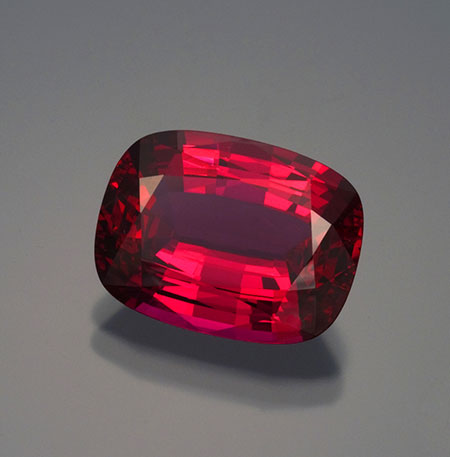 |
| Rare red. 10.21-carat cushion red spinel from Burma, 15.9 x 12.01 x 6.67 mm. Ask for Inv. #18576. (Photo: Wimon Manorotkul) |
This month we feature a 10-carat red spinel from Burma with a spectacular red hue and a lot of character. In normal lighting conditions this gem is deep purplish red; under bright lighting or natural sunlight the gem comes alive with a slightly pinkish red hue and a fluorescent glow. The gem has an Gübelin Gem Lab cert from 1993 with its original weight of 15.81 carats. It was recently recut to its current weigh of 10.21 carats to improve cut and brilliance.
Click here to see our inventory of more spinels.
Interested? Call or email us to inquire. [back to top]
July 18, 2010: Mint Grossular Garnet
Green grossular is a pleasant variety of the garnet family. Lighter green hues—often described as mint—glow with a subtle beauty. Gems such as our feature this month seem to have a neon quality, a fluorescence in natural light. Varying amounts of V2O3 & Cr2O3 (vanadium and chromium) account for the intensity of the green.
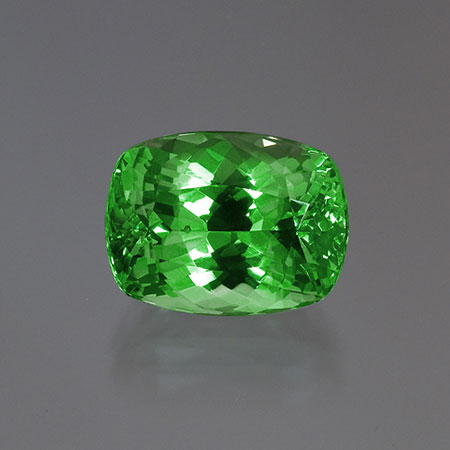 |
| Green Jewel. Mint grossular garnet, 12.04 carats, 14.63 x 11.14 x 8.87 mm., Inventory #18012. (Photo: Jason Stephenson) |
These green jewels are occasionally found in the Merelani Hills of northern Tanzania. Mint garnets under 5 carats are fairly common, but stones over 10 carats are extremely rare, especially with this highly saturated, pure mint color. Its darker, more evergreen brother, tsavorite, is found in Merelani occasionally and further to the north in a similar geologic setting from northern Tanzania into southern Kenya.
Read more about the Merelani deposit here.
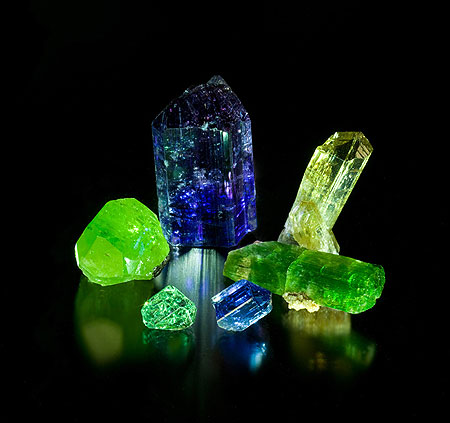 |
| Merelani mix. Clockwise from top center: tanzanite 5.5 x 2.7 cm., yellow zoisite 4.6 x 1.5 cm., tremolite 5.1 x 1.8 cm., tanzanite 1.7 x 1.1 cm., grossular garnet 0.9 x 1.4 cm, diopside 3 x 2.5 cm. From the collection of Bill Larson. (Photo: Jason Stephenson) |
Interested? Select the inventory number above, call, or email us to inquire. [back to top]
June 17, 2010: Mozambique Paraiba Tourmaline Pair
This month we feature a pair of Mozambique paraiba tourmalines par excellence.
These two beauties were swimming around solo in our inventory for a couple of years until we realized they made a stunning matched pair. As our stock of fine paraibas from Mozambique has dwindled, these seem to find a common bond in size, shape, and that fluorescent glow we come to recognize with these copper-bearing tourmalines.
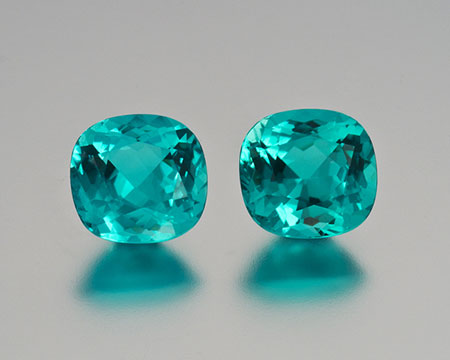 |
| Bonded: Paraiba tourmaline from Mozambique; right, 6.0 carats, 11.35 x 10.71 x 7.47 mm.; left, 5.53 carats, 11.23 x 10.81 x 7.04 mm. (Photo: Mia Dixon) |
Right along with our stock, the actual deposit in Mozambique has been drying up quickly. Numerous sources report only small, included pieces of rough being found on the outskirts of the main paraiba ore lens. Just as Mother Nature assembled this particular variety of tourmaline into a small deposit, we have brought together two of the finest paraibas in a gorgeous bond.
See our selection of paraibas here. Read more about the Mozambique deposit here.
Interested? Call or email us to inquire. [back to top]
May 18, 2010: Golden Tourmaline from Mozambique
This month we feature an unexpected tourmaline from Mozambique. Along with the discovery of paraiba-type tourmaline, and the amazing spectrum of neon colors, a few other unique colors have surfaced as well. This golden tourmaline exhibits a dominantly yellow hue with a kiss of orange. A gemologist may even be puzzled to site-ID this gem, which hints at chrysoberyl, golden beryl, sapphire, and zircon. A chameleon of sorts for the inquisitive eye of a collector. A perfect jewel, precisely faceted, to round out a tourmaline collection or as a centerpiece for a one-of-a-kind design.
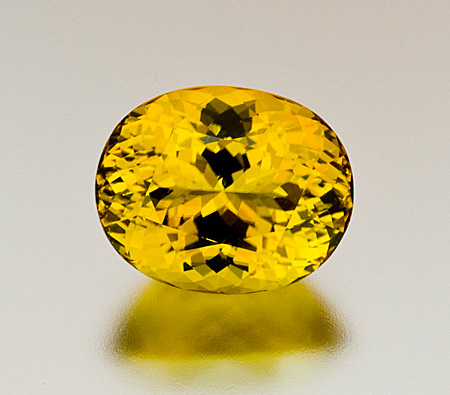 |
| Golden tourmaline from Mozambique, 11.19 carats, 15.01 x 12.08 x 9.31 mm. This stone has been sold. (Photo: Jason Stephenson) |
See other tourmalines from Mozambique:
Interested? Select the inventory number above, call, or email us to inquire. [back to top]
April 13, 2010: Made in America
This month we visit some homegrown stones that remind us of the rare treasures the U.S. has spawned.
Oregon has continuously produced beautiful and natural feldspar sunstones. Intense, orangey-red gems such as the 5.30-carat pictured below are some of the rarer hues found at the Dust Devil Mine outside of Plush, Oregon.
California’s state gem has taken a hiatus for the time being, as far as new production, but we still see a few jewels circulating in the trade. The Benitoite Gem Mine in San Benito County has blessed us with truly rare and beautiful gems over the years, including the 2.63-carat round shown below.
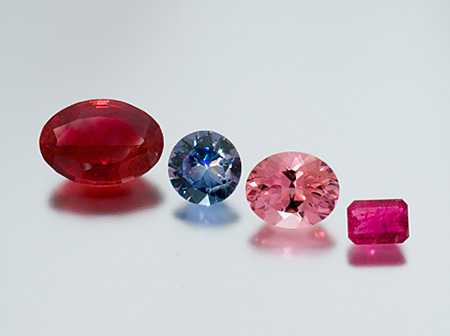 |
| American Neighbors: 5.30-carat oval sunstone, 14.80 x 10.69 x 5.86 mm.; 2.63‑carat round benitoite, 8.79 x 4.68 mm.; 3.44-carat oval pink tourmaline, 11 x 9.1 x 5.8 mm., and 0.75-carat red beryl 7.12 x 5.26 x 2.62 mm. (Photo: Jason Stephenson) |
In Southern California, the Himalaya Mine tourmaline still has a presence, with all the stockpiles left in our safes here at Pala. Occasionally, pink tourmalines are still found in the surrounding mines, but the quality and quantity seem to be limited. The 3.44-carat pictured above is one of the cleanest and most pure pinks we have left.
Red beryl is another gem that seems to be out of production for now, but luckily we still see a few of these intense red jewels bubble up now and again. The Violet claim, in the Wah Wah Mountains of Utah, produced the most red beryl, including this little 0.75-carat beauty.
And speaking of red beryl, loyal readers may recall our featured stone from May 2008. It’s back in stock.
Interested? Call or email us to inquire. [back to top]
March 16, 2010: Spinel from Tajikistan
We have been reporting on the new electric pink spinels coming out of Tanzania, and the superb reds still trickling out of Burma, but the most historical spinel deposit in the Pamir mountains of Tajikastan has been producing some beautiful large stones recently as well. Originally coined the Balas Ruby, which was later tested to be spinel, this was the material that has adorned some states’ royal crown jewels. Even recently we have seen rosy reds and pastel pinks still being mined from this region. This month’s monster 22.76-carat spinel is quite unusual for its size and rich, rosy red color. A wonderful collector’s piece to complete a worldwide spinel locality assemblage.
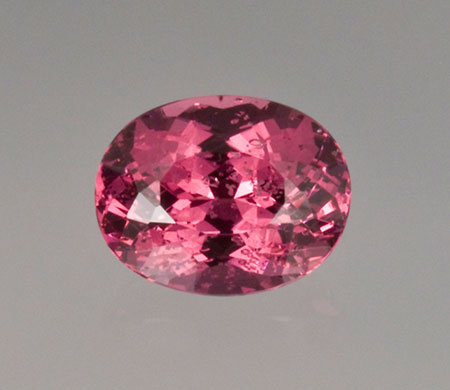 |
| Big Rosy Red: A 22.76-carat spinel from Tajikistan, 18.54 x 14.55 x 11.47 mm. Inventory #11669. (Photo: Jason Stephenson) |
This beautiful and gemological gem would probably be a pick of the late Dr. Eduard J. Gübelin. He loved to collect gems that were not only attractive on the outside, but also intriguing on the inside. A photomicrograph of this extraordinary spinel from Tajikistan reveals a beautiful suite of natural inclusions. Taking a tour of this inner world, we note the well-formed octahedron just left of center; probably a negative crystal formed as a result of exsolution during the spinel’s growth. The large crystal seen just right of center appears to be an apatite crystal, while many of the smaller rounded nodules scattered to the left and lower left are probably more sub-euhedral apatites. The intriguing guest mineral emerging into the light at lower left, hints at being quartz, another fascinating inclusion to be found in spinel.
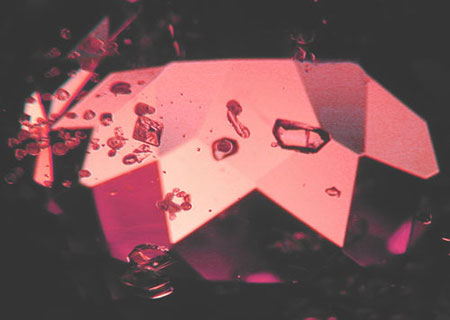 |
| In bloom. The internal world of this month’s featured gemstone. (Photo: Jason Stephenson) |
Search the entire inventory of spinels on Palagems.com.
Interested? Select the inventory number above, call, or email us to inquire. [back to top]
February 21, 2010: Prase Opal From Tanzania
This month we feature prase opal from some recently unearthed veins on Mount Iyobo in central Tanzania. Prase opal is a nickel-bearing variety of common opal, with nickel being the chromophore that illuminates the neon bluish-green hue. Chrysoprase and prase opal can be similar in appearance but can easily by separated by varying RI and SG. Both varieties range from low-quality opaque material to high-quality translucent jewels; however, the prase opal tends to be more translucent and gemmy. Pala International just recently purchased some of the fascinating prase opal rough while at this year’s Tucson show.
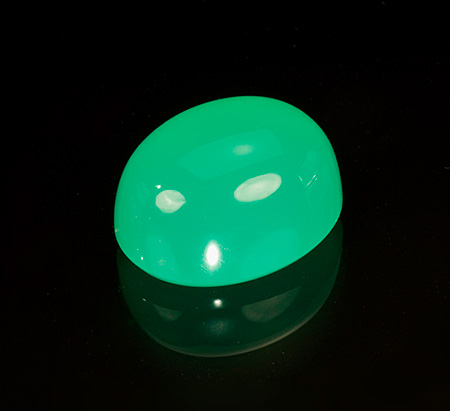 |
| Tanzanian treat. A glowing prase opal cabochon showing the most pure and intense color; 11.80 carats, 16 x 12.6 x 9 mm. Price available upon request. (Photo: Jason Stephenson) |
Chrysoprase and prase opal have been mined on Iyobo Mountain in central Tanzania for more than 20 years, with the first accounts being described by Gübelin in 1975. The most recent discovery revealed some of the most intense and beautiful bluish green material to be seen by the gem trade. The majority of the production is in the chrysoprase form, while the prase opal is the more rare find from this deposit. Chrysoprase and prase opal both form in discontinuous veins within metamorphosed ultramafic rocks with the most dominant host rock being altered serpentine.
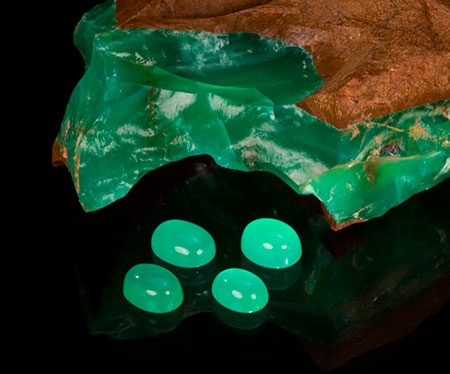 |
| Goody goody gum drops. An assortment of the prase opal cabs with a chunk of rough showing the gem vein and the surrounding matrix. (Photo: Jason Stephenson) |
See “Chrysoprase and Prase Opal from Haneti, Central Tanzania,” by James E. Shigley, Brendan M. Laurs, and Nathan D. Renfro, in the current issue of Gems & Gemology.
Interested? Call or email us to inquire. [back to top]
January 4, 2010: Burmese Red Spinel
This month we feature a Burmese red spinel with a single octahedral crystal, in conjunction with the theme of this year’s Tucson Gem and Mineral Show: gem crystals. As the world opens its eyes to new gem varieties, spinel is standing at the front of the line, intense and beautiful. Nothing better than a good ol’ fashioned flame-red spinel. This spinel exhibits the best Burma has to offer, with a slightly orangey red hue, high saturation, and a pleasing cushion cut.
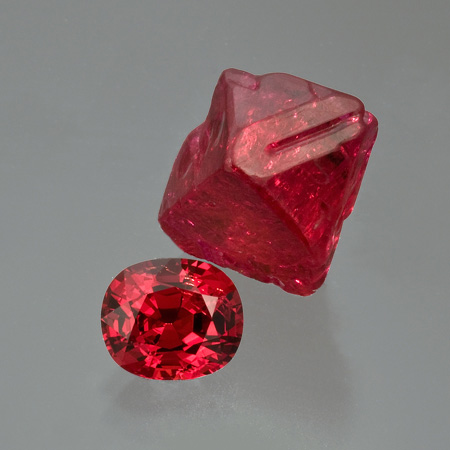 |
| Crystal & jewel: 2.24-carat Burmese faceted red spinel, 8.3 x 7 x 5.1 mm,, with 15-carat Burmese spinel crystal, 17 x 12 x 10.5 mm. Inventory #16655. (Photo: Mia Dixon) |
As we see many deposits producing fine spinels these days, with Tanzania, Tajikistan, Vietnam, Madagascar, and Sri Lanka, to name a few, nothing quite compares to some of the rich reds that are produced in Burma.
Interested? Select the inventory number above, call, or email us to inquire. [back to top]
Pala International’s Featured Stones – 2009
Featured in Pala’s Gem News.
December 16, 2009: Spessartite Suite
This month Pala features what has become a rare commodity in the colored stone world: a large, fine spessartite suite consisting of 17 well-matched mandarin colored garnets. This set graduates from 8 x 7 mm. ovals to 12 x 10 mm. ovals, which are set off by a pear-shaped center stone measuring 14.6 x 12.5 mm.
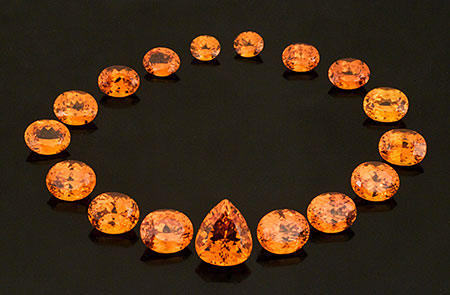 |
| Spessartite suite: Inventory #16390. (Photo: Mia Dixon) |
Larger spessartites with exemplary orange color such as these have become increasingly rare as the inventory of fine Nigerian material disseminates amongst connoisseurs. With the deposit in Nigeria being out of production for a few years now, and the new Tanzanian material being heavily included and found in smaller sizes, the supply chain has been cut off. This colorful suite may be one of the last great assemblages of the fine material we have all come to know and love from Nigeria.
Interested? Select the inventory number above, call, or email us to inquire. See also our Spessartite Buying Guide. [back to top]
November 18, 2009: Topaz
This month we thought we would follow the birthstone trail and take a closer look at some of the colors within the topaz family for the month of November.
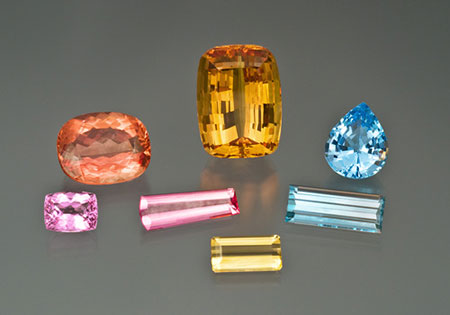 |
| Topaz suite: Pink cushion 4.97 cts. (Inventory #17535), imperial cushion 22.49 cts. (Inventory #17513), rose tapered emerald cut 4.76 cts. (sold), golden cushion 53.80 cts. (Inventory #1643), yellow emerald cut 4.11 cts. (Inventory #5070), light blue emerald cut 9.76 cts. (Inventory #8679), blue pear shape 10.74 cts. (not inventoried). (Photo: Mia Dixon) |
From the irradiated blues to the precious pinks, topaz can be an economical source of color for a neophyte, or a prize for the advanced collector. All the controversy of irradiated blues has surely softened that market, but many people are still enticed by the neon blue hues. Imperial topaz from the golden to red hues still are exclusive to a few mines in the Minas Gerais region of Brazil. As the supply seems fairly low but steady, and the demand keeps rising, it’s harder to match stones with collectors, causing prices to continue their ascent.
And if we refer to Kensho Okamoto’s table, listed here, we find that the topaz family helps to calm down, and cheer up, the mind. We all could use a taste of that medicine.
Interested? Select the inventory numbers above, call, or email us to inquire. [back to top]
October 19, 2009: Phenomenal Gems
This month we feature two truly phenomenal gems.
As our curiosity for the natural wonders of the gem world matures we seem to appreciate truly fine phenomenal more and more. When the unique properties line up to create a show of light and color, we are mystified and enthralled by their beauty. As scientists we wonder how the conditions culminated and what elements coalesced to produce such a colorful and symmetrical gem: the right and left brain blending to an immaculate perception of these interactive jewels.
Burmese star ruby
This jewel combines the best properties one can expect from a star ruby. This stone, which features a truly pigeon’s-blood-red body color and a sharp, well-defined star, is from the Mogok Valley of Burma. It appears as a deep red gem under normal lighting conditions, but when hit by a ray of sun it comes alive.
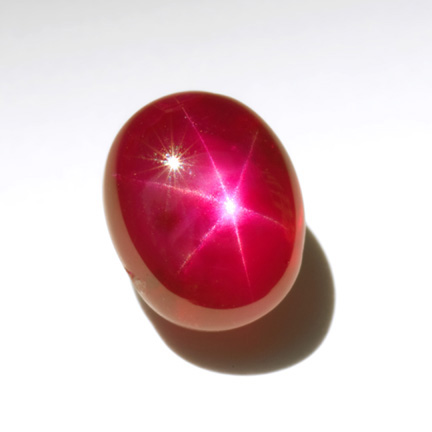 |
| Burmese star ruby. Inventory #16647, 5.18-carat oval cut, 9.82 x 7.92 x 5.87 mm. (Photo: Wimon Manorotkul) |
Cat’s eye chrysoberyl
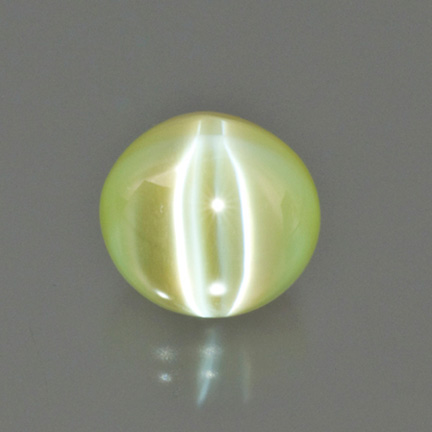
The second featured stone not only has a distinct eye but the body color glows a warm, golden lime hue. This jewel also exhibits the milk-and-honey effect, and can wink as well. We believe this chrysoberyl comes from the Arusha region in northeastern Tanzania because of its unique electric lime body color and its velvety appearance, but it may be of Sri Lankan origin.
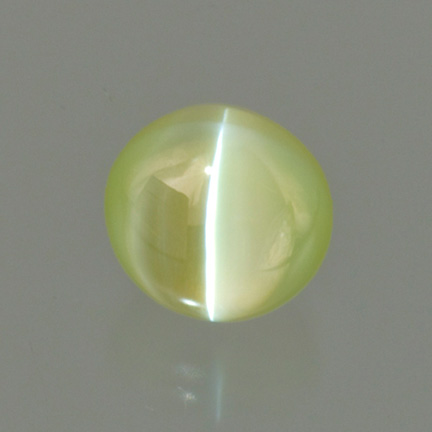 |
| Cat’s eye chrysoberyl. Above, a single light source illuminates the sharp, centered eye with a hint of the milk-and-honey effect. Below, the eye will open and close as two light sources are used, keeping one stationary while rolling the other perpendicular to the eye. A fun trick for any gem lover. Round, 13.25 carats, 12.75 x 7.89 mm. Price upon request. (Photos: Jason Stephenson) |
 |
Interested? Call or email us to inquire. [back to top]
September 15, 2009: Red Zircon from Tanzania
This month we had a power struggle amongst contenders for Pala’s featured gemstone. The victor was a late entry, but it easily eclipsed the competiion. We are pleased to present for September a substantial (not the least due to its weight of 152.47 carats), purportedly-natural red zircon from Tanzania.
Bill Larson gives us the background:
This is the largest fine red zircon I have ever seen. It is said to be from newly mined material in Tanzania and unenhanced. But note: Pala has not certified this gem with GIA yet. It was shown directly from a master Thai cutter through a friendly, serious gem dealer in Bangkok before he had even purchased the gem. We did an immediate negotiation, and Pala owns said gemstone.
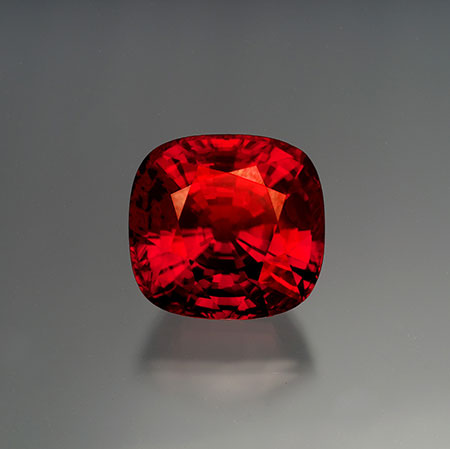 |
| Super-sized. Orangy-red zircon from Tanzania, 152.47 carats, 26.1 x 25.9 x 20.1 mm. (Photo: MIa Dixon) |
In the sun this zircon glows like a red coal. A slight orange secondary color makes it superbly beautiful. In artificial light it glows red. This is a museum-quality gem.
Interested? Call or email us to inquire. [back to top]
August 19, 2009: Chrysocolla Suite
This month we feature a stunning suite of chrysocolla from the Globe Hills of Arizona. This neon-blue gem silica is reminiscent of a paraiba color due in part once again to the presence of copper. These stones feature a beautiful, even Caribbean-blue color with a few subtle clear veins running through the material. Cabochons were cut from same piece of rough so the 11-piece set has uniform color and sets up nicely for a necklace layout.
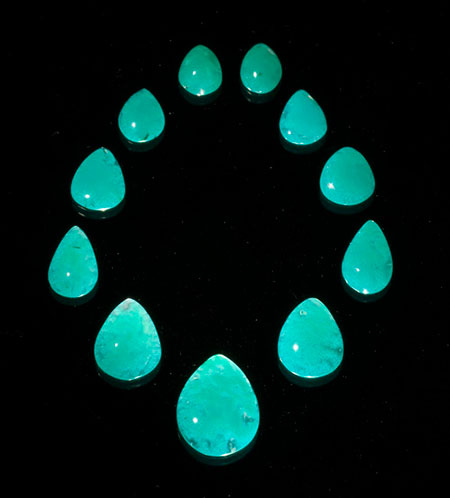 |
| Gem chrysocolla suite, 11 pieces with a total weight of 34.68 carats, ranging in size from 11 x 8 to 15 x 21 mm. Inventory #17488. (Photo: Jason Stephenson) |
The suite was carved by San Diego artist Bud Standley, who now has a studio in Balboa Park’s Spanish Village Art Center.
Below is a piece of rough chrysocolla, also from the Globe district in Arizona, displaying the electric blue hue and a layer of druse covering some of the botryoidal formations.
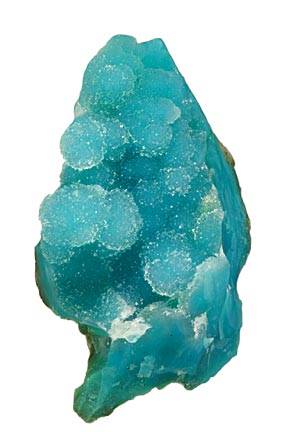 |
| Rough chrysocolla specimen, 4.6 x 3.6 x 2.1 cm. Inventory #17401. (Photo: John McLean) |
Interested? Select the inventory numbers above, call, or email us to inquire. [back to top]
July 16, 2009: New Dawn of Demantoids
This month we feature an exquisite new demantoid garnet from Russia. This 3.51-carat jewel has a succulent green hue, medium tone, and full saturation. Inside, we find a fine example of the diagnostic horsetail inclusion.
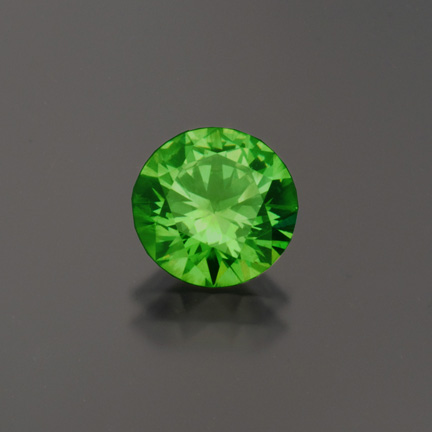 |
| Russian demantoid garnet, above, 3.51 carats, dimensions 9.38 x 5.8 mm. Below, the same demantoid under different lighting conditions, bringing out the phenomenal dispersion from within. (Photos: Above, Mia Dixon; Below, Jason Stephenson) |
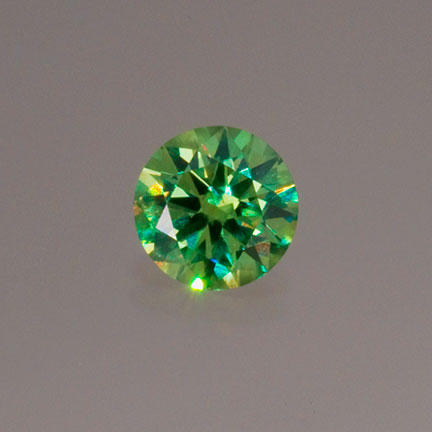 |
Recent mining ventures in Russia have begun to produce new demantoid garnet material. Pala is once again involved with distribution and we have a fine selection to offer. Extremely saturated greens in all shapes and sizes, many with superb examples of horsetails and some other intriguing inclusions.
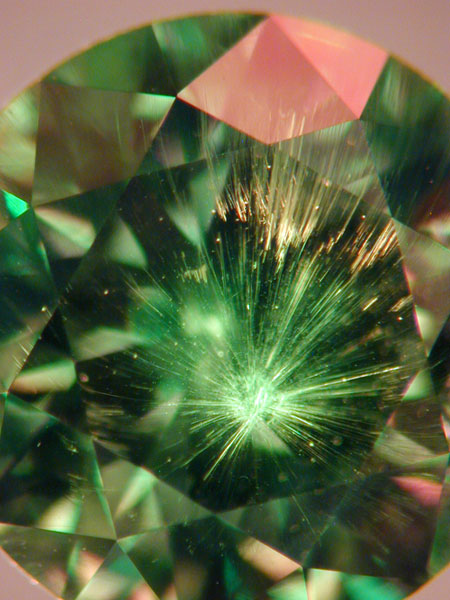
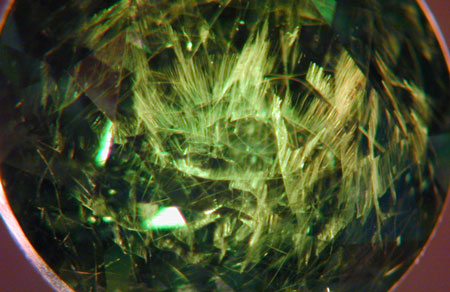 |
| Aurora adamantis. The aurora-like inclusions above are actually interwoven bands of horsetails. This is from a 2.33-carat round, 7.3 x 5.0 mm. (not from our featured gemstone). (Photomicrograph: Jason Stephenson) |
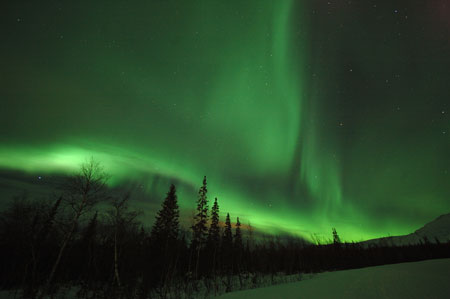 |
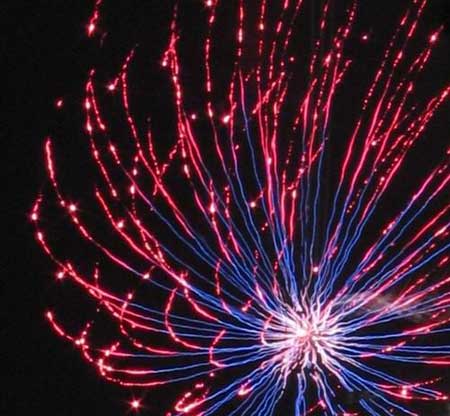
Some of these quiescent internal formations seem to resemble other active formations on a grander scale. The radiating horsetail spray with a definable core resembles an exploding firework. The interwoven bands of horsetails are reminiscent of the liquidity and beauty of the aurora borealis.
 |
| Pow! An inclusion mimics a firework spray. From a 1.21-carat round, 6.0 x 4.0 mm. (Photomicrograph: Jason Stephenson) |
 |
These micro to macro associations gives us a little insight into the complex dynamics that are at work during crystallization of these demantoid garnets. Heat, pressure, and chemistry meet in a unique situation in time and space. Beauty is found on many scales.
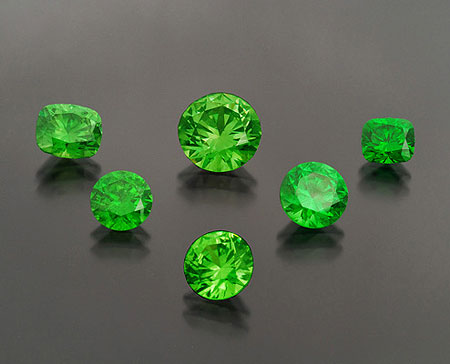 |
| Suite of Russian demantoid garnet, (clockwise from left) 1.97 carats, 7.46 x 6.25 mm.; 3.51 carats, 9.38 x 9.38 mm.; 1.15 carats, 6.07 x 5.44 mm.; 1.28 carats, 6.68 x 6.68 mm.; 1.98 carats, 7.41 x 7.41 mm.; 1.73 carats, 7.23 x 7.23 mm. (Photo: Mia Dixon) |
Interested? Select call or email us to inquire.
See this new page on Palagems.com:
- Demantoid Disclosure: The ins and outs of reporting treatment and locality
For other information on demantoid garnet:
- Reds Turn to Green: Russia’s Stunning Demantoid Discovery
- Demanotoid – From the Ural Mountains of Russia
- Update on the Karkodino and Babrovka Mines (May 2000)
- Search for demantoid garnet on Palagems.com
[back to top]
June 23, 2009: Sunstone from Tanzania
This month we feature a mesmerizing sunstone from Tanzania. This unique variety of feldspar requires a closer look as flashes of spectral colors come firing out of the stone. Geometric platelets fill the inside of this jewel like confetti at a tickertape parade or looking into an active psychedelic snow globe.
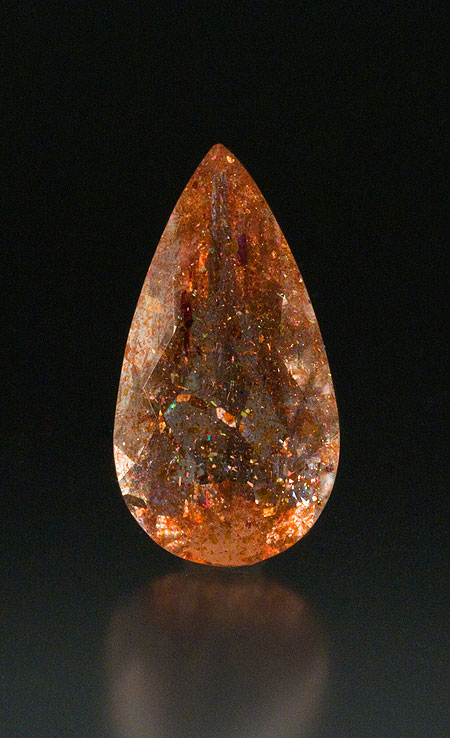 |
| Sunstone from Tanzania, Arusha Region, 20.37 carats, 29 x 15.3 x 8.9 mm. Inventory #17383. (Photo: Mia Dixon) |
These randomly oriented inclusions are hematite platelets, a product of exsolution, and exhibit a rainbow of interference colors as the light passes through at different angles. The hematite platelets display mainly a reddish orange hue, which gives this stone its warm body color. This beautiful gemstone would work well in a designer pendant or simply as a collector’s stone demonstrating these unusual internal characteristics.
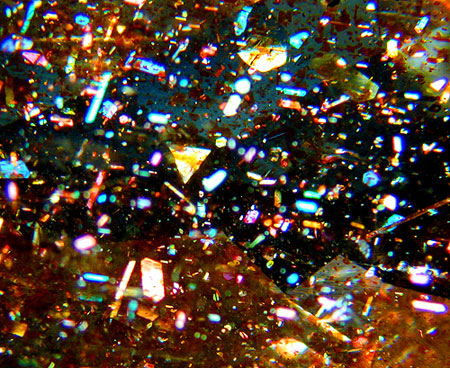 |
| Party colors. Photomicrograph showing the illuminated hematite platelets. (Photo: Jason Stephenson) |
Interested? Select Inventory #17383, call, or email us to inquire.
See also this February 2005 article, “On the Horizon: In search of East Africa’s eye-catching Maasai sunstone,” from Lapidary Journal Jewelry Artist. [back to top]
May 21, 2009: World-Class Lavender Hackmanite
A phenomenal variety of sodalite and a member of the feldspathoid group, hackmanite is mostly found in a translucent cabochon form. This month we feature a transparent faceted hackmanite from Afghanistan. This gem is near-flawless and exhibits all the unusual optical characteristics associated with hackmanite.
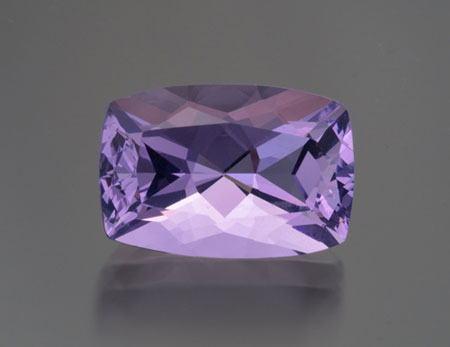 |
| Lavender hackmanite from Afghanistan, 7.87 carats, 16.28 x 11.08 x 8.64 mm. This stone has been sold. (Photo: Mia Dixon) |
Hackmanite is known for its unique color-shift phenomenon when subjected to warm white light or daylight. The phenomenon is known as tenebrescence. Hackmanite will often increase in saturation when allowed to be “charged up” in daylight and sometimes shifts between lavender and magenta hues. Long-wave ultraviolet light also brings out an amazing fluorescence, as seen directly below; in this case we see a glowing orange/yellow hue. The distinctive color phenomena are derived from the sulphur component in hackmanite’s chemistry. Light can polymerize the sulphur into different-length molecules and ions that, in turn, have different colors. (Thanks to Dr. George R. Rossman for clarification of the color phenomena science. See this Caltech webpage for more on the sodalite group.)
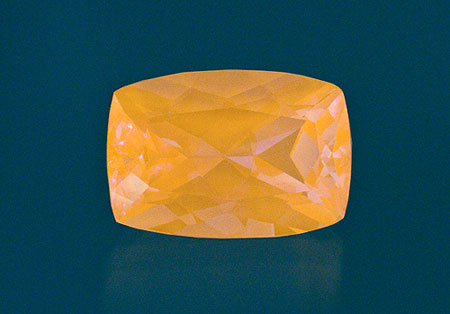 |
| Long-wave ultraviolet light shows off the fluorescence of this hackmanite. (Photo: Mia Dixon) |
An amazing feature that is illuminated by the unusual optics of this stone is seen when a beam of long-wave UV light is shot through the table. You can actually see the refraction of light as it travels though the stone: entering the table, bouncing off the pavilion, and traveling back out the table. A living example of all the diagrams you’ve seen drawn with stick figures in gem books. Like a laser through smoke the path of light is captured by the internal structure of the gem, and highlighted by the facets and form of this hackmanite.
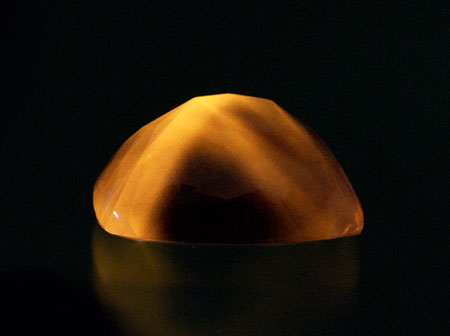 |
| A beam of long-wave ultraviolet light demonstrates the refraction path. (Photo: Mia Dixon) |
Interested in something similar? Call, or email us to inquire. [back to top]
April 16, 2009: Aqua-marine
This month we feature a dazzling aquamarine. In the gem trade aquamarine most often refers to the blue variety of beryl, but the first element of this compound word actually implies some green. Even Webster’s Dictionary defines aqua as “a light greenish blue color.” Today most pure-blue aquamarines are heated from greenish blue rough; the heated process removes the secondary green hue and leaves only the blue hue.
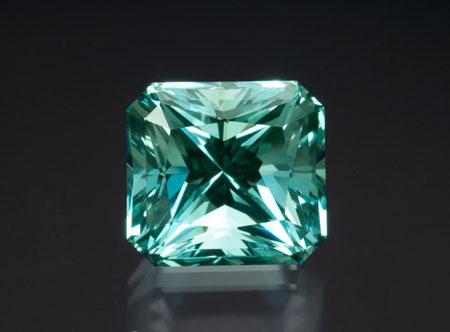 |
| A flawless 22-carat natural aquamarine with an exquisite radiant-style faceting. This stone has been sold. (Photo: MIa Dixon) |
Our featured aquamarine exhibits the beautiful blend of blue and green in its natural state. It’s reminiscent of open ocean water, which is of course implied by the second element of the word: marine. Major producers of gem-quality aquamarine today are Brazil, China, and several countries in Africa.
Interested? Select Inventory #15579, call, or email us to inquire. [back to top]
March 18, 2009: Bi-Color Topaz
A new look at an exceptional gemstone
This month’s featured stone comes to us from Brazil and is precious and imperial in many ways.
When we’re talking about topaz, imperial is a descriptive term for golden orangey-yellow hues, and precious is usually reserved for the more pink-red hues. However, these terms can, and often are, used interchangeably by gem dealers. Exceptional colors like these are only found near the town of Ouro Preto within in the state of Minas Gerais in Brazil.
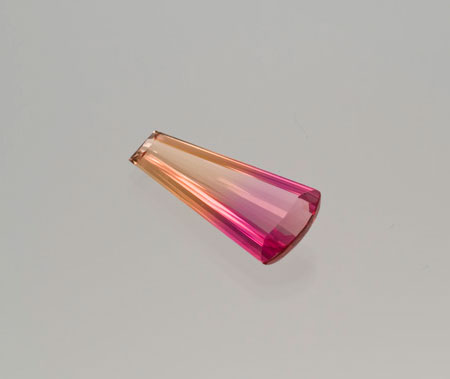 |
| Bi-color topaz, 13.35 carats, 27 x 11.8 x 5.42 mm. Inventory #15507. (Photos: Jason Stephenson) |
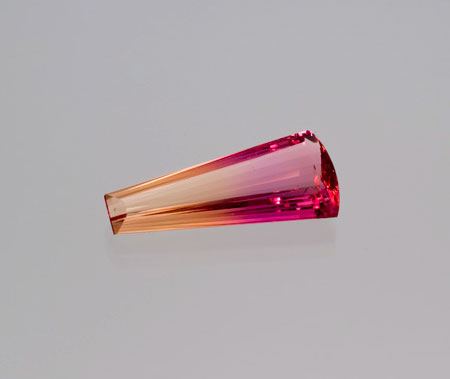 |
The top half of the stone exhibits the classic golden color, while the bottom seems to collect all the rich rosy pink color. This combination of color is extremely rare to find within the same stone—not to mention a flawless interior. And the origin of color in this jewel is natural; the original crystal actually exhibited these two distinct hues. (Oftentimes rich imperial colors can be heated to produce the pinkish hues.) A true collector’s gem fashioned to fit nicely into a one-of-a-kind pendant.
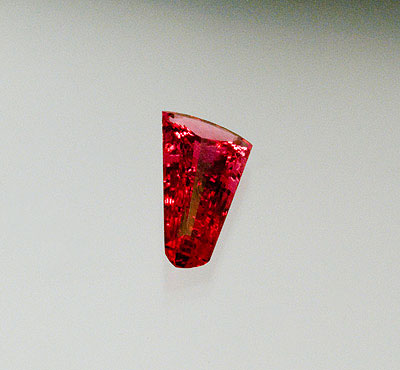 |
| Stoked. Oblique angle of the topaz showing the fire within. Savvy readers may recall this stone accompanying a Gem News story last October; we thought it deserved a second look… (Photo: Jason Stephenson) |
Interested? Select Inventory #15507, call, or email us to inquire. [back to top]
February 25, 2009: From the Rough
An assortment of newly acquired gems that were bought
in the rough at this year’s Tucson show
One fun and curious aspect of the Tucson show is the chance to roll the dice and buy rough crystals of various colored stones in hopes that they will morph into beautiful gems. Evaluating the rough and trying to imagine what the finished stone will look like can be enjoyable. There’s always a gamble when buying rough gem material, but the payout can be surprising and rewarding.
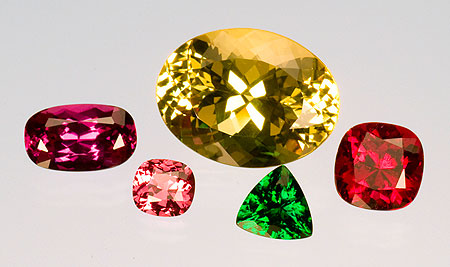 |
| Smooth around the edges. All five of this month’s featured gemstones came from unfaceted material obtained by Pala International at this month’s Tucson show. (Photo: Jason Stephenson) |
This month we feature a few jewels that came from the rough and into the light as happy, newborn jewels. A 36.67-carat large oval greenish-yellow apatite from Mexico, a 7.57-carat elongated cushion umbalite garnet from Tanzania, a 1.91-carat small cushion pinkish red spinel from Tanzania, a 2.80-carat trilliant chrome tourmaline from Tanzania, and a 6.42-carat cushion rubellite tourmaline from Nigeria.
Interested? Call or email us to inquire. [back to top]
January 19, 2009: Rhodochrosite from a New Locality
Pala International obtained a parcel of rough rhodochrosite at November’s West Coast Gem & Mineral Show in Costa Mesa, from a locality that has yet to be confirmed. We will keep you posted as the mystery of origin unfolds.
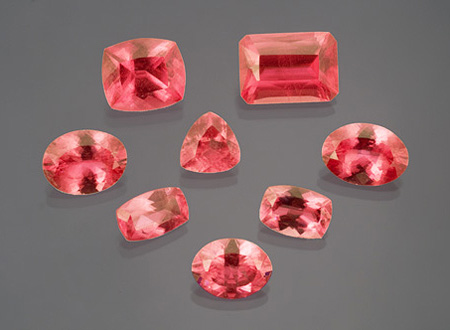 |
| Selection of the new rhodochrosite material; sizes ranging from 2.5 to 10.5 carats. (Photo: Mia Dixon) |
The material is the classic, beautiful pinkish-red hue, with more peach or orange secondary than some of the other rhodochrosite localities. Reminiscent of a padparadscha sapphire, with a pleasing blend of colors and a fluorescent glow. There are several localities around the world that produce rhodochrosite mineral specimens but there are really only two that produce facetable rough in quantity and quality: the Kalahari manganese fields of South Africa, and the Alma District of Park County in Colorado.
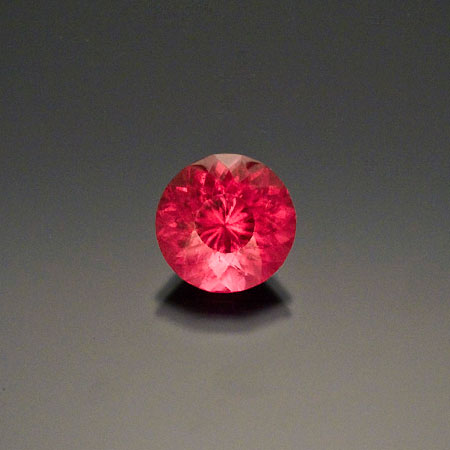 |
| Here is a fine example of what Colorado can produce: a 19.78-carat round brilliant, 16.8 mm in diameter. This stone has been sold. (Photo: Jason Stephenson) |
Displaying these three examples, you can see the unique variations of red produced by each deposit. Production from South Africa and Colorado is extremely limited; however, the new material is available now.
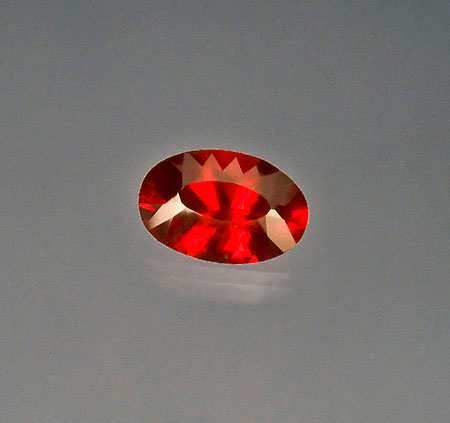 |
| Another example of a fine rhodochrosite, this time from South Africa: 16.27-carat oval brilliant, 20.21 x 13.41 mm. From the Gladnick collection. (Photo: Jason Stephenson) |
Interested? Call or email us to inquire. [back to top]
See other: