Kashmir Sapphires
Note: We are pleased to reprint this paper on the Kashmir sapphire mines. It is the first eye-witness account of the deposit and as such represents a landmark in the literature of gemology.
Reprinted from Records of the Geological Survey of
India
Vol. 23, Pt. 2, May, 1890, pp. 59–69
The existence of sapphires in considerable quantities in some part of the North-West Himalayas was first brought to light in 1881, or early in 1882, when some were brought into Simla by traders from Lahol, who stated that they had been obtained from a spot among the mountains on the borders of Zanskar, where a landslip had laid bare the rocks beneath the soil, and disclosed the presence of the gems. Various stories are told of the original discovery; according to one of these, which was told me on the spot, a certain shikari, having lost the flint from his gun while out hunting, or, as is the custom of the natives when in want of a light for their pipes, looking for a handy fragment of quartz or other hard rock to strike a light with, picked up a small sapphire, and finding that it answered his purpose better than the ordinary fragments of quartz he was in the habit of using, carried it about with him for some time, and eventually sold it to a Laholi trader, by whom it was taken to Simla, where its value was recognised. Enquiries were then made, which resulted in the discovery of the spot where the shikari had picked up the stone, and for some time, until guards were posted near the locality by the Maharajah of Kashmir, in whose territory it lies, large quantities of the stones were brought to Simla and sold at absurdly low prices, the Laholis only asking about one rupee per seer for them. Another story runs to the effect that a number of traders who had arrived in the Simla bazaar with borax from Rupshu were emptying their baskets in a merchant’s shop, when a stone fell out and was thrown by the merchant into the street. The well-known jeweller, Mr. Jacobs, happened to be passing at the time, and, so the story goes, was struck by the stone. Picking it up, perhaps with the intention of returning it, he saw what it was, and on the merchant’s claiming it, when he saw that there was something unusual about it, bought it for a small sum. This latter story, if it is to be relied on, would seem to point to the existence of another and as yet unknown locality for the gems, somewhere in Rupshu; otherwise it would be difficult to account for the presence of the sapphire among the borax, which is brought to Simla along a route that does not pass anywhere near the known locality in Pádar. Various stories have been circulated of the discovery of sapphires in Kulu and other portions of the North-West Himalayas, but up to the present time none of these have been confirmed.
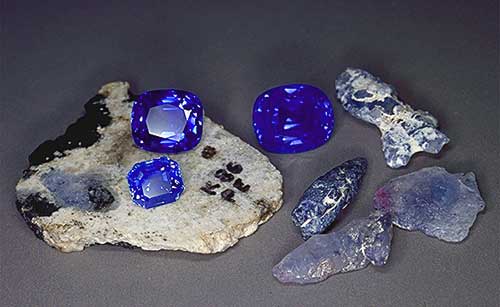 |
| A selection of both rough and cut Kashmir sapphires. The cut stones range from 6–14 ct. (Photo: Henry Hänni/SSEF) |
Early in 1882 a few specimens of the gems were sent down from Simla to the Indian Museum, and examined by Mr. F.R. Mallet, who published a full account of their mineralogical and chemical characters in the Records for that year—Vol. XV, page 138. Mr. Mallet also published an account of them, with figures of the crystals, in Part IV of the Manual of the Geology of India, p. 40. In the former paper he says:— “The physical and chemical characters of the specimens slow conclusively that they are true sapphires. The specific gravity of the larger piece was found to be 3.959 and of the smaller 3.961. The mineral scratches topaz; is infusible before the blowpipe; and when fused in powder with acid potassium sulphate, and dissolved in water, yields a bulky precipitate of alumina with ammonia.”
At the time when these specimens were sent down, considerable doubts existed as to the locality in which they were found. This was partly due to the similarity in the name of the district of Pádar in the Chinab Valley, in which they were actually found, with that of the village of Padam1 in Zanskar, from which district it was at first stated that they had been obtained. This mistake was pointed out by Mr. Lydekker in his memoir on the geology of Kashmir (Memoirs, Geological Survey, Vol. XXII, p. 336). The locality is correctly given in a letter from the Rev. A. W. Heyde, Moravian missionary at Kyelung, printed with Mr. Mallett’s paper in the Records above cited, as 2 or 3 kos to the east of Machél in Pádar; but the statement of one of his informants, that the place could be most easily reached by way of the Pentse Lá, one of the passes leading from Kashmir to Zanskar, is incorrect, as a lofty range of mountains extends between the actual locality and that pass.
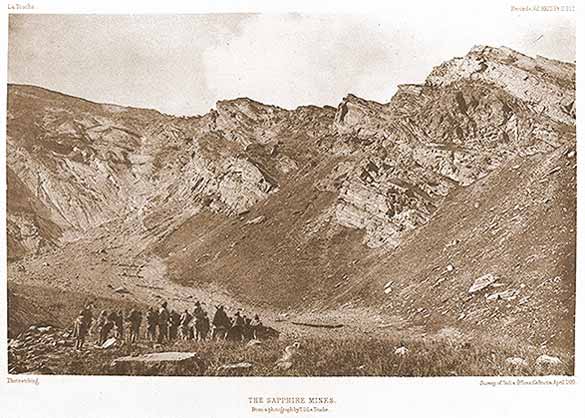 |
| Plate I. The Kashmir sapphire mines. From a photograph by T.D. LaTouche. |
In the year 1887 the Kashmir Durbar, finding that the revenue from the mines, which had been worked by them with considerable profit since the first discovery, was steadily diminishing, applied to the Government of India for a geologist to examine the mines, and I was deputed to visit and report upon their present condition. I arrived at Srinagar about the middle of August, and obtained as much information as possible about the position of the mines, which I was told were situated near the village of Soomjam on the Bhutna, a tributary of the Chinab entering it from the north-east at Gulabgarh in the district of Padar. Crossing the Marbal pass, 11,550 feet, at the head of the Kashmir Valley, I reached Kishtwar, near the junction of the Wardwan and Chináb Rivers, both of which had to be crossed by jhulas, or rope bridges, in 6 days. Thence a somewhat difficult path led up the left bank of the Chináb to Gulabgarh. The river runs through an exceedingly deep and narrow gorge, and the path generally keeps at a considerable height above it, but the numerous side streams, which also run in deep gorges, necessitate a descent and ascent of two or three thousand feet in several places, so that the marches are very trying: the path is, however, practicable for unladen ponies. This portion of the journey took 5 days to accomplish, though the distance from Kishtwar in a direct line is only 24 miles. At Gulabgarh the valley opens out considerably and is well cultivated: here the Chináb is again crossed by a long and somewhat shaky jhula close to an old fort which stands at the junction of the Bhutna with the larger river. From this point, which is about 6,000 feet above sea-level, the rise up the valley of the Bhutna is considerable, about 250 feet per mile, but the valley is more open, and the path keeps near the bank of the river, so that travelling is much easier. Soomjam, the highest village on the southern side of the lofty range dividing Zanskar from the Chináb Valley, is reached in 2 marches, or 13 in all from Srinagar; this village lies at an altitude of about 11,000 feet in Latitude 33° 25' 30" N. and Longitude 76° 28' 10" E., at the lower end of a broad level plain, about 5 miles long and 1/2 mile broad. This was formerly occupied by an extension of the glaciers which now descend only as far as its upper end from the passes leading into Zanskar, a large moraine stretching from side to side of the valley immediately above Soomjam, and the polished surfaces of the cliffs on either side, indicating their former extent A general extension of the glaciers in former times over the whole of this region is shown by the occurrence, near the head of each of the streams draining this range of mountains, of a similar more or less level and open plain, near the lower ends of which are generally found the remains of an ancient moraine. But the difference in altitude between these old moraines and those now forming is not so great as one would expect, considering that in other parts of the Himalayas they are found as much as 5,000 feet below the present limits of the glaciers. This may perhaps be accounted for by supposing that during glacial times this portion of the hills stood at a lower elevation than at present, and has undergone a considerable upheaval since that period.
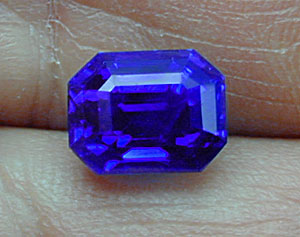 |
| This 4-ct. plus Kashmir sapphire
exhibits the velvety blue color that has made
stones from this source without peer in the world. (Photo: John McLean; Gem: Pala International) |
A steep climb of about 2,500 feet to the W. N. W. from Soomjam brings one to the lower end of a small triangular valley, formed by a bifurcation of one of the spurs that run down from the lofty peaks to the north, and in this the sapphire mines, or rather diggings, are situated, This valley is shut in on the north and west by steep cliffs rising to some 3,000 feet above it and is open to the south and east, whence there is a magnificent view of the glaciers and snowy peaks surrounding the head of the Bhutna and its tributaries. The trigonometrical survey station of Ganar, 14,210 feet, lies about a mile to the west of the mines, and I found by careful comparison of simultaneous observations made with mercurial barometers that the altitude of my camp, just below the workings, was 13,160 feet. Up to this level the hill-sides are covered with grass and various flowers, a wild onion being very common; but it is just above the limit of the birch, which reaches an altitude of about 13,160 feet on the slopes below. Above this the ground is nearly bare of vegetation, a few grasses, stonecrops, and scanty flowers, among which a kind of musk with a dark bluebell-shaped flower was rather common, being the only plants. When I visited the place in 1888 in the middle of July, snow was lying on the ground close above the camp to a depth of 8 feet, and did not disappear till the end of August, a few small patches lingering on throughout the year. The climate, however, was not severe during the time I was there; between the 17th July and the 23rd September the thermometer did not once fall below freezing point, and snow fell on only three occasions, the 23rd August and 24th and 30th September. The lowest temperature registered was 28° F. on the 27th September and the highest 69.2° F. on the 15th August. At the beginning of October snow began to fall regularly and work had to be given up for the season.
In the year 1887 the Kashmir Durbar, finding that the revenue from the mines, which had been worked by them with considerable profit since the first discovery, was steadily diminishing, applied to the Government of India for a geologist to examine the mines…
The small upland valley in which the sapphires are found is about 1,000 yards long by 400 yards broad at its lower end; the floor rises at an average angle of about 20° to the north-west, narrowing to a point, and is thickly covered with loose debris fallen from the surrounding cliffs. It is from a narrow strip of this debris, averaging about 100 feet in width, along the northern side of the valley, that the sapphires are at present obtained. They appear to have been originally derived from a spot high up on the cliffs to the north of the valley, near the head of a small ravine which enters it at some distance from the apex (see plan, Pl. III); this accounts for their distribution along only one side of the valley.
The rock of which the cliffs are composed is mainly a coarse schistose gneiss, containing a white felspar and much black mica; portions of it are also crowded with deep red and brown garnets. On the northern side a thick bed of coarsely crystalline siliceous limestone (seen to the right of Pl. I near the top of the cliff) is intercalated with the gneiss. This I traced to the south-east as far as Soomjam and to the north-west for about two miles. The thickness of the bed is not constant, as it increases from about 6 feet near Soomjam to 100 feet or more near the mines, but its upper and lower surfaces appear to be strictly conformable with the foliation planes of the gneiss. Also interbedded with the gneiss are several large masses of a peculiar hornblende-like rock (kupfferite): this is in part a felted mass of fibrous lamellae, and in part made up of radiating fibrous aggregates several inches in diameter: the colour is generally grey or olive green, with patches of a brighter green. The masses are frequently from 20 to 30 feet thick (one large detached mass, under which the coolies employed at the mines have burrowed holes in which they live, standing out from the hill-side close to my camp, must have been 100 feet thick at least), but die away rapidly in a horizontal direction. Between them and the gneiss is generally found a band, from 1 to 2 feet thick, of a soft rock composed of short acicular fibres, bright green or white in colour, apparently of the same mineral, or in places a band of rock entirely composed of crystals of mica. I have only found this rock in the vicinity of the sapphire mines, but whether its presence is in any way connected with the development of the sapphires I cannot say. I found one specimen in which a crystal of sapphire was imbedded in the kupfferite, but this was the only case I saw of their occurrence in contact. All these rocks have a pretty constant easterly dip of about 40°. Lastly, the gneiss is traversed by numerous dykes of granite occasionally parallel with its foliation, but usually cutting directly across it. This granite is generally very coarse-grained (pegmatite), composed of large crystals of milk-white felspar with much quartz, either clear or milk-white and occasionally pink, and sparsely scattered plates of dark-coloured mica up to an inch or so in diameter. As accessories the granite contains well-developed crystals of black tourmaline, called coal by the coolies, sometimes of large size (up to 4 or 5 inches in length), light-green enclase, kyanite, minute red garnets, and finally crystals of corundum or sapphire. These last are associated with a white felspar, apparently a plagioclastic variety, occurring in small grains, which give a porous character to the portions of the rock in which they occur. The sapphire crystals appear to be very local in their development, the only spot where they have hitherto been found in situ being near the top of the ridge bounding the northern side of the small valley above mentioned, and about 1,600 feet above it. Here the face of the rock has been laid bare by a landslip, and at first the sapphires were taken out of the granite itself; but when I visited the mines this patch of rock had ceased to yield any for some time, nor did the closest search bring any more to light. On the northern side of the ridge, however, I discovered some large blocks of the granite crowded with crystals of corundum, most of which had a bluish tint; but all my efforts to find the source of these blocks were of no avail, owing to the enormous depth to which the rocks composing this side of the ridge had been weathered,—so much so that it would require a landslip to lay the rock sufficiently bare to enable it to be properly searched. I attempted to bring one about by digging deep trenches across the hill-side in which water might collect, but without success.
The sapphire crystals appear to be very local in their development, the only spot where they have hitherto been found in situ being near the top of the ridge bounding the northern side of the small valley above mentioned, and about 1,600 feet above it. Here the face of the rock has been laid bare by a landslip, and at first the sapphires were taken out of the granite itself; but when I visited the mines this patch of rock had ceased to yield any for some time, nor did the closest search bring any more to light.
Although many dykes of granite are seen in other parts of the cliffs surrounding the head of the valley, none of them appear to contain sapphires, and none are found in the debris covering the floor of the valley, except in a narrow strip along its northern edge. In this, crystals and fragments of sapphire and corundum are fairly numerous, especially near the head of the valley; and at the time of my first visit about 100 coolies were employed in searching for them by digging up the surface with small kodalis and picking up any sapphires they came across. This was not a very satisfactory method of working the deposit, for the darker coloured and therefore better gems were liable to escape notice, and the upper 6 inches or so were worked over and over again, with very poor results: so I had a simple washing apparatus made of a few planks and set up at a large spring which issued from the hill-side near the camp, and the stuff containing the sapphires carried down to it in baskets This washing apparatus consisted of a platform about 6 feet square, over which a strong stream of water was kept flowing, which carried away the mud and finer particles, the coarse pebbles and sand being held back by a low edging of upright planks; then when cleaned sufficiently the sand and gravel were thrown into a broad and gently sloping trough, through which a moderate stream of water was kept running, when the sapphires could easily be detected and picked out (Pl. II). Most of the stones obtained in this way were small fragments, some not much larger than a pin’s head, and crystals, the great majority showing very little colour and being of small value as gems. Occasionally, however, a larger stone of good colour would be found; thus the largest obtained in 1887 weighed about 6 oz., and was partly of a very brilliant colour; but in 1888 the largest weighed only 104 grains, and very few were found weighing more than 50 grains. These are not to be compared with those brought down when the mine was first discovered. I was shown some in the treasury at Jammu that measured 5 inches in length by 3 inches in breadth, and though none of these were uniformly coloured, but shaded off into white at either end of the crystal, still some very fine gems might be cut from them.
In order to find out whether or not the deposit was equally productive in every part, I had small pits dug at various points, and the stuff taken out of each of them weighed and then washed separately, afterwards weighing the sapphires obtained. It was found that the yield of sapphires steadily decreased towards the lower end of the deposit; but it so happened that the largest stone obtained was found in the lowest pit of all, which, however, produced only one other fragment of sapphire, weighing 1/7 tola. It would probably therefore be worth while to work over the whole of the deposit, which can easily be done by the use of such a washing apparatus as I devised, though, owing to the shortness of the season during which work can be carried on, it will take several years yet to do so. I found also that the productiveness of the deposit decreased rapidly from the surface downwards, so that at a depth of more than 3 feet no sapphires whatever were found.
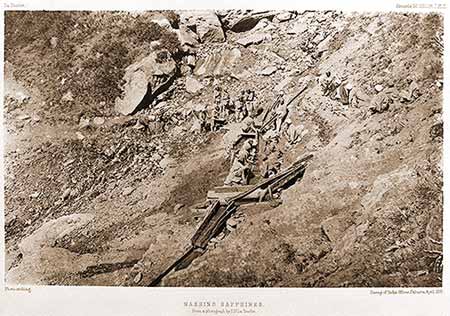 |
| Plate II. Washing for Kashmir sapphires. From a photo by T.D. LaTouche. |
During the working season of 1888, i.e., from the 17th July to the 29th September, the total quantity of corundum obtained was 1,630 tolas, of which perhaps one fourth would be commercially valuable; but the average weight of the stones, calculated from the results of 25 days’ working, during which I counted and weighed each day’s production, was not more than 10 grains; and I hardly think that, considering the inaccessible character of the locality, the difficulty of obtaining labour and of preventing smuggling, the yield of sapphires will in the future be very profitable, unless the actual bed in which they occur in situ can be again discovered.
Besides the corundum several other minerals, interesting from a scientific point of view, though not commercially valuable, are found in the granite of this region. For a determination of the species of most of these I am indebted to Mr. F.R. Mallet, late of the Geological Survey, who kindly examined them for me. These are the following:—
- Light-green crystals of tourmaline are found in a granite vein about 1 mile from the ridge in which the sapphires occur; they are fairly numerous in some parts of the rock, thickly encrusting the surface of large crystals of quartz, or penetrating for some distance into their interior. The crystals are transparent, very thin in proportion to their length, seldom reaching a length of more than two inches, with a breadth of about 1/8 inch, and are very brittle. Their mode of occurrence is exactly similar to that of the rubellite, a pink variety of tourmaline, of Rozena in Moravia (Indian Museum), which is also found in long thin crystals penetrating crystals of quartz.
- A rare mineral, Cookeite, which is stated by Dana (Manual of Mineralogy, p. 314) to be an alteration product of rubellite, is found enveloping the green tourmaline; a cross section showing a rod of the latter enclosed in a thick walled tube of Cookeite; this is pink or white in colour and occurs in fairly considerable quantities. Mr. Mallet says: “The hardness is about 2.5; lustre pearly on cleavage faces; it exfoliates strongly when heated before the blowpipe, and colours the flame crimson, showing the presence of lithia.”
- Spodumene. A few lilac-coloured crystalline blocks of this mineral, which also contains lithia, were found in a valley to the north of the sapphire mines, between them and the place where the green tourmalines were found: none of these were found in situ.
- A large block of prebnite was also found in the same valley. There can be no doubt, I think, that this and the last mineral were derived from the granite.
- Traces of copper carbonate were found in some of the granite veins to the west of the sapphire mines, but in very small quantity.
- Some well-formed hexagonal prisms of beryl were brought to me from near Machél, a village on the Bhutna below Soomjam. On my return from the mines I visited the place, which was about 4 miles to the west of Machél and at an altitude of about 12,000 feet, but I found that the beryls did not occur in any large quantity, and those found were very poor in colour, bluish green shading into white.
- A few pieces of a dark-blue mineral, lazulite, were brought to me, which were said to have been obtained from an almost inaccessible spot two or three days’ journey from Gulabgarh. I was not able to reach the spot by reason of a heavy fall of snow which came on while I was at Gulabgarh.
- Fairly clear crystals of quartz or rock-crystals are obtained in many places over the whole of this region, but they do not seem to occur in sufficient quantity in any one place to make it worth while to mine for them systematically.
During the working season of 1888, i.e., from the 17th July to the 29th September, the total quantity of corundum obtained was 1,630 tolas, of which perhaps one fourth would be commercially valuable…
While at the mines I made several excursions into the valleys near, and sent out many intelligent natives to try and discover new localities for sapphires, but, except in one instance, without success. This was close to the Hagshu-lá, one of the passes leading from the Bhutna Valley into Zanskar; and as I crossed this pass on a flying visit which I made to Zanskar during my stay at the mines, I was enabled to investigate the “find.” The pass is about 16,600 feet in altitude, and large glaciers descend from it on either side to the north and south. Near the head of that on the southern side, and close to the foot of the final ascent from the glacier to the pass, a large block of granite, lying on the moraine beside the glacier, was pointed out to me, which contained numerous blue hexagonal crystals, and these on investigation turned out to be sapphires. At first I thought that they were merely kyanite, as they appeared to possess the different hardness on two faces of the crystal which is characteristic of that mineral; but Mr. Mallet found that this was really due to a glaze of mica covering the basal cleavage planes which he thinks is caused by a partial alteration of the mineral, and pronounced them to be really sapphire. Some of the crystals were about an inch in diameter, but none of them were of a good colour throughout, the blue shading into a greenish blue in places. It was impossible to discover the source of this block of granite, which was the only one visible, during the short time I was able to stay at the spot, but there can be no doubt that it came from some part of the cliffs surrounding the head of the glacier. The spot where this block was lying is about 15,500 feet above the sea, and it probably came from some point which is much higher, and perhaps inaccessible.
I could obtain no information confirming the statement made in Mr. Heyde’s letter, quoted above, that “in the immediate neighbourhood of the spot described (i.e., Soomjam) the people know of two others, in one of which the blue stone is found, not below the ground, but in horizontal seams of a large rock, but also, as it appears, surrounded or embedded in that white stuff.” This may refer to the lazulite found near Gulabgarh, which is associated with a white schistose mineral. Nor could I get any further information about the locality which in the same letter is said to exist above the monastery at Bardun in Zanskar, and I was not able, from want of time, to pay a visit to Bardun. There seems to be no reason, however, why sapphires should not occur in many other places in this region where the rocks are pierced by granite veins, and other localities may in time be brought to light either by chance, as in the case of the original discovery, or by a closer search than I was able to make.
After I had seen the operations at the sapphire mines fairly commenced and in working order, I paid a visit to Zanskar, whence specimens of certain other minerals besides the sapphire above described had been brought to me, and as the district appears to be one seldom visited by Europeans, some account of my journey may be interesting. Leaving Soomjam about the middle of August, I crossed the main range by the Hagshu-lá 16,600 feet, a pass which is not often used by the natives, though a good deal lower than the Umasi-lá further to the east. Large glaciers descend from either side of the pass, that on the north being the longer, about 16 miles, without counting its numerous tributaries. The glaciers are easily traversed after one has surmounted the mass of moraine matter which entirely covers their lower ends, sometimes for a distance of half a mile or more; above this the surface is generally nearly level, and very free from crevasses, those that do occur being usually narrow and easily jumped across; until the head of the glacier is reached, where there is generally a steep slope rising towards the nevée, and cut up by numerous large transverse crevasses, which occasionally give trouble, but with care they can be avoided, and ropes are never used by the natives while crossing them.
The valley, called the Hagshu Tokpho, leading down from the pass to the north, opens into the wider valley of the Zanskar River, a large tributary of the Indus; here the valley is open and fairly level for a long distance, containing many villages and monasteries, and in parts well cultivated, but almost bare of trees. The only trees of any size that I saw were some small poplars planted near the village of Seni; these I was told had been brought from Ladakh. A shrubby willow is plentiful in the ravines on either side of the main river and along its banks, but all timber for building purposes has to be imported.
To the north of the Zanskar River in this part of its course a considerable change takes place in the aspect of the mountains, corresponding with a change in their geological structure. Those on the south are rugged and precipitous, mainly formed of gneiss, while on the north they are generally smothered in talus to their summits, which gives them a more rounded appearance and renders them easy to climb; the latter are formed of the slaty schists of the Panjal series, a rock which disintegrates rapidly under the action of frost.
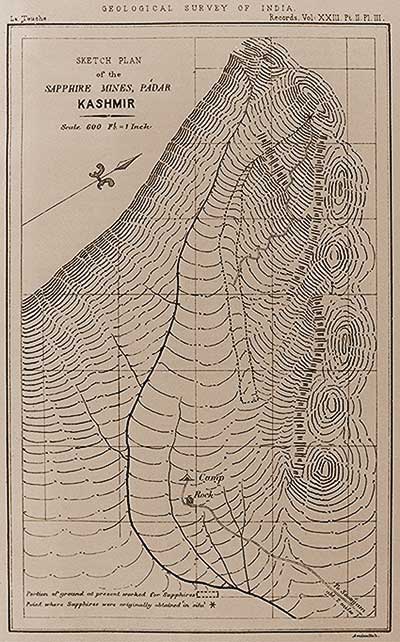 |
| Plate III. Sketch plan of the Kashmir sapphire mines, Pádar, Kashmir. Scale 600 ft. = 1 inch |
I crossed these mountains by a little-used path across the Rulakun-lá, about 17,500 feet—an easy pass and quite practicable for hill ponies; some miles, however, to the north of the pass, near the village of Rulagong, another change takes place in the nature of the country, corresponding again with a change in the rocks These are massive limestones and slaty rocks of Supra Kuling age, much contorted on a large scale, and through them the streams have cut enormously deep ravines with almost perpendicular sides, recalling, though perhaps on a small scale, the canons of America. The Zanskar River has also cut a similar gorge through these rocks, where the gorge, 100 feet above the river, is sufficiently narrow to allow of a wooden bridge being thrown across. I was informed that the lumps of native copper, from which Zanskar is said to derive its name, are found in the bed of the river near this bridge, but only in the winter, when the upper waters of the river are frozen, and the bed here is more or less dried up; in September, when I crossed it, the river was in full flood, and it was useless to attempt to search for the copper.
Three days’ marching through the gorges north of Rulagong brought me to the village of Linshot, at the foot of a lofty scarp, mainly formed of a black foetid limestone, the upper beds of the Supra Kuling series. Near this village I discovered several large masses of a similar black limestone crowded with nummulites, and traced them up to a peak, called Z4 on the maps, immediately above the Singhe-lá, 16,601 feet, a pass by which the scarp is crossed, where I found the nummulites at an elevation of about 18,500 feet above sea-level. These nummulites were first discovered by Dr. Thomson in 1852 when he crossed Singhe-lá, but subsequently Mr. Lydekker had thrown some doubt on this being the locality in which they were found, as they escaped his notice when he crossed the pass. A description of the locality and the rocks in which the nummulites occur will be found in the Records, Geological Survey, Vol. XXI, Pt. IV, p. 160.
The depression which forms the pass itself, as well as another, the Sirsa-lá, of about the same height, several miles to the north, is caused by the intervention of a broad band of shaly rocks between the black limestones on the west and the hard limestones and slates of the lower Supra Kuling series on the east; these latter are sharply contorted on a large scale, the differently-coloured bands of rock rendering the contortions very visible on the precipitous face of the cliffs. Many sections thus exposed recall the familiar examples of rock twisting shown in Heim’s plates of the structure of various parts of the Alps.
In the valleys to the north and west of the Sirsa-lá are found numerous blocks of a whitish heavy rock, allied to jadeite, called zoisite; it takes a high polish and might be made use of in the same manner as jadeite for ornamental cups, &c. A small quantity is sometimes taken to Lahol by the natives, so they told me, and sold for about R3 per seer. It eventually finds its way to Amritsar, I believe, where it is cut and polished. The Srinagar stone-workers to whom I showed some specimens of it, found that it was too hard for them to work into ornaments. The source of these blocks of zoisite is probably the area of tertiary trap shown in Mr. Lydekker’s map to the south-west of the Sirsa-lá, and forming the peaks D24 and D28, which are drained by the streams to the west of the pass. Numerous blocks of the traps are found with the zoisite, and in many cases the two are intermingled in the same block.
From this point I returned, taking the more frequented route through Yelchung to the Zanskar Valley near the village of Zangla. In many of the ravines through which this route passes earth-pillars are very numerous and often of large size. One group of them is in the Khurna-foo Valley; they are formed from a stiff clay which has apparently been consolidated by the weight of glaciers—a grund moraine, in fact,—and this is frequently full of large blocks of rock which are sometimes seen either capping the pillars or sticking out from their sides.
From the Zanskar Valley I returned to Soomjam across the main range by the Umasi-lá 17,369 feet, a pass which, though nearly 1,000 feet higher than the Hagshu-lá, is not so difficult, and is often crossed by ponies, several of which were brought across by my party. The valleys on either side are filled with large glaciers; but these do not present many difficulties. A halt has to be made near the top of the pass at an elevation of about 16,000 feet, and here, as may be imagined, it is bitterly cold; but unless a strong wind is blowing—and this as far as my experience goes is a very rare occurrence at night during August and September,—one can camp out, even at this altitude, without much discomfort.
In the valleys to the north and west of the Sirsa-lá are found numerous blocks of a whitish heavy rock, allied to jadeite, called zoisite; it takes a high polish and might be made use of in the same manner as jadeite for ornamental cups, &c.
On my return to the sapphire mines I found the work progressing favourably, though no gems of any remarkable size had been found during my absence. With the end of September the weather began to break, and snow fell for some days, so that work had to be given up for the season; and after weighing and packing up the season’s yield of sapphire, which was taken in charge by the Maharaja’s officials to be carried direct to Jammu, I set out on my return journey to Kashmir. On the way I visited various localities in which rock-crystal, iron ore, and other minerals were said to exist, but did not find any of them worth the trouble of mining. Among these was a bed of arsenopyrite, a compound of arsenic, sulphur, and iron, which was found near the village of Berali between Gulabgarh and Machél, and at about 3,000 feet above the Bhutna; but the bed seemed to be small in extent. I also paid a visit to the iron-works of Soap in the Kashmir Valley, the ore for which is obtained from a bed of impure calcareous limonite intercalated in the limestones and rocks to the east of Achibal. The bed is only 1 or 2 feet in thickness, and dips at an angle of 35° into the hill, but its outcrop extends for a distance of at least two miles along the hill-side, and there must be sufficient ore here to keep the small native furnaces supplied for many years to come, so long as there is any demand for the iron, but it would certainly not be advisable to start large blast furnaces on the English plan, and moreover the ore seems to be very poor in quality.
So much has been said lately about the great mineral resources of Kashmir, that it may perhaps be well, in conclusion, to say a few words on the subject. In speaking of the mineral wealth that might be brought to light by properly-conducted prospecting, it does not seem to be generally taken into consideration that the natives of the country have for ages had good opportunities of discovering what minerals the hills contain, and that as a rule they have shown themselves fully capable of making use of their opportunities. I think that I am not far wrong in saying that in very few instances in India have useful minerals been discovered in localities that were unknown to the natives, and in which the ores had not been worked by them at one time or another. Even the more uncivilised hill tribes are more or less well acquainted with the minerals their hills contain, and are by no means in the condition of the Blacks of Australia or the Bushmen of Southern Africa, in whose country the European prospector has found so great a field for his energies. To take a single instance: the Khasis of Assam, who till the beginning of the present century had hardly felt the influence of Western civilization, have for ages obtained their iron from an ore which occurs as minute grains of magnetite disseminated in the granite of their hills. Many a highly-trained European geologist might justly have been sceptical as to the possibility of obtaining a productive iron ore from granite, and would very possibly have passed the rock over as being utterly useless for such a purpose. Yet the Khasis discovered the mineral, and in all parts of the hills ancient heaps of slag testify to the use they made of their discovery; moreover, they obtained the ore by a process which was ingenious and even scientific—in fact, a kind of hydraulic mining somewhat similar to the latest process devised for obtaining gold in California. Can it be doubted that if any other useful minerals existed in their hills, the Khasis would not have found and worked them long ago? Similarly, in Kashmir, any mineral deposits that exist are probably well known to the natives, and, if useful, are already worked, and these are not of any great importance. Even the common minerals, coal and iron, are not found in any large quantity, and where they do occur, are poor in quality. Accident may bring to light the presence of some of the rarer minerals, as in the case of the sapphires, but even the most energetic and intelligent prospector might spend years among the mountains before making such another discovery.
CALCUTTA, 1889.
_________________________
Footnote
text
1 In the name Padam the “a” is short, while the first in
Pádar is long; the former word is the same that occurs in
the Buddhist prayer, “Om mani padme haun,” and is said
to signify a lotus. The village is so named from being built round
the foot of a conical knoll, on which the chief’s house stands,
thus resembling the petals and central portion of a lotus blossom. (back
to text)
For further information on Kashmir sapphires, see Richard Hughes’ (Palagems.com ex-webmaster) writings at: